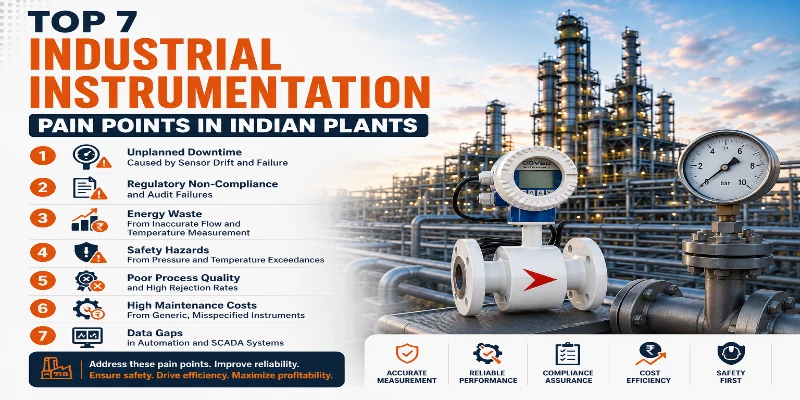
Top 7 Industrial Instrumentation Pain Points in Indian Plants (And How to Fix Them)
Walk into any cement kiln, chemical reactor, pharma cleanroom, or sugar mill across India, and you’ll hear the same complaint in different words: “Our instruments keep letting us down.” A thermocouple drifts quietly for weeks before anyone notices. A pressure transmitter fouls in viscous slurry. A calibration certificate goes missing right before an FSSAI or AERB audit.
These aren’t isolated incidents — they’re symptoms of a much bigger, industry-wide pattern. After working across cement, chemical, pharmaceutical, food processing, oil & gas, and power sectors, Aavad Instrument has identified seven recurring failure points that quietly drain crores from Indian plants every year — usually long before anyone connects the dots back to a misspecified sensor or an expired calibration tag.
Below, we break down each pain point, the real cost behind it, and the instrumentation strategy that actually solves it — not just patches it.
1. Unplanned Downtime Caused by Sensor Drift and Failure
Sensor degradation is rarely dramatic. It’s gradual, invisible, and expensive.
- Thermocouples in high-temperature kilns lose accuracy as their junctions oxidize, feeding the control loop slightly wrong numbers for weeks before a shutdown forces the issue.
- RTDs in chemical reactors suffer element contamination from process media, shifting resistance readings just enough to throw off batch temperature control.
- Pressure transmitters in viscous or slurry-laden lines foul at the diaphragm, dulling response time until the transmitter effectively “freezes” mid-process.
The financial impact is brutal: a single unplanned shutdown in a cement kiln can cost ₹8–12 lakhs per hour in lost production, not counting restart energy costs and potential equipment stress.
The fix: A preventive instrument replacement cycle combined with an NABL-traceable calibration programme — rather than a reactive “replace when it fails” approach — has been shown to cut this category of downtime by up to 70%. Scheduled drift-checking catches degradation while the sensor is still within tolerance, not after it has already cost a shift.
2. Regulatory Non-Compliance and Audit Failures
Compliance isn’t optional in regulated Indian industries — it’s existential.
- Pharmaceutical plants must satisfy Schedule M and increasingly 21 CFR Part 11 documentation standards for any data-generating instrument.
- Food processing units answer to FSSAI and HACCP, both of which demand demonstrable calibration traceability on every temperature and pressure point in the critical control chain.
- Nuclear facilities operate under AERB oversight, where instrumentation documentation gaps are treated as safety findings, not paperwork issues.
An instrument without an NABL-certified calibration certificate isn’t just a documentation gap — it’s a direct line to batch rejection, an FDA warning letter, or a full regulatory shutdown. These losses dwarf the cost of buying compliant instrumentation in the first place.
The fix: Build calibration traceability into procurement, not into an audit-week scramble. Every transmitter, RTD, and thermocouple should arrive with NABL-traceable documentation as a baseline requirement, not an optional add-on.
3. Energy Waste From Inaccurate Flow and Temperature Measurement
Small measurement errors compound into large fuel bills.
A ±2°C temperature error in a steam boiler control loop translates to roughly 1–2% fuel waste. That sounds minor — until you scale it across a 100 TPH boiler running 350 days a year, where the same small error becomes ₹35–70 lakhs in avoidable fuel costs annually.
The same principle applies downstream: uncalibrated flow meters in water treatment or chemical dosing systems routinely cause over-dosing, wasting chemicals and pushing effluent parameters out of compliance — turning an instrumentation problem into an environmental liability.
The fix: Precision temperature and flow measurement isn’t a “nice to have” efficiency upgrade — for high-throughput utilities like boilers and dosing systems, it pays for itself in fuel and chemical savings within a single budget cycle.
4. Safety Hazards From Pressure and Temperature Exceedances
This is the pain point with the highest stakes. Over-pressure events in a reactor vessel, or an unanticipated temperature runaway in a heat exchanger, are life-threatening — not theoretical risks.
Pressure relief systems and safety shutdown logic are only as good as the transmitter feeding them real-time data. If that transmitter lags, drifts, or fails silently, the safety system reacts too late — or not at all.
This is why SIL 2-rated pressure transmitters and redundant RTD configurations aren’t over-engineering in oil & gas, chemical, and power sectors — they’re the minimum bar for a defensible safety case.
The fix: Treat safety-instrumented systems (SIS) components differently from standard process instrumentation in your specification process. SIL-rated hardware with documented proof-test intervals should be non-negotiable on any vessel or exchanger with runaway potential.
5. Poor Process Quality and High Rejection Rates
Quality problems often trace back to measurement precision long before they trace back to raw materials or operator error.
- In plastic injection moulding, a ±5°C variation in melt temperature is enough to cause dimensional inconsistency and visible colour shift in the finished part.
- In sugar refining, imprecise evaporation temperature control directly reduces crystallisation yield — a measurement problem masquerading as a process yield problem.
Switching to precision sensors with ±0.1°C accuracy has been shown to eliminate much of this batch-to-batch variability, reducing quality rejection rates by 30–50% in comparable process environments.
The fix: Audit your highest-rejection-rate process lines for sensor accuracy class before assuming the root cause is mechanical or material. Often, it isn’t.
6. High Maintenance Costs From Generic, Misspecified Instruments
This is the pain point that looks like a cost-saving decision and turns out to be the opposite.
Importing generic European or Chinese sensors without application-specific engineering is a common procurement shortcut — and a costly one. A standard stainless-steel thermowell dropped into sulphuric acid service, for example, can corrode through in a matter of weeks.
Application-engineered thermowells built in Hastelloy C-276 or titanium, by contrast, are specified for the actual chemistry, temperature, and velocity of the process — and routinely last 5–10 years in the exact same environment where a generic thermowell failed almost immediately.
The fix: Specify instrumentation by application chemistry and process conditions, not by catalogue price. Aavad Instrument’s approach to thermowell and sensor selection — matching material grade to actual service conditions — typically reduces replacement and maintenance costs by 60–80% over generic alternatives.
7. Data Gaps in Automation and SCADA Systems
India’s Industry 4.0 push is colliding with a legacy instrumentation problem in plant after plant.
Many facilities upgrading SCADA and DCS systems discover their existing field instruments weren’t built for the integration they now need:
- Legacy 4-wire instruments with limited digital output
- Inconsistent signal protocols across the plant floor — mV, 4–20mA, HART, Modbus, Profibus often coexisting without a clean integration path
- Poor wiring practices that introduce noise and signal loss exactly where data integrity matters most
The result is a smart-factory initiative bottlenecked by instrumentation that simply can’t talk to the new system cleanly.
The fix: Modern transmitters with HART 7, Foundation Fieldbus, or IIoT-ready outputs remove this bottleneck at the source, giving SCADA/DCS upgrades a clean digital foundation instead of a patchwork of protocol converters.
Why Indian Plants Choose Aavad Instrument Pvt.Ltd.
Every pain point above shares a common thread: generic instrumentation, generic calibration, and generic specification create problems that only surface after they’ve already cost money, compliance standing, or safety margin.
Aavad Instrument addresses this at the specification stage — pairing application-engineered sensors (thermowells in corrosion-resistant alloys, SIL-rated transmitters, NABL-traceable RTDs) with calibration programmes built around the regulatory reality of Indian cement, chemical, pharmaceutical, food processing, oil & gas, and power industries.
The goal isn’t just supplying instruments. It’s closing the seven gaps above before they turn into a shutdown, an audit failure, or a safety incident.
Aavad Instrument Pvt. Ltd.
Precision Measurement. Reliable Performance. Industrial Excellence.
 +91 90996 22823
 www.aavadinstrument.com
 hrg@aavadinstrument.com
Frequently Asked Questions
What is the biggest cause of unplanned downtime in Indian process plants? Sensor drift and failure — particularly in thermocouples, RTDs, and pressure transmitters — is among the most common causes. A preventive replacement cycle backed by NABL-traceable calibration can reduce this downtime by up to 70%.
Why do pharmaceutical and food plants need NABL-certified calibration certificates? Regulators such as Schedule M, 21 CFR Part 11, FSSAI, and HACCP require documented, traceable calibration on critical instruments. Without it, plants risk batch rejection, FDA warning letters, or a regulatory shutdown — costs far higher than compliant instrumentation.
How much fuel can a temperature measurement error waste in a boiler? A ±2°C error in a steam boiler control loop causes roughly 1–2% fuel waste. On a 100 TPH boiler running 350 days a year, that translates to an estimated ₹35–70 lakhs in avoidable fuel costs annually.
What is a SIL 2-rated pressure transmitter, and why does it matter? SIL 2 (Safety Integrity Level 2) is a certification confirming a transmitter meets a defined reliability standard for safety-critical applications. It’s essential in oil & gas, chemical, and power plants where pressure relief and shutdown logic depend on accurate, real-time data.
Why do generic imported thermowells fail quickly in corrosive service? Generic stainless-steel thermowells aren’t engineered for specific process chemistry. In sulphuric acid service, for instance, they can corrode through in weeks, while application-engineered thermowells in Hastelloy C-276 or titanium typically last 5–10 years in the same environment.
How does poor temperature control affect product quality? Even small deviations matter: a ±5°C melt-temperature variation in plastic injection moulding can cause dimensional inconsistency and colour shift, while imprecise evaporation control in sugar refining lowers crystallisation yield. Precision sensors with ±0.1°C accuracy can cut rejection rates by 30–50%.
What instrumentation challenges come up during SCADA or DCS upgrades? Legacy 4-wire instruments and inconsistent protocols (mV, 4–20mA, HART, Modbus, Profibus) often create integration bottlenecks. Modern transmitters with HART 7, Foundation Fieldbus, or IIoT-ready outputs resolve this and give Industry 4.0 upgrades a clean digital foundation.
How do I know if my plant’s instrumentation is application-engineered or just generic? Check whether your sensors and thermowells were specified against your actual process chemistry, temperature, and velocity — or selected from a generic catalogue by price. If documentation doesn’t reference your specific service conditions, it’s likely generic, and the maintenance cost difference can be 60–80% over the instrument’s life.