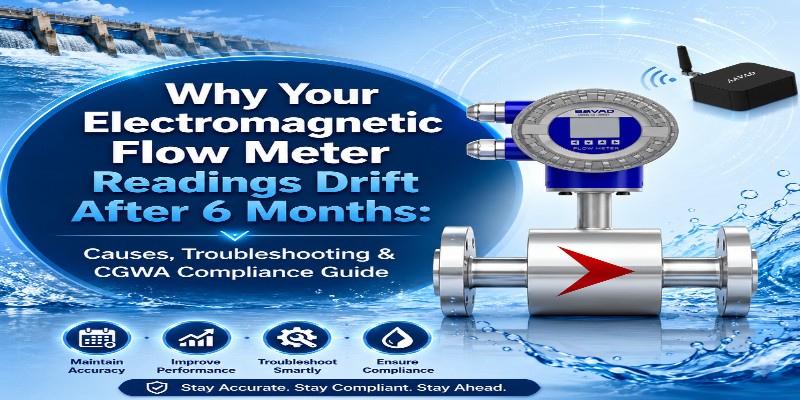
Why Your Electromagnetic Flow Meter Readings Drift After 6 Months: Causes, Troubleshooting & CGWA Compliance Guide
If your flow meter passed commissioning fine and is now reading wrong, the meter probably isn’t broken — the installation or the environment around it has changed. Here’s where to actually look, plus the CGWA compliance angle most guides skip.
An electromagnetic flow meter has no moving parts, which is exactly why drift confuses people — there’s nothing to visibly wear out. But “no moving parts” doesn’t mean “nothing changes.” Six causes account for the overwhelming majority of drift complaints.
1. Electrode fouling or coating
The measuring electrodes need direct electrical contact with the fluid. In hard water, slurries, or any liquid with suspended solids or scaling tendency, a thin coating builds up on the electrode surface over months. This doesn’t always trigger an obvious fault — it shows up as a slow, steady reading drift rather than a hard failure, which is exactly why it gets missed during routine checks.
2. Liner wear or damage
Abrasive media (sand-laden water, slurries) gradually erode the meter’s internal liner, especially near the electrodes. This changes the flow profile the meter is measuring and introduces a wear-pattern-specific error that’s very hard to diagnose without an internal inspection.
3. Grounding and bonding issues
Electromagnetic meters rely on a clean reference ground. If a grounding strap corrodes, a nearby pump’s electrical noise increases, or pipework gets re-routed and a bond is lost during other maintenance work, the meter’s signal-to-noise ratio degrades — and the reading drifts without any mechanical change to the meter itself.
4. Upstream/downstream straight-pipe disturbance
Most electromagnetic flow meters need a minimum straight, unobstructed pipe run before and after the meter (commonly cited as roughly 5 diameters upstream, 3 diameters downstream, though this varies by model — always check the manufacturer’s datasheet). If a valve, elbow, or pump gets added or relocated near the meter during unrelated plant work, the flow profile entering the meter changes and accuracy degrades, even though the meter itself is functioning perfectly.
5. Partially filled pipe
Electromagnetic meters are typically calibrated assuming a full pipe. If a downstream valve, change in demand, or a leak elsewhere in the line causes the pipe to run partially full at the meter location, readings become unreliable in a way that looks exactly like “drift” but is actually a violated installation assumption.
6. Signal cable degradation
The shielded cable between the sensor and the converter is sensitive to moisture ingress at cable glands and to mechanical damage. A compromised cable shield doesn’t usually cause a complete failure — it introduces noise that shows up as instability or slow drift in the displayed reading.
The CGWA compliance angle
For groundwater extraction users in India, the Central Ground Water Authority (CGWA) mandates digital water flow meters with telemetry for monitoring and reporting extraction volumes, as part of groundwater regulation compliance. This is a separate consideration from general flow accuracy: a CGWA-compliant installation needs both an accurate meter and a telemetry system that reliably transmits extraction data without gaps, since reporting continuity is itself part of the compliance requirement.
A drifting or intermittently-failing meter doesn’t just cost you accuracy — in a CGWA-monitored installation, it can create reporting gaps that draw regulatory scrutiny independent of the actual water usage. This makes the maintenance checklist below doubly important for regulated extraction sites.
Maintenance checklist to catch drift early
- Verify grounding strap integrity and resistance every 6 months
- Inspect cable gland seals for moisture ingress at the same interval
- Confirm no pipework, valves, or pumps have been added within the required straight-run distance
- Cross-check meter reading against a portable reference flow check annually
- For CGWA installations, confirm telemetry transmission logs show no unexplained gaps
Why Industries Choose Aavad Electromagnetic Flow Meters
Aavad Instrument Pvt. Ltd. manufactures and supplies high-performance electromagnetic flow meters designed for industrial process measurement and groundwater monitoring applications.
Applications
- Water Treatment Plants
- Wastewater Treatment Plants
- Chemical Industries
- Textile Industries
- Food Processing Facilities
- Power Plants
- Groundwater Extraction Systems
Key Features
✔ High Accuracy Measurement
✔ No Moving Parts
✔ Long Service Life
✔ Telemetry Integration
✔ SCADA Compatibility
✔ CGWA Compliance Support
✔ Remote Monitoring Capability
Running a CGWA-regulated extraction site?
Aavad supplies CGWA-compliant electromagnetic flow meters with integrated telemetry built for continuous, audit-ready reporting.
Frequently Asked Questions (FAQs)
1. Can electrode fouling be cleaned without removing the meter from the line?
In some installations, yes. If the line can be safely drained and the meter is accessible, cleaning may be possible without completely removing the meter. However, this depends on the flow meter’s design and the process requirements. Always follow the manufacturer’s maintenance guidelines before attempting any in-line cleaning procedure.
2. How can I determine whether flow meter drift is caused by electrode fouling or a grounding issue?
The behavior of the readings provides the first clue. Grounding problems usually result in noisy, unstable, or erratic measurements. Electrode fouling, on the other hand, typically causes a slow, gradual, one-directional drift that develops over weeks or months. Further inspection and diagnostics may be required to confirm the root cause.
3. Is CGWA telemetry a one-time installation or an ongoing compliance requirement?
CGWA telemetry is an ongoing compliance requirement. The telemetry system must continuously transmit accurate groundwater extraction data throughout the validity period of the extraction permit. Reliable equipment operation, regular maintenance, and uninterrupted data transmission are essential for maintaining compliance.
4. Does pipe material affect the accuracy of an electromagnetic flow meter?
Electromagnetic flow meters measure the flow of conductive fluids directly and are generally not affected by pipe material. However, selecting the correct liner and electrode materials is critical. These components must be compatible with the fluid’s chemical properties to prevent fouling, corrosion, and wear, which can ultimately impact long-term measurement accuracy and reliability.
Need a CGWA-Compliant Electromagnetic Flow Meter?
Aavad Instrument Pvt. Ltd. supplies high-accuracy electromagnetic flow meters with telemetry integration for groundwater monitoring, industrial water management, and regulatory compliance applications across India.
📞 +91 90996 22823
Aavad Instrument Pvt. Ltd.
Precision Flow Measurement. Reliable Compliance. Smarter Water Management.