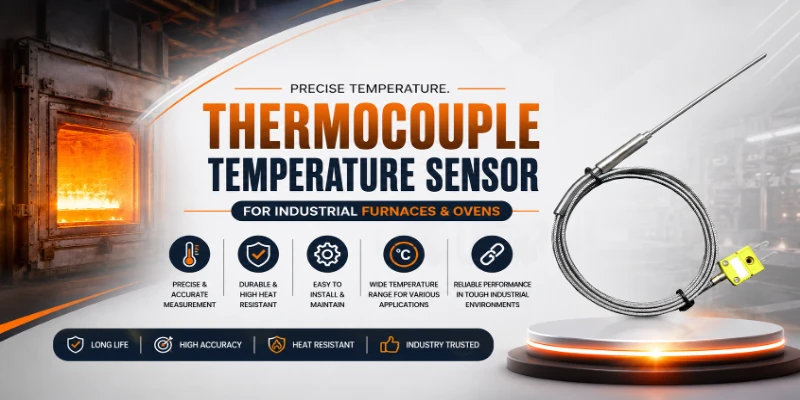
Thermocouple Temperature Sensor: How to Select the Right One for Your Industrial Application
“Thermocouple temperature sensor” is one of the most searched instrumentation terms in India — and one of the most ambiguous. A thermocouple temperature sensor could be a general description covering dozens of types, configurations, and ranges, or it could be the specific compact K-type probe with an Omega connector that an engineer needs for a furnace replacement. This guide bridges both: it explains how to select the right thermocouple temperature sensor for your application, and it covers Aavad’s AKES-3×250 — a compact, K-type, connector-terminated probe specifically built for industrial furnaces, ovens, extruders, and general process temperature measurement.
What Is a Thermocouple Temperature Sensor?
A thermocouple temperature sensor converts temperature into a millivolt electrical signal through the Seebeck effect — the voltage generated when two dissimilar metal wires are joined at a sensing junction and the junction is heated. This voltage is read by a temperature controller, indicator, or data logger calibrated for the specific thermocouple type, and converted to a temperature reading.
Thermocouple temperature sensors are the most widely used industrial temperature measurement device in India and globally, for three fundamental reasons:
- No external power required — the thermocouple generates its own signal from the measured temperature
- Wide temperature range — from cryogenic temperatures to 1,700°C+ depending on type
- Simple, rugged construction — few components, minimal failure modes, easily replaceable
Full Specifications: Aavad AKES-3×250 Thermocouple Temperature Sensor
| Parameter | Specification | Engineering Significance |
|---|---|---|
| Type | K (Cr/Al) | Chromel/Alumel — the most widely used industrial thermocouple type |
| Make | Aavad Instrument | ISO 9001:2015 |
| Model | AKES–3×250 | 3mm OD, 250mm sensor length |
| Configuration | Simplex | Single element, 2-wire output |
| Temperature range | 0 to 600°C | Covers industrial ovens, furnaces, process equipment |
| Material of construction | SS 316 | Corrosion-resistant for general industrial service |
| Insulation | Compacted MgO | Stable electrical isolation under thermal cycling |
| Cable length | 1 Metre | Compact — for installations near the measurement point |
| Cable type | FG/FG/SS | Fiberglass/Fiberglass/SS braid for hot ambient cable paths |
| Sensor tip | Sharp edge | Improves insertion into semi-solid or contact measurement points |
| Sensor OD | 3 mm | Compact — suits tight sensor wells and small bore insertion points |
| Sensor length | 250 mm | Sufficient reach for most furnace and process insertion points |
| Connector | Omega type small Male-Female Connector | Polarized, K-type matched, quick-connect termination |
Why K Type Is India’s #1 Industrial Thermocouple Choice
K type (Chromel/Alumel) thermocouples are the dominant choice for general industrial temperature measurement across India because:
- Widest industrial temperature range (up to 1,372°C as a type) — the AKES-3×250 is specified to 600°C to match its SS 316 sheath and 3mm compact construction
- Universal controller compatibility — every PID controller, multi-zone temperature control unit, data logger, and DCS/PLC in Indian industrial use supports K type as a standard input
- Cost-effective — K type conductors (Chromel/Alumel) are base-metal alloys, significantly less expensive than noble-metal types
- Good stability across the industrial temperature range — stable, repeatable output for process control applications
The Sharp Edge Tip: Why It Matters
The sharp edge tip on the AKES-3×250 is a deliberate design choice — not a cosmetic detail. A sharp, tapered tip:
- Pierces semi-solid materials — useful for spot-check measurements in putty, foam, food products, or plastics that have partially solidified
- Concentrates insertion force on a small contact area, allowing clean penetration into tight sensor wells without the blunt deformation that a flat-tipped probe would cause
- Improves thermal contact at the sensing tip with less surrounding material disturbing the measurement
- Enables hand-held spot measurement — the sharp tip can be pressed against a surface or inserted into a material for a quick manual reading without a permanent mounting fixture
The Omega Small Connector: Fast, Error-Free Connection in Compact Spaces
The Omega type small Male-Female Connector is the miniature-form version of the thermocouple connector family:
- Type-matched contacts — the connector’s conductors match the K-type thermoelectric characteristic at the connector junction, preventing parasitic thermoelectric error
- Polarized — physically prevents reversed-polarity connection
- “Small” (miniature) size — compact footprint for installations in tight spaces, on handheld instruments, or on equipment panels with limited clearance
- Male-Female — the sensor cable terminates in a male plug; the instrument-side cable terminates in a matching female socket — clean, identifiable, replaceable
The 1-metre cable on the AKES-3×250 combined with the Omega small connector makes this sensor well suited to compact, nearby-instrument installations — where the sensor is close to its controller and a long cable run would be excess and difficult to manage.
How to Select the Right Thermocouple Temperature Sensor: 6 Key Questions
Before ordering any thermocouple temperature sensor, answer these six questions:
1. What is your actual process temperature range? The AKES-3×250 covers 0–600°C. For temperatures above 600°C in continuous service, a K-type sensor with an SS 310 sheath (better oxidation resistance), or a higher-range sensor type, may be more appropriate.
2. What is your required insertion depth? The AKES-3×250 provides 250mm of sensing length. Confirm this reaches the representative process point in your furnace, oven, or vessel — not just the near-wall zone.
3. What probe OD fits your sensor well? The 3mm OD suits most compact industrial sensor wells and small bore applications. For larger bore thermowells or direct-immersion fittings, a larger OD (6mm, 8mm) may be required.
4. What connector or termination does your instrument require? The AKES-3×250 uses an Omega small Male connector. Confirm this matches your instrument’s input cable termination — if your controller uses a different connector family or bare wire termination, specify accordingly.
5. How long a cable run do you need? 1 metre is standard on the AKES-3×250. For longer runs to a remote controller or junction box, specify a custom cable length — available through Aavad’s standard supply or custom order.
6. Is your installation environment chemically aggressive or exposed to washdown? SS 316 handles most general industrial environments well, but for aggressive acid/alkali exposure, confirm chemical compatibility. FG/FG/SS cable handles elevated ambient temperatures and general industrial environments.
Industries and Applications Across India
Industrial Ovens and Furnaces
Nationwide: Heat treatment, baking, curing, drying, and sintering equipment across automotive, food, ceramics, pharmaceutical, and general manufacturing industries — wherever a compact, connector-terminated K-type probe needs to reach 250mm into a furnace opening and connect quickly to a nearby controller.
Plastic Extrusion and Injection Molding
Hubs: Ahmedabad, Rajkot (Gujarat) | Pune, Nashik (Maharashtra) | Noida, Faridabad (NCR) | Chennai (Tamil Nadu) | Ludhiana (Punjab) Process barrel and die temperature monitoring where a 3mm compact probe with Omega connector suits the OEM machine’s wiring system.
Power Generation and Boiler Monitoring
Hubs: Korba (CG) | Singrauli (MP) | Gandhinagar, Wanakbori (Gujarat) | Ramagundam (AP) | Ennore (TN) Exhaust gas, flue gas, and general zone temperature measurement in boiler and power plant equipment.
Chemical and Petrochemical Processing
Hubs: Ankleshwar, Vapi, Bharuch (Gujarat) | Raigad (Maharashtra) | Visakhapatnam (AP) General process temperature measurement where a compact probe with Omega connector integrates with portable or panel-mounted controllers.
Laboratories, Testing, and Research
Nationwide: Research labs, QC testing environments, and engineering test setups where a sharp-tipped, connector-terminated probe allows quick, repeatable sensor placement and controller connection.
Food Processing and Agricultural Equipment
Hubs: Ahmedabad, Anand (Gujarat) | Pune, Nashik (Maharashtra) | Ludhiana (Punjab) | Hyderabad (Telangana) Dryers, roasters, pasteurizers, and heating equipment in the 100°C–600°C range where a compact, connector-terminated probe suits the measurement point.
India-Wide Coverage
Aavad Instrument supplies Thermocouple Temperature Sensors PAN India from Ahmedabad:
Gujarat: Ahmedabad, Vadodara, Surat, Rajkot, Ankleshwar, Vapi, Morbi, Bharuch, Gandhinagar, Jamnagar, Mehsana
Maharashtra: Pune, Nashik, Mumbai, Aurangabad, Nagpur, Raigad
Delhi NCR: Noida, Greater Noida, Faridabad, Gurugram | Haryana: Gurugram, Manesar, Panipat
Tamil Nadu: Chennai, Coimbatore, Hosur, Tiruppur, Ennore | Karnataka: Bengaluru, Mysuru, Hubballi
Telangana & AP: Hyderabad, Sangareddy, Visakhapatnam | UP: Noida, Kanpur, Lucknow, Agra
Rajasthan: Jaipur, Bhiwadi, Kota, Alwar | Punjab: Ludhiana, Amritsar, Mohali
MP, WB, Odisha, Jharkhand, CG, Kerala, HP, Uttarakhand, Goa, Assam: PAN India
Aavad Instrument: India’s #1 Thermocouple Temperature Sensor Manufacturer
Aavad Instrument Pvt. Ltd., Chandkheda, Ahmedabad, Gujarat:
- ISO 9001:2015 certified | NABL-accredited calibration laboratory
- 15+ years | 38M+ installations | 2,900+ customers | 12+ countries
- Trusted by BHEL, ONGC, HAL, BARC, NALCO, Indian Railways, Indian Oil, Bharat Petroleum, L&T, NPCIL, Torrent Pharma, Aditya Birla Group, PepsiCo, Sintex, Kohler, Cera, Saint-Gobain, MIDHANI, RVUN
Frequently Asked Questions
Q1. What is a thermocouple temperature sensor and how does it work?
A thermocouple temperature sensor uses two dissimilar metal wires joined at a sensing junction. When the junction is heated, it generates a small voltage (EMF) proportional to the temperature difference between the hot junction and the reference end. A connected controller or indicator calibrated for the specific thermocouple type converts this voltage to a temperature reading.
Q2. Why is K type the most commonly used thermocouple in India?
K type (Chromel/Alumel) covers the widest temperature range of common base-metal thermocouple types, is compatible with virtually all industrial temperature controllers as a standard input, and provides a good balance of accuracy, stability, and cost — making it the default general-purpose choice for most Indian industrial temperature applications.
Q3. What does “sharp edge tip” mean on the AKES-3×250 sensor?
The sharp, tapered probe tip concentrates insertion force on a small area, allowing the sensor to be inserted into tight sensor wells, semi-solid materials, or contact measurement points without the blunt deformation or resistance that a flat-tipped probe would encounter.
Q4. What is an Omega type small connector and why is it used?
The Omega type small (miniature) connector is a compact, polarized thermocouple connector with type-matched contacts (K-type alloy), physically preventing polarity reversal during connection. The “small” (miniature) size suits compact installations and portable instruments where a standard-size connector would be too large.
Q5. What is the difference between the AKES-3×250 and a standard wire-type K thermocouple with bare leads?
The AKES-3×250 terminates in an Omega small Male connector rather than bare wire leads. This enables quick, tool-free connection and disconnection at the instrument end — and eliminates the risk of reversed-polarity connection that bare leads require care to prevent. The sensing element, sheath, insulation, and cable are otherwise equivalent.
Q6. Can a custom cable length be ordered for the AKES-3×250?
Yes — cable lengths beyond the standard 1 metre can be specified when ordering. Contact Aavad at +91 90996 22823 or through Build Your Products.
Q7. Does Aavad supply thermocouple temperature sensors across all Indian states?
Yes — PAN India from Ahmedabad, with active deployments across all major Indian industrial states including Gujarat, Maharashtra, Delhi NCR, Haryana, Tamil Nadu, Karnataka, Telangana, AP, UP, Rajasthan, Punjab, MP, WB, Odisha, Jharkhand, Chhattisgarh, and beyond.
Buy Thermocouple Temperature Sensors from India’s #1 Manufacturer
View the product page and download datasheet AKES-3X250 or contact Aavad Instrument for a quote.
📞 +91 90996 22823 | ✉ hrg@aavadinstrument.com | ISO 9001:2015 | NABL Accredited | Ahmedabad, Gujarat | PAN India Supply