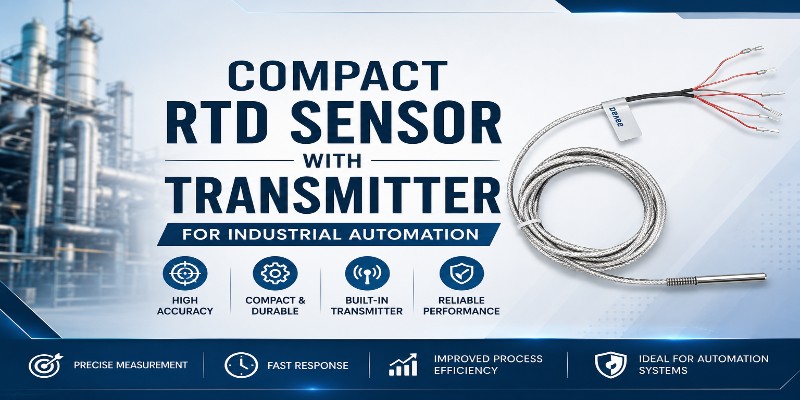
Compact RTD Sensor With Transmitter: Why 4-20mA Output Beats Raw RTD Signals Over Long Distances
In a small plant where a temperature sensor sits two metres from its controller, transmitting a raw RTD resistance signal works perfectly well. But in a large chemical plant in Ankleshwar, a power station in Korba, or an industrial facility in Pune with temperature sensors installed hundreds of metres from the central control room — the raw 3-wire PT100 resistance signal faces a problem that most engineers don’t discover until after installation: over long cable distances, resistance in the cable itself adds measurement error, and electromagnetic interference from motors, drives, and electrical equipment corrupts the low-level signal. The solution that Indian plants have standardized on is the Compact RTD Sensor With Transmitter — a PT100 RTD sensor with an integrated head-mounted temperature transmitter that converts the resistance signal to a 4-20mA current output at the sensor itself, before the signal travels across the plant.
What Is a Compact RTD Sensor With Transmitter?
A Compact RTD Sensor With Transmitter integrates two components in one assembly:
- The RTD sensing element (in this case, a PT100 Class A duplex configuration in SS 316, -50°C to 400°C) that measures temperature as a resistance change
- A head-mounted temperature transmitter that converts the RTD’s resistance output to a standardised 4-20mA current loop signal, powered by 24V DC from the control panel
The transmitter electronics fit into the compact cable head or inline housing of the sensor assembly, creating a single unit that outputs a clean 4-20mA signal rather than a raw resistance.
Full Specifications: Aavad APED-8×50 Compact RTD Sensor With Transmitter
| Parameter | Specification | Engineering Significance |
|---|---|---|
| Type | PT-100 | Standardised IEC 60751 platinum resistance element |
| Make | Aavad Instrument | ISO 9001:2015 |
| Model | APES | Compact RTD with transmitter assembly |
| Datasheet | APED-8X50 | Available for download from product page |
| Configuration | Duplex | Two independent PT100 elements — primary and standby redundancy |
| Total wires | 3 + 3 | 3-wire compensation for each of the two duplex elements |
| Accuracy | Class A | ±(0.15 + 0.002 |
| Temperature range | -50 to 400°C | Covers refrigeration through moderate process temperatures |
| Material of construction | SS 316 | Corrosion-resistant for chemical and process environments |
| Insulation | Compacted MgO | Stable electrical isolation under thermal cycling |
| Cable length | 1 metre | Short run — transmitter converts to 4-20mA at sensor |
| Cable type | TF/TF/SS | Teflon/Teflon/SS braid — moisture and heat resistant |
| Sensor OD | 8 mm | Standard for process connection fittings |
| Sensor length | 50 mm | Compact active sensing length |
| Input | RTD | Transmitter input is PT100 resistance |
| Power supply | 24V DC | Standard 2-wire 4-20mA loop power |
| Output | 4-20mA, 2-wire (single output) | Industry standard current loop output |
| Calibration range | -50 to 400°C | Full span calibrated at the transmitter |
Why 4-20mA Beats Raw RTD Signals Over Long Distances: The Complete Technical Explanation
Problem 1: Cable Resistance Adds Measurement Error
A PT100 RTD has a nominal resistance of 100 Ohms at 0°C, changing by approximately 0.385 Ohms per °C. A 200-metre cable run with standard 0.5mm² copper conductors adds approximately 14 Ohms of cable resistance — equivalent to a false reading of roughly 36°C of temperature error if the cable resistance is not precisely compensated.
3-wire configuration compensates for this — but only if the cable resistance in each leg is truly equal, which is never perfectly true across a long run. A head-mounted transmitter eliminates this problem entirely by converting to 4-20mA at the sensor point — the current signal is not affected by cable resistance over the remaining long run to the control panel.
Problem 2: EMI Corrupts Low-Level Resistance Signals
In a plant environment full of variable frequency drives, large motors, switching power supplies, and high-current buses, the low-level signals in a raw RTD cable (millivolt scale voltage changes) are susceptible to electromagnetic interference pickup. Over long cable runs without careful shielding and routing, this EMI appears as noise in the measurement — a stable temperature appearing to “wander” by ±1°C or more on the controller display.
A 4-20mA current loop is inherently noise-immune: the transmitter outputs a current (not a voltage), and current loops are far less susceptible to electromagnetic interference than voltage signals. A 4-20mA signal can be transmitted reliably over hundreds of metres of standard 2-wire shielded cable in typical industrial plant environments.
Problem 3: Multiple Receivers Share One Signal
A 4-20mA current loop can be connected to multiple receivers in series — your DCS, a separate alarm indicator, a datalogger, and a safety relay can all read the same temperature from one sensor simultaneously by sharing the current loop. A raw RTD can only connect to one instrument without signal conditioning, since connecting it to multiple receivers changes the measurement circuit’s resistance balance.
Why Duplex (3+3 Wires) Configuration Matters in This Assembly
The APED-8×50 uses a duplex configuration — two independent PT100 elements inside a single 8mm SS 316 sheath, each with its own 3-wire output (totaling 6 wires). This duplex design provides:
- Primary element → connected to the transmitter’s first input → single 4-20mA output for normal operation
- Standby element → available as an independent backup if the primary element fails
The integrated transmitter converts the primary element’s output to 4-20mA. If the primary element fails, the standby element is available for reconnection to the transmitter input (or a separate indicator) without removing and replacing the entire sensor assembly — the 8mm probe body containing both elements remains in the process.
Where Compact RTD Sensors With Transmitters Are Used Across India
Chemical and Petrochemical — Long-Distance Signal Runs
Hubs: Ankleshwar, Vapi, Dahej, Bharuch (Gujarat) | Raigad, Pune (Maharashtra) | Visakhapatnam (AP) | Chennai (TN)
In large chemical plants where DCS marshalling rooms may be 100–500 metres from process measurement points, head-mounted transmitters at each sensor point eliminate the long-distance raw RTD signal problem, delivering clean 4-20mA signals to the control room regardless of cable run distance.
Power Generation — Remote Temperature Monitoring
Hubs: Korba (CG) | Singrauli (MP) | Ramagundam (AP) | Gandhinagar (Gujarat) | Ennore (TN) | Chandrapur (Maharashtra)
Power plant temperature monitoring loops from boiler and turbine sensor points to control rooms — often 200–500+ metres — benefit from head-mounted transmitters that maintain signal integrity over these distances.
Oil and Gas — Hazardous Area Installations
Hubs: Jamnagar, Dahej, Hazira (Gujarat) | Visakhapatnam (AP) | Mumbai (Maharashtra)
In offshore platforms and onshore oil installations where IS (intrinsically safe) or Ex-rated loop-powered transmitters are required for classified areas, the 4-20mA 2-wire format is the standard signal for hazardous area temperature monitoring.
HVAC and Building Automation
Major commercial and industrial buildings across: Delhi, Mumbai, Bengaluru, Hyderabad, Chennai, Pune, Ahmedabad, Kolkata, Jaipur
Building management systems across large commercial and industrial complexes use 4-20mA temperature transmitters as the standard signal format for integration with SCADA and BMS controllers — the single, noise-immune current signal connects multiple floors, zones, and AHU monitoring points to a central BMS panel.
Food, Pharmaceutical, and Cold Chain
Hubs: Ahmedabad, Ankleshwar (Gujarat) | Aurangabad, Pune (Maharashtra) | Hyderabad (Telangana) | Baddi (HP)
Pharma clean rooms, food processing cold rooms, and validation-monitored process equipment often use 4-20mA temperature transmitters because the standardised output integrates cleanly with validation data logging systems that record and timestamp the 4-20mA signal for batch records.
Machinery and Rotating Equipment
Nationwide: Motor winding temperature, gearbox oil temperature, compressor discharge temperature — wherever a compact, duplex-element probe with transmitter fits the space available around rotating equipment and provides 4-20mA directly to the machine’s local protection relay or PLC.
India-Wide Coverage
Aavad Instrument supplies Compact RTD Sensors With Transmitters PAN India from Ahmedabad:
Gujarat: Ahmedabad, Vadodara, Surat, Rajkot, Ankleshwar, Vapi, Bharuch, Dahej, Jamnagar, Gandhinagar, Hazira, Morbi
Maharashtra: Pune, Nashik, Mumbai, Aurangabad, Nagpur, Chandrapur, Raigad
Tamil Nadu: Chennai, Coimbatore, Hosur, Ennore, Tuticorin
Karnataka: Bengaluru, Mysuru, Hubballi, Mangaluru | AP & Telangana: Hyderabad, Visakhapatnam, Ramagundam
MP & CG: Singrauli, Pithampur, Indore, Bhopal, Korba, Raipur, Bhilai
Rajasthan: Jaipur, Bhiwadi, Kota, Alwar | UP: Noida, Kanpur, Lucknow
Delhi NCR, Haryana, Punjab, WB, Odisha, Jharkhand, Kerala, HP, Uttarakhand, Goa, Bihar, Assam: PAN India
Aavad Instrument: India’s #1 Compact RTD Transmitter Manufacturer
Aavad Instrument Pvt. Ltd., Chandkheda, Ahmedabad:
- ISO 9001:2015 certified | NABL-accredited calibration laboratory
- 15+ years | 38M+ installations | 2,900+ customers | 12+ countries
- Trusted by BHEL, ONGC, HAL, BARC, NALCO, Indian Railways, Indian Oil, L&T, Torrent Pharma, Aditya Birla Group
Frequently Asked Questions
Q1. What is a compact RTD sensor with transmitter and why is it needed?
It is a PT100 RTD sensing probe with an integrated head-mounted temperature transmitter that converts the RTD’s resistance output to a 4-20mA current loop signal at the sensor point. It is needed for long-distance signal transmission in large industrial plants, where raw RTD resistance signals degrade over long cable runs due to cable resistance errors and electromagnetic interference.
Q2. Why is 4-20mA output preferred over raw RTD signals in large plants?
4-20mA current loop signals are immune to electromagnetic interference, unaffected by cable resistance over long runs, and can be shared by multiple receivers in series. Raw RTD resistance signals are susceptible to EMI pickup and cable resistance errors over distances beyond a few metres, which a head-mounted transmitter eliminates by converting the signal at source.
Q3. What does “duplex” mean in this RTD sensor assembly?
Duplex means the 8mm probe contains two independent PT100 sensing elements (3+3 wires). The primary element connects to the transmitter for normal operation; the standby element provides a backup without requiring sensor body removal if the primary fails.
Q4. What is the power supply requirement for the compact RTD transmitter?
24V DC — the standard 2-wire 4-20mA loop power supply used across industrial instrumentation systems globally. The transmitter is loop-powered, drawing its operating power from the same 2-wire cable that carries the 4-20mA output signal.
Q5. What is the calibration range of this transmitter?
-50°C to 400°C — spanning the full operating range of the PT100 sensing element in this assembly.
Q6. Can this sensor be used in hazardous areas?
Confirm with Aavad’s engineering team whether your specific installation requires IS (intrinsically safe) or Ex-rated certification. The 4-20mA 2-wire format is inherently compatible with IS barriers for hazardous area use, but confirm your specific area classification before specifying.
Q7. Is NABL calibration available?
Yes — Aavad’s in-house NABL-accredited calibration laboratory provides traceable calibration certificates for compact RTD transmitter assemblies on request.
Buy Compact RTD Sensors With Transmitter from India’s #1 Manufacturer
View the product page and download datasheet APED-8X50 or contact Aavad Instrument for a quote.
📞 +91 90996 22823 | ✉ hrg@aavadinstrument.com | ISO 9001:2015 | NABL Accredited | Ahmedabad, Gujarat | PAN India Supply