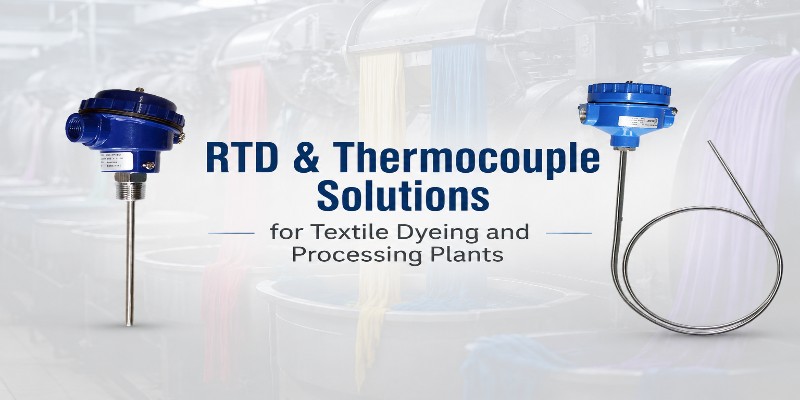
RTD and Thermocouple Selection for Textile Dyeing and Processing Plants: A Practical Guide for Reliable Temperature Measurement
By Aavad Instrument Pvt. Ltd. | RTD & Thermocouple Manufacturer in Ahmedabad, Gujarat, India
Textile Industry Instrumentation | Temperature Measurement | Industrial Sensors
Introduction
Textile manufacturing is one of India’s largest industrial sectors, with major production hubs located in Surat, Ahmedabad, Vapi, Mumbai, Tiruppur, Coimbatore, Ludhiana, Panipat, and Bhilwara. From dyeing and bleaching to drying, curing, and finishing, temperature control plays a critical role in ensuring product quality, color consistency, process efficiency, and energy optimization.
However, textile plants present a unique challenge for temperature sensors.
Unlike many industrial environments where temperature is the primary concern, textile processing combines:
- High humidity
- Chemical exposure
- Steam environments
- Continuous thermal cycling
- Aggressive cleaning chemicals
As a result, sensors that perform perfectly in other industries often fail prematurely in dye houses, stenter machines, and textile finishing plants.
The reality is simple:
In textile processing, sensor life is often determined more by chemical resistance and environmental protection than by temperature range alone.
This guide explains how to select the right RTD sensor or thermocouple for textile dyeing and processing applications while maximizing reliability and minimizing maintenance costs.
Why Temperature Measurement Matters in Textile Processing
Modern textile manufacturing relies heavily on precise temperature control throughout the production cycle.
Even small temperature deviations can lead to:
❌ Uneven dye penetration
❌ Color inconsistency
❌ Fabric quality defects
❌ Increased energy consumption
❌ Production losses
Accurate temperature monitoring helps manufacturers achieve:
✔ Consistent dyeing results
✔ Better fabric quality
✔ Reduced reprocessing
✔ Improved energy efficiency
✔ Higher production reliability
Mapping Temperature Zones in a Textile Processing Plant
Different areas of a textile plant operate under completely different process conditions.
Selecting a single sensor type for all applications often leads to premature failures.
Textile Plant Temperature Zones
| Process Area | Typical Temperature Range | Main Challenge | Recommended Sensor |
|---|---|---|---|
| Dye Baths / Jet Dyeing Machines | 60°C – 140°C | Chemical exposure, moisture | PT100 RTD with 316L or PTFE-coated sheath |
| Jigger Machines | 70°C – 130°C | Corrosive dyes and chemicals | RTD Sensor with corrosion-resistant sheath |
| Stenter Machines | 120°C – 220°C | Continuous heat and airflow | Mineral Insulated Thermocouple |
| Drying Chambers | 100°C – 220°C | High humidity and heat cycling | High-Temperature Thermocouple |
| Steam Boilers | 150°C – 350°C+ | Pressure and scaling | Thermowell Mounted Thermocouple |
| Finishing & Curing Ovens | 140°C – 250°C | Oxidation and thermal stress | K Type Thermocouple or N Type Thermocouple |
Why Sheath Material Matters More Than Sensor Type
One of the biggest mistakes in textile plants is selecting sensors based only on operating temperature.
Many engineers focus on whether they need:
- RTD
- Thermocouple
while overlooking the most important factor:
The Sheath Material
In dyeing operations, the sheath is the first component exposed to:
- Chlorine bleach
- Reactive dyes
- Acids
- Alkalis
- Detergents
- Scouring chemicals
When the sheath begins to corrode, moisture enters the sensor assembly and causes inaccurate readings long before complete failure occurs.
316L Stainless Steel: The Recommended Baseline
For most textile applications, 316L stainless steel offers significantly better corrosion resistance than standard SS304.
Benefits of 316L RTD Sensors
✔ Improved chloride resistance
✔ Better protection against dye chemicals
✔ Longer service life
✔ Reduced maintenance frequency
Best Applications
- Dye baths
- Jet dyeing machines
- Jiggers
- Chemical process tanks
For most textile dyeing applications, a 316L RTD sheath should be considered the minimum recommended specification.
PTFE-Coated and Hastelloy Sensors for Aggressive Dye Processes
Some textile processes involve highly aggressive chemical exposure.
Examples include:
- Bleaching operations
- Reactive dye processing
- Strong alkaline treatments
- Acid washing systems
In these environments, even 316L stainless steel may eventually suffer pitting corrosion.
Recommended Solutions
PTFE-Coated RTD Sensors
Provide excellent chemical resistance and protection.
Hastelloy Sheathed Sensors
Suitable for highly corrosive process environments.
Benefits
✔ Superior corrosion resistance
✔ Extended service life
✔ Lower replacement costs
✔ Better long-term measurement stability
RTD Sensors for Dye Bath Applications
For direct immersion applications, PT100 RTD sensors remain the preferred choice.
Why RTDs Work Best in Dye Baths
RTDs provide:
✔ Higher accuracy
✔ Excellent repeatability
✔ Stable long-term performance
✔ Better process control
Recommended Configuration
- PT100 RTD
- 316L Stainless Steel Sheath
- 3-Wire Configuration
- Thermowell Installation
- IP67 Connection Head
Thermocouples for Stenter Machines and Drying Chambers
Stenter machines operate under sustained high temperatures and continuous airflow conditions.
In these applications, thermocouples offer advantages over RTDs.
Recommended Thermocouple Types
K Type Thermocouple
Most widely used in textile drying systems.
Temperature Range:
-200°C to 1260°C
N Type Thermocouple
Provides improved stability at elevated temperatures.
Benefits
✔ High-temperature capability
✔ Fast response
✔ Rugged construction
✔ Long operating life
Why Thermowells Are Essential in Textile Plants
A thermowell is a protective tube that isolates the sensor from direct process contact.
In textile plants, thermowells provide significant operational advantages.
Benefits of Thermowell Installation
✔ Sensor replacement without process shutdown
✔ Reduced maintenance time
✔ Protection from chemical attack
✔ Longer sensor life
✔ Improved operational reliability
For continuous-production dye houses, thermowells often provide one of the highest returns on investment.
The Most Overlooked Failure Point: Connection Heads
Many textile plants assume sensor failure occurs at the sensing element.
In reality, connection heads and cable terminations fail more frequently.
Common Causes
- High humidity
- Steam exposure
- Thermal cycling
- Water ingress
- Condensation
Result
The sensor appears to “drift” even though the sensing element remains functional.
Why IP65/IP67 Protection Matters
For textile applications, connection heads should be rated:
✔ IP65 minimum
✔ IP67 preferred
These ratings help prevent:
- Moisture ingress
- Corrosion
- Signal instability
- Premature sensor failure
Practical Sensor Buying Checklist for Textile Plants
Before purchasing a sensor, verify the following:
Chemical Compatibility
Identify:
- Bleach concentration
- Dye chemistry
- Acids
- Alkalis
Sheath Material
Prefer:
✔ 316L Stainless Steel
✔ PTFE Coating
✔ Hastelloy
Protection Rating
Specify:
✔ IP65
✔ IP67
Installation Method
Consider:
✔ Direct immersion
✔ Thermowell installation
Pressure Requirements
For boilers and steam systems, verify:
✔ Temperature Rating
✔ Pressure Rating
These are separate specifications.
Why Textile Plants Choose Aavad RTDs & Thermocouples
Aavad Instrument Pvt. Ltd. supplies customized temperature sensors designed specifically for textile manufacturing environments.
Available Solutions
✔ PT100 RTD Sensors
✔ PT1000 RTD Sensors
✔ K Type Thermocouples
✔ N Type Thermocouples
✔ Thermowells
✔ High-Temperature Assemblies
✔ PTFE-Coated Sensors
✔ Hastelloy Sheathed Sensors
Applications Across Textile Industry
AAVAD temperature sensors are suitable for:
- Dye Houses
- Stenter Machines
- Jet Dyeing Machines
- Jigger Machines
- Drying Chambers
- Boilers
- Steam Systems
- Textile Finishing Plants
Frequently Asked Questions
Is 316L stainless steel always sufficient for textile dye baths?
For most textile dyeing applications, yes. However, highly aggressive bleaching or reactive dye processes may require PTFE-coated or Hastelloy sheathing.
Why do sensor readings drift even when the sensor tests correctly?
Moisture ingress into the connection head or cable termination often causes measurement instability under operating conditions.
Does a thermowell affect sensor response time?
Yes. Thermowells slightly increase response time due to added thermal mass. However, the maintenance benefits usually outweigh this limitation.
Can the same sensor be used in dyeing and finishing operations?
Generally no. Dye baths and finishing ovens have different temperature and chemical requirements, making application-specific sensor selection more effective.
Conclusion
Textile processing environments place unique demands on temperature sensors. The most successful installations are not determined by temperature range alone but by selecting the correct sheath material, protection rating, mounting arrangement, and environmental protection features.
For dye houses, stenters, drying chambers, boilers, and finishing plants, choosing the right RTD sensor or thermocouple can dramatically improve reliability, reduce downtime, and lower maintenance costs.
Need Help Selecting the Right Sensor?
Aavad Instrument Pvt. Ltd. manufactures customized RTD sensors, thermocouples, and thermowells designed specifically for textile dyeing and processing applications.
Head Type RTD Sensor Manufacturer – Aavad Instrument Pvt. Ltd.
Head Type Thermocouple Manufacturer – Aavad Instrument Pvt. Ltd.
📞 +91 90996 22823
Aavad Instrument Pvt. Ltd.
Reliable Temperature Measurement for Textile Manufacturing Excellence