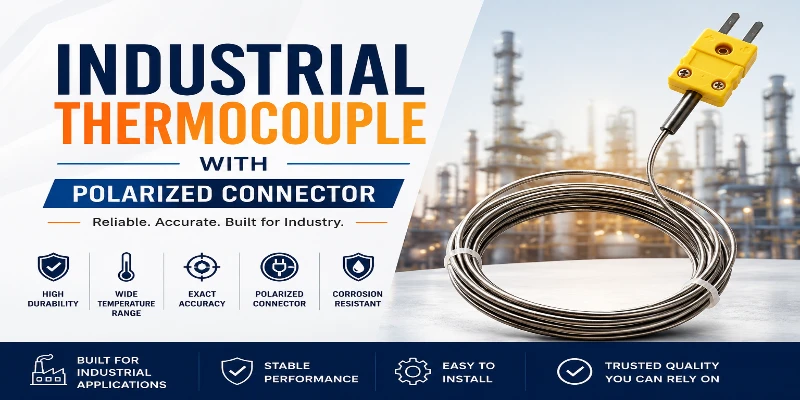
Thermocouple with Connector: Industrial Applications, Types, and How to Choose the Right One
A thermocouple that’s hardwired into a terminal block does its job, right up until it needs to be replaced — and then someone’s opening a panel, identifying wires, and re-terminating under time pressure. A thermocouple with connector sidesteps that entire process: unplug the old one, plug in the new one, done. This guide covers what these connector-terminated thermocouples actually are, the types available, and how to choose the right one for your application.
What Is a Thermocouple with Connector, and Why Use One?
A thermocouple with connector terminates not in bare wire leads or a terminal block, but in a standard plug designed to mate with a corresponding socket on the instrument side. This polarized plug-and-socket design allows quick and simple connection and interchange — when a sensor needs replacing, a technician disconnects the old plug and connects the new one, with no wire stripping, no terminal screws, and no risk of miswiring polarity.
How Polarized Standard Plugs Prevent Wiring Errors and Speed Up Replacement
Thermocouple polarity matters — reversing the positive and negative legs produces a corrupted or backwards-reading signal. A polarized connector physically prevents this: the plug’s pin geometry only fits the socket one way, so there’s no possibility of connecting it backward. This single design feature eliminates a surprisingly common field error and cuts replacement time from minutes of careful rewiring down to seconds.
Types of Thermocouple Connectors: Standard Plug, Miniature Plug, and Panel Mount
| Connector Type | Typical Use Case |
|---|---|
| Standard plug | General industrial applications, robust enough for shop-floor handling |
| Miniature plug | Space-constrained installations where a smaller footprint is needed |
| Panel mount socket | Fixed instrument-side connection point, often on a control panel or junction box |
| Type-specific color coding | Connector bodies are typically color-coded by thermocouple type (K, J, T, etc.) to prevent cross-connecting incompatible sensor types |
Always confirm the connector type and size matches both your sensor and your receiving instrument or extension cable — mismatched connector sizes are a common source of installation delays.
Connector Thermocouples vs Hardwired Terminal Block Sensors — Key Differences
| Factor | Connector Thermocouple | Hardwired Terminal Block |
|---|---|---|
| Replacement speed | Seconds — unplug and reconnect | Minutes to longer — requires wire termination |
| Risk of polarity error | Eliminated by polarized plug design | Possible if wires are misidentified |
| Mechanical robustness of connection | Generally good, but exposed to disconnection if knocked | More permanent, less prone to accidental disconnection |
| Best suited for | Frequent sensor swaps, OEM machinery, lab/test setups | Fixed process installations, long-term unattended monitoring |
Common Industrial Applications: Heat Treatment, OEM Machinery, Lab & Test Equipment
- Heat treatment processes — mineral insulated thermocouples with connectors offer an operating temperature range from 0°C to above 800°C, making them well suited to heat-treatment furnace and oven monitoring where sensors are periodically swapped for calibration or replacement
- OEM machinery — equipment manufacturers commonly specify connector-terminated sensors so end users can replace a failed sensor without specialized rewiring skills
- Laboratory and test equipment — research and testing setups often need sensors swapped between different test points or experiments, making quick-connect designs far more practical than hardwired sensors
- Portable temperature measurement — connector-terminated probes paired with handheld indicators are standard for spot-check and troubleshooting applications across plants
Material and Temperature Considerations: Sheath, Insulation & Operating Range (0°C to 800°C+)
Connector thermocouples built on mineral insulated (MI) construction typically offer an operating range from 0°C up to and above 800°C, depending on the specific element type and sheath material. They’re generally manufactured with an insulated (ungrounded) junction, which reduces electrical interference and provides a more stable reading, and are available with grounded or exposed tip configurations and sheath materials including stainless steel, Inconel, or Nicrosil — selected based on your specific process temperature and atmosphere.
Bend Radius and Mechanical Flexibility for Connector-Terminated MI Thermocouples
Although typically supplied straight, MI-based connector thermocouples can usually be bent around formers — with a radius of approximately three times the probe diameter — and shaped to suit your specific application’s installation geometry. This flexibility makes connector thermocouples practical for installations where the sensing point isn’t in a straightforward, easily accessible location.
How to Choose the Right Connector Thermocouple for Your Application
- Confirm the thermocouple type (K, J, T, etc.) matches your process temperature range and existing instrumentation calibration.
- Match the connector size and style to your instrument-side socket or extension cable.
- Select sheath material based on your process atmosphere and any corrosive exposure.
- Decide between grounded, ungrounded, or exposed-tip junction based on your response-time and electrical-interference requirements.
- Confirm probe diameter and length fit your specific installation point and thermowell, if applicable.
- Check if field bending is required, and confirm the minimum bend radius for your chosen product.
Maintenance Advantages: Why Fast Interchange Reduces Plant Downtime
For any application where sensors are periodically replaced — due to drift, mechanical damage, or scheduled calibration swaps — the time saved by a polarized plug-and-socket connection adds up. A maintenance technician carrying spare connector-terminated sensors can restore a failed measurement point in the time it takes to walk to the panel and plug in a replacement, rather than scheduling a rewiring task that may require an electrician or extended downtime.
Aavad Instrument’s Thermocouple with Connector Range
Aavad Instrument Pvt. Ltd., based in Ahmedabad, Gujarat, manufactures the Thermocouple with Connector, built on mineral insulated construction with a standard polarized plug:
- Operating temperature range: 0°C to above 800°C (mineral insulated construction)
- Junction options: Insulated (ungrounded) as standard, with grounded or exposed-tip configurations available
- Sheath material options: Stainless steel, Inconel, or Nicrosil, selected per application
- Bend capability: Can be bent around formers with a radius of approximately three times the probe diameter
- Connector type: Polarized standard plug for quick, error-free connection and interchange
Manufactured under an ISO 9001:2015 quality system with calibration support from Aavad’s in-house NABL-accredited laboratory, this product sits within the broader Thermocouple Connector category and Wire Type RTD & Thermocouple Sensor Manufacturer range.
Frequently Asked Questions
Q1. What is the advantage of a polarized thermocouple plug over a standard wired terminal? A polarized plug physically prevents incorrect (reversed-polarity) connection, since its pin geometry only fits the matching socket one way — eliminating a common field wiring error and significantly speeding up sensor replacement.
Q2. Can connector-type thermocouples be used in hazardous areas? This depends on the specific connector and enclosure certification. For hazardous (Ex) area installations, confirm with your supplier whether the specific connector thermocouple model carries the appropriate certification for your zone classification, or whether a head-type flameproof design is more appropriate.
Q3. What temperature range do connector thermocouples typically support? Mineral insulated connector thermocouples commonly support 0°C to above 800°C, depending on the specific element type and sheath material — always confirm the exact rated range of your chosen product against your process requirements.
Q4. Are connector and socket types interchangeable between different manufacturers? Not always — confirm that your connector’s pin configuration, size, and thermocouple-type color coding are compatible with your specific receiving instrument or extension cable before ordering, especially when sourcing replacement sensors from a different supplier than your original equipment.
Q5. How do I choose between a standard size and miniature size connector? This depends primarily on your available installation space and your instrument-side socket size — miniature connectors suit space-constrained panels, while standard plugs offer more robust mechanical handling for general shop-floor use.
Get the Right Connector Thermocouple for Your Application
Aavad Instrument’s engineering team can help you specify the correct connector type, sheath material, and junction configuration for your process. Request a quote or view the Thermocouple with Connector product page for complete specifications.