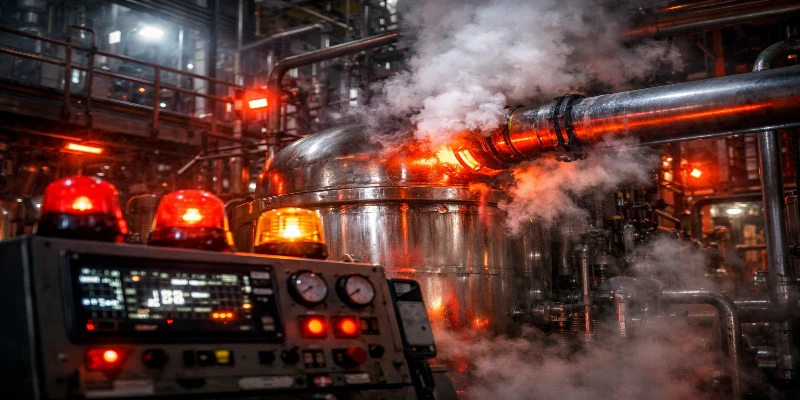
⚠️ What Happens If You Use the Wrong Thermocouple Type in Your Process Plant?
⚙️ Introduction
Temperature measurement is one of the most critical parameters in any industrial process. From boilers and furnaces to chemical reactors and food processing lines, accurate temperature control ensures product quality, safety, and efficiency.
However, using the wrong thermocouple type can lead to serious problems. In many cases, it may not be immediately visible, but over time, it can cause process inefficiency, equipment damage, and even safety hazards.
Therefore, choosing the correct thermocouple is not just a technical decision—it is a critical operational requirement.
🔥 Why Thermocouple Selection Matters
Different thermocouples (K, J, T, N, S, R, etc.) are designed for specific temperature ranges and environments.
Each type has:
- Different temperature limits
- Different material properties
- Different resistance to corrosion and oxidation
As a result, using the wrong type can lead to inaccurate readings and system failure.
❌ 1️⃣ Inaccurate Temperature Readings
The most immediate issue is wrong temperature measurement.
If the thermocouple is not suitable:
- It may show lower or higher readings
- Calibration may drift quickly
- Process control becomes unreliable
👉 Impact:
- Poor product quality
- Process instability
- Increased rejection rates
🔥 2️⃣ Sensor Failure at High Temperatures
Some thermocouples cannot handle extreme heat.
For example:
- Using a J-type thermocouple in a high-temperature furnace
- Using low-grade materials in combustion zones
Consequently, the sensor may:
- Burn out
- Melt or degrade
- Stop working suddenly
👉 Impact:
- Unexpected downtime
- Emergency shutdowns
- Increased maintenance costs
⚗️ 3️⃣ Chemical Corrosion and Damage
Industrial environments often contain:
- Corrosive gases
- Acids or chemicals
- Moisture and oxidation
If the thermocouple material is not compatible, it will degrade quickly.
👉 Impact:
- Reduced sensor life
- Frequent replacement
- Unstable readings
⚡ 4️⃣ Slow Response Time
Some thermocouples are not designed for fast-changing processes.
If the wrong type is used:
- Temperature changes are detected slowly
- Process control becomes delayed
👉 Impact:
- Inefficient operations
- Poor system performance
- Energy losses
🛑 5️⃣ Safety Risks
Incorrect temperature measurement can lead to dangerous conditions.
For example:
- Overheating in boilers
- Underheating in chemical reactions
- Failure in safety systems
👉 Impact:
- Equipment damage
- Fire or explosion risks
- Safety hazards for workers
💸 6️⃣ Increased Operational Costs
Using the wrong thermocouple increases:
✔ Maintenance frequency
✔ Replacement costs
✔ Energy consumption
✔ Production losses
Therefore, a small mistake in selection can lead to major financial impact.
🧠 How to Choose the Right Thermocouple
To avoid these issues, always consider:
✔ Temperature Range
Choose a thermocouple that can handle your maximum process temperature.
✔ Environment
Check for:
- Corrosion
- Vibration
- Moisture
✔ Response Time
Fast processes require faster sensors.
✔ Accuracy Requirement
Critical processes need high precision.
⚙️ AAVAD INSTRUMENT PVT. LTD. – Reliable Thermocouple Solutions
AAVAD INSTRUMENT PVT. LTD. provides a wide range of industrial thermocouples designed for different applications.
👉 Explore Thermocouples:
https://www.aavadinstrument.com/product-category/thermocouple-sensor/
We offer:
✔ K, J, T, N, R, S type thermocouples
✔ High-temperature and corrosion-resistant designs
✔ Custom-built sensors for specific industries
✔ Long-life and stable performance
🌱 Conclusion
Using the wrong thermocouple type may seem like a small mistake, but it can lead to serious operational, financial, and safety issues.
Therefore, selecting the correct thermocouple is essential for maintaining:
- Accuracy
- Efficiency
- Safety
- Reliability
With the right expertise and high-quality sensors from AAVAD INSTRUMENT PVT. LTD., you can ensure your process runs smoothly and efficiently.
AAVAD Instrument Pvt.Ltd. – Precision Temperature Measurement for Every Industry.