Description
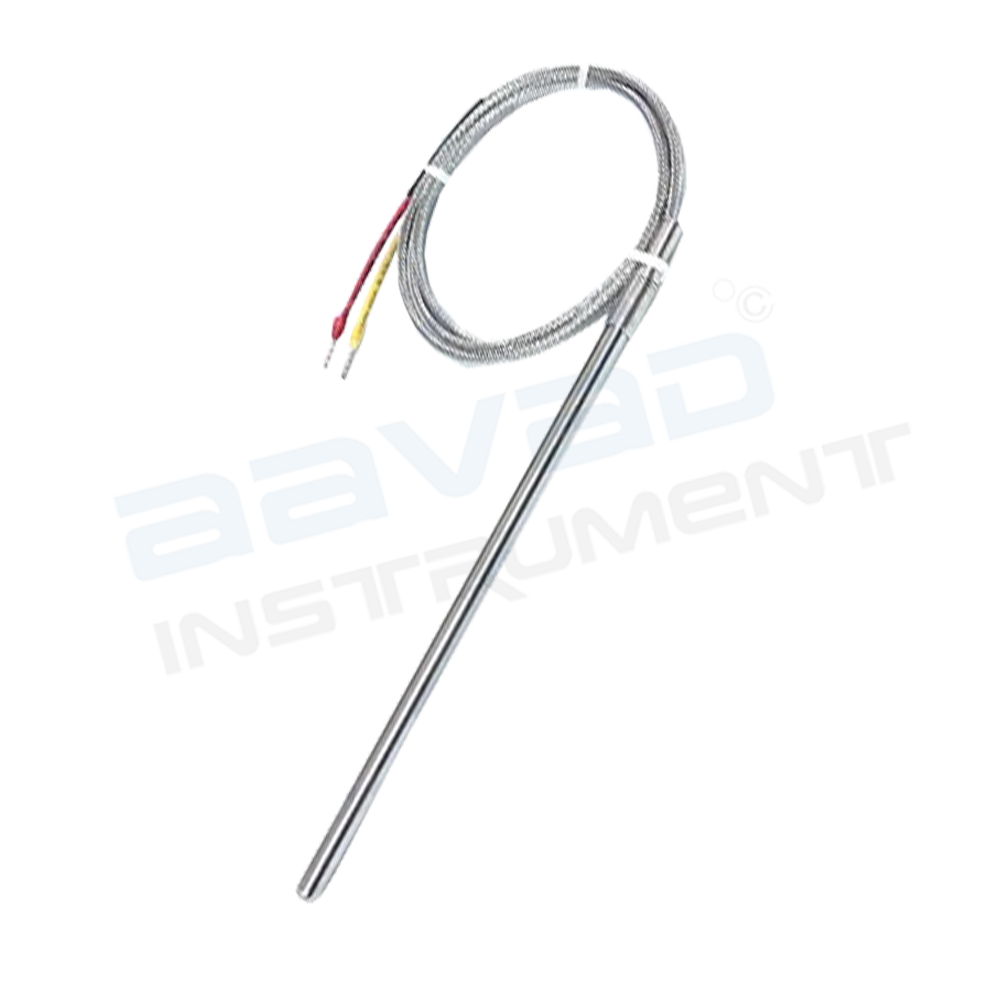
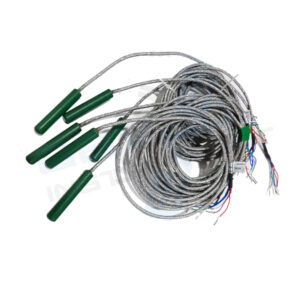
The Aavad Transition Joint Thermocouple (Model AKES-6×600) is a K-Type industrial temperature sensor engineered for high-temperature applications where mechanical vibration, cable movement, and repeated handling can reduce the service life of conventional thermocouples. A key feature of this design is the transition joint, a reinforced strain-relief section that protects the connection between the rigid mineral-insulated sheath and the flexible extension cable.
In many industrial installations, the junction where the metal sheath meets the flexible cable is exposed to continuous bending, vibration, or accidental pulling. Over time, these mechanical stresses can damage internal conductors and lead to premature sensor failure. The transition joint absorbs and distributes these forces, helping improve mechanical reliability and extending the operational life of the thermocouple in demanding environments.
This model features a simplex K-Type thermocouple element with a stated ±0.75% accuracy, an Inconel 600 sheath, and an operating temperature range of 0°C to 1200°C. Inconel 600 provides excellent resistance to oxidation and high-temperature corrosion, making it suitable for continuous operation in furnaces, kilns, heat treatment equipment, combustion systems, and other severe industrial processes. The 6 mm sheath diameter offers a balance between durability and response time, while the 600 mm insertion length enables accurate temperature measurement in deep process zones.
The sensor is supplied with a 3-meter FG/FG/SS (fiberglass insulated with stainless steel braided) cable, providing excellent resistance to heat, abrasion, vibration, and mechanical wear. This robust construction makes the thermocouple suitable for applications where both high temperature and mechanical reliability are essential.
Key Features
-
Heavy-Duty Strain Relief Transition Barrel Absorbs mechanical tension and vibration stress at the probe-to-cable connection to prevent wire fatigue and breakage.
-
Inconel 600 High-Temperature Alloy Sheath High-nickel alloy construction delivers exceptional oxidation, carburization, and scale resistance up to 1200°C.
-
Aavad’s Highest Wire-Type Thermal Rating (1200°C) Engineered specifically for severe heat processes where standard stainless steel sheaths degrade or fail.
-
Extended 600mm Insertion Sheath Penetrates deep into large combustion chambers, kiln walls, and multi-zone heat treatment furnaces.
-
High-Accuracy K-Type Calibration ($pm 0.75%$) Standardized Chromel-Alumel element delivers accurate, reliable signal output across extreme thermal sweeps.
-
3-Meter High-Heat FG/FG/SS Armored Cable High-temperature fiberglass insulated wire shielded by a flexible stainless steel outer braid protects against heat and abrasion.
Applications
-
High-Temperature Furnaces & Kilns Thermal monitoring in ceramic kilns, continuous annealing furnaces, and heat treatment lines.
-
Power Generation & Utility Plants Flue gas temperature monitoring, boiler combustion paths, and turbine exhaust ducts.
-
Chemical & Petrochemical Processing Thermal cracking units, incinerator stacks, and high-heat reactor vessels.
-
Metal Processing & Foundries Heat tracking around non-ferrous metal forging, heat treating, and smelting operations.
-
Vibration-Prone Machinery & Equipment Industrial machinery where movement or cable flexing damages standard headless thermocouple connections.
Datasheet
FAQs
1. What is a Transition Joint Thermocouple?
A Transition Joint Thermocouple is an industrial temperature sensor featuring a reinforced transition joint (strain-relief section) between the metal sheath and the flexible extension cable. This design minimizes mechanical stress at the cable entry point, improving durability, reliability, and service life in demanding industrial environments.
2. What is the purpose of a Transition Joint?
The transition joint protects the critical connection where the rigid thermocouple sheath meets the flexible cable. It reduces damage caused by continuous vibration, repeated bending, twisting, and accidental pulling, helping prevent cable breakage and sensor failure while maintaining accurate temperature measurement.
3. Why is a Transition Joint important in Industrial Applications?
Many industrial processes expose temperature sensors to constant vibration, mechanical movement, and harsh operating conditions. A transition joint significantly extends sensor life by reducing mechanical fatigue at one of the most common failure points, making it ideal for heavy-duty industrial machinery and continuous process monitoring.
4. What temperature range does a Transition Joint Thermocouple support?
The operating temperature range depends on the thermocouple type and sheath material. A K-Type Transition Joint Thermocouple typically measures temperatures from 0°C to +1200°C, making it suitable for high-temperature industrial applications such as furnaces, kilns, heat treatment, and process heating.
5. Where are Transition Joint Thermocouples commonly used?
These thermocouples are widely used in steel plants, power plants, cement industries, chemical processing, petrochemical plants, furnaces, heat treatment equipment, glass manufacturing, ceramic kilns, OEM machinery, and industrial automation systems where sensors are exposed to vibration and frequent mechanical movement.
6. Can Transition Joint Thermocouples be customized?
Yes. Transition Joint Thermocouples can be customized with different thermocouple types (K, J, T, N, R, S, B), sheath materials such as SS316, SS310, Inconel 600, sheath diameters, insertion lengths, cable types, cable lengths, process connections, and termination options to meet specific industrial process requirements.
7. Why Choose Aavad Instrument Transition Joint Thermocouples?
Aavad Instrument Pvt. Ltd. Transition Joint Thermocouples are precision-engineered for reliable temperature measurement in demanding industrial environments. Manufactured with premium thermocouple elements, durable SS316, SS310, or Inconel sheaths, and reinforced transition joints, our sensors deliver excellent accuracy, superior mechanical strength, and extended service life. We also offer customized sheath diameters, insertion lengths, cable assemblies, process connections, and thermocouple configurations for OEM and industrial applications.