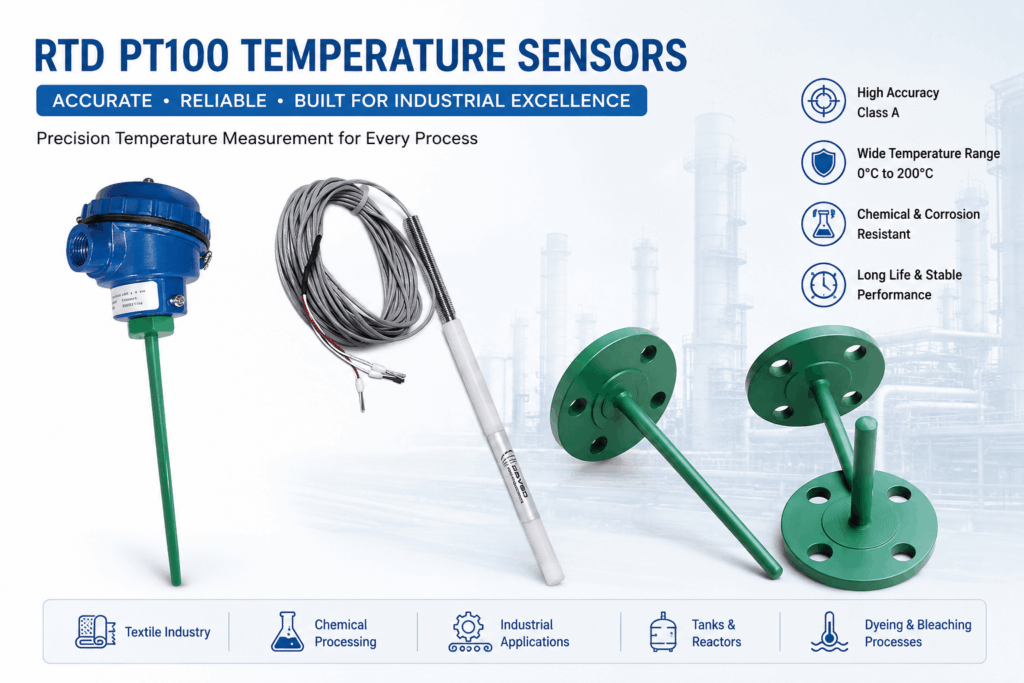
PTFE RTD PT100 Temperature Sensor for Textile Dyeing & Chemical Processing Plants – Complete Industrial Guide (2026)
Introduction
Temperature plays a critical role in textile dyeing, chemical manufacturing, pharmaceutical production, water treatment, food processing, and many industrial applications. Even a slight temperature variation can lead to poor product quality, increased production costs, and equipment damage.
Standard stainless steel RTD sensors often fail in aggressive chemical environments where acids, alkalis, and corrosive chemicals are present.
This is where the PTFE RTD PT100 Temperature Sensor becomes the preferred solution.
Designed with a PTFE (Teflon) protective sleeve, this sensor offers exceptional resistance against corrosive chemicals while providing highly accurate temperature measurement. It is widely used in textile dyeing machines, chemical reactors, acid tanks, electroplating plants, and process industries throughout India.
In this complete guide, we’ll explain everything you need to know before selecting a PTFE RTD PT100 Temperature Sensor.
What is a PTFE RTD PT100 Temperature Sensor?
A PTFE RTD PT100 Temperature Sensor is a resistance temperature detector equipped with a platinum PT100 sensing element enclosed inside a PTFE (Teflon) protective sleeve.
The PT100 element changes resistance with temperature, allowing precise temperature measurement.
The PTFE sleeve protects the sensing element from:
- Sulphuric Acid
- Hydrochloric Acid
- Nitric Acid
- Caustic Chemicals
- Dye Chemicals
- Bleaching Solutions
- Salt Solutions
- Corrosive Liquids
This combination provides both high measurement accuracy and excellent chemical resistance.
Why PTFE Protection is Important?
Many industries use highly corrosive chemicals.
A normal SS304 or SS316 sensor may gradually corrode, causing:
- Incorrect temperature readings
- Frequent sensor failures
- Process shutdown
- Product rejection
- Increased maintenance cost
PTFE coating acts as a protective barrier between chemicals and the sensor.
Benefits of PTFE Protection
✔ Excellent Chemical Resistance
✔ Non-Stick Surface
✔ High Corrosion Resistance
✔ Long Service Life
✔ Moisture Resistant
✔ Low Maintenance
✔ Excellent Electrical Insulation
✔ Suitable for Strong Acid Applications
How PT100 Technology Works
The PT100 sensor contains pure platinum.
At:
- 0°C = 100 Ohms
- 100°C = 138.5 Ohms
The transmitter or temperature controller converts this resistance into accurate temperature readings.
Compared to thermocouples, PT100 sensors provide:
- Better Accuracy
- Higher Stability
- Long-Term Repeatability
- Less Signal Drift
Key Features of PTFE RTD PT100 Temperature Sensor
- High Accuracy Class A / Class B
- IEC 60751 Standard
- PT100 Platinum Element
- PTFE Protective Sleeve
- Acid Resistant Construction
- Excellent Corrosion Resistance
- Fast Response Time
- Long Operational Life
- Weatherproof Connection Head
- Various Probe Lengths Available
- 3 Wire / 4 Wire Configuration
- Mineral Insulated Option Available
- High Mechanical Strength
- Suitable for Continuous Industrial Operation
Technical Specifications
| Parameter | Specification |
|---|---|
| Sensor Type | RTD PT100 |
| Accuracy | Class A / Class B |
| Standard | IEC 60751 |
| Protection | PTFE Sleeve |
| Temperature Range | -50°C to 250°C (Application Dependent) |
| Probe Material | SS316 with PTFE |
| Cable | PTFE Insulated |
| Wiring | 2 Wire / 3 Wire / 4 Wire |
| Mounting | Threaded / Flanged / Compression |
| Head Type | Weatherproof Aluminium Head |
| Protection Class | IP65 / IP67 |
| Process Connection | Custom Available |
Applications in Textile Industry
The textile industry requires extremely accurate temperature control.
Applications include:
Dyeing Machines
Maintains precise dye bath temperature.
Jet Dyeing Machine
Ensures uniform dye penetration.
Soft Flow Dyeing
Controls heating profile.
Winch Dyeing
Maintains constant liquor temperature.
Jigger Machine
Improves color consistency.
Bleaching Process
Controls peroxide temperature.
Mercerizing Plant
Accurate alkali process monitoring.
Stenter Machine
Temperature monitoring.
Chemical Preparation Tank
Protects sensor from chemicals.
Applications in Chemical Industry
PTFE RTD sensors are ideal for:
- Acid Storage Tank
- Chemical Mixing Vessel
- Reactor Temperature Monitoring
- Chemical Transfer Lines
- Electroplating Plant
- Fertilizer Industry
- Specialty Chemicals
- Paint Industry
- Pigment Manufacturing
- Resin Manufacturing
- Polymer Plants
- Effluent Treatment Plants
Industries Using PTFE RTD PT100 Sensors
- Textile Industry
- Chemical Industry
- Pharmaceutical Plants
- Water Treatment
- Food Processing
- Dairy Industry
- Sugar Industry
- Power Plants
- Steel Industry
- Paper Industry
- Fertilizer Plants
- Petrochemical Plants
- Electroplating Industry
- Battery Manufacturing
- Laboratory Applications
Advantages Over Conventional RTD Sensors
| Conventional RTD | PTFE RTD PT100 |
| Limited Chemical Resistance | Excellent Chemical Resistance |
| Frequent Replacement | Longer Life |
| Corrosion Risk | Highly Corrosion Resistant |
| Higher Maintenance | Low Maintenance |
| Short Service Life | Extended Service Life |
| Limited Acid Use | Ideal for Acid Applications |
Factors to Consider Before Buying
Choose the sensor based on:
Temperature Range
Select according to process requirements.
Chemical Compatibility
Confirm compatibility with the process chemicals.
Probe Length
Ensure proper immersion depth.
Process Connection
Threaded, Flanged or Compression Fitting.
Accuracy
Choose Class A where higher precision is required.
Cable Length
Select suitable cable length for installation.
IP Rating
Weatherproof or Waterproof depending on environment.
Installation Best Practices
- Install with sufficient immersion depth.
- Avoid mechanical bending.
- Prevent cable tension.
- Use proper cable glands.
- Calibrate periodically.
- Protect junction box from water ingress.
- Ensure correct wiring.
Maintenance Tips
Regular maintenance improves sensor life.
Recommended practices:
- Inspect PTFE sleeve periodically.
- Clean chemical deposits.
- Verify calibration annually.
- Check cable insulation.
- Tighten process connections.
- Replace damaged sleeves immediately.
Common Problems & Solutions
Sensor Reading Fluctuates
Cause: Loose wiring.
Solution: Inspect terminal connections.
Sensor Failure
Cause: Chemical damage.
Solution: Use PTFE coated sensor.
Incorrect Temperature
Cause: Improper installation.
Solution: Increase immersion depth.
Slow Response
Cause: Chemical deposits.
Solution: Clean sensor regularly.
Why Industries Prefer PTFE RTD PT100 Sensors
Industrial plants across India choose PTFE RTD PT100 sensors because they deliver:
- Reliable Performance
- High Measurement Accuracy
- Superior Chemical Resistance
- Long Operational Life
- Reduced Downtime
- Lower Maintenance Cost
- Improved Product Quality
- Better Process Safety
Why Choose AAVAD Instrument Pvt. Ltd.?
AAVAD Instrument Pvt. Ltd. is a trusted Indian manufacturer and supplier of industrial temperature measurement solutions.
We offer:
- Custom Built RTD PT100 Sensors
- PTFE Coated Temperature Sensors
- Textile Industry Solutions
- Chemical Industry Solutions
- NABL Calibration Support
- Fast Pan India Delivery
- Technical Consultation
- Competitive Pricing
- Experienced Engineering Team
- OEM & Bulk Supply
Whether your application involves textile dyeing, acid storage tanks, chemical reactors, or process industries, AAVAD provides reliable and high-performance temperature sensing solutions tailored to your requirements.
Frequently Asked Questions (FAQs)
Is PTFE resistant to acids?
Yes. PTFE offers outstanding resistance to most industrial acids, alkalis, solvents, and corrosive chemicals.
Why is PT100 preferred over thermocouples?
PT100 sensors provide higher accuracy, better stability, and superior repeatability for industrial temperature measurement.
Which industries commonly use PTFE RTD sensors?
Textile, chemical, pharmaceutical, electroplating, food processing, water treatment, and petrochemical industries.
Can PTFE RTD sensors be customized?
Yes. Probe length, cable length, process connection, mounting type, and wiring configuration can all be customized.
What accuracy classes are available?
Class A and Class B as per IEC 60751.
Conclusion
The PTFE RTD PT100 Temperature Sensor is one of the most dependable solutions for accurate temperature measurement in corrosive industrial environments. Its combination of platinum RTD technology and PTFE protection ensures precise readings, long service life, and resistance to harsh chemicals.
For industries such as textile dyeing, chemical processing, pharmaceuticals, electroplating, and water treatment, investing in a high-quality PTFE RTD PT100 sensor improves process efficiency, reduces maintenance costs, and enhances overall plant reliability.
If you are looking for a trusted PTFE RTD PT100 Temperature Sensor Manufacturer and Supplier in India, AAVAD Instrument Pvt. Ltd. offers customized solutions engineered for demanding industrial applications with reliable support and nationwide supply.
Suggested Internal Links
- RTD PT100 Temperature Sensors
- Thermocouples
- Thermowells
- Industrial Temperature Sensors
- Electromagnetic Flow Meters
- Contact Us