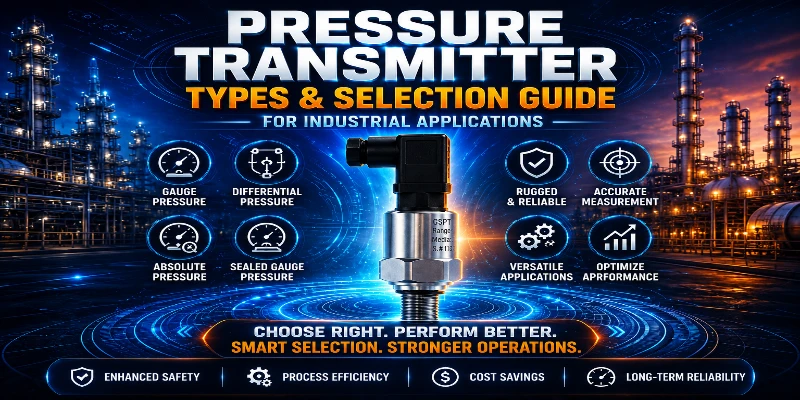
Pressure Transmitter Types: Gauge, Absolute & Differential — Industrial Selection Guide India 2026
By AAVAD Instrument Pvt. Ltd. | Pressure Transmitter Manufacturer in Ahmedabad, Gujarat, India
Category: Pressure Measurement | Process Instrumentation | Industrial Automation
Introduction
Pressure measurement is one of the most important parameters in industrial process control. Whether you’re operating a chemical plant, pharmaceutical facility, water treatment plant, oil refinery, power station, or food processing unit, accurate pressure monitoring directly impacts safety, efficiency, product quality, and equipment reliability.
Modern industries increasingly rely on pressure transmitters rather than traditional pressure gauges because transmitters provide continuous electronic signals that can be integrated with PLC, SCADA, DCS, and Industry 4.0 systems.
However, selecting the wrong pressure transmitter can lead to inaccurate measurements, process failures, downtime, and unnecessary maintenance costs.
This comprehensive guide explains pressure transmitter types, output signals, selection criteria, installation best practices, and industrial applications to help engineers and procurement teams choose the right solution.
What is a Pressure Transmitter?
A pressure transmitter is an electronic device that measures pressure and converts it into a standardized output signal such as:
- 4–20mA
- HART Protocol
- Modbus
- Fieldbus
The signal is then transmitted to:
- PLC Systems
- SCADA Systems
- DCS Platforms
- Control Rooms
- Industrial Automation Systems
Unlike traditional gauges, pressure transmitters enable remote monitoring and automated process control.
How Does a Pressure Transmitter Work?
A pressure transmitter contains a sensing element that detects pressure.
When pressure is applied:
- The sensing diaphragm deflects.
- Internal electronics convert this movement into an electrical signal.
- The transmitter outputs a proportional signal.
- Control systems interpret and display the pressure value.
This allows real-time process monitoring and control.
Types of Pressure Transmitters
Selecting the correct transmitter type depends on the application.
Gauge Pressure Transmitter
A gauge pressure transmitter measures pressure relative to atmospheric pressure.
Common Applications
- Water systems
- Air compressors
- Pumps
- Hydraulic systems
- Utility services
Advantages
✔ Most common type
✔ Cost-effective
✔ Suitable for industrial processes
Example
If atmospheric pressure is 1 bar and process pressure is 5 bar, the gauge transmitter displays 5 bar.
Absolute Pressure Transmitter
An absolute pressure transmitter measures pressure relative to a perfect vacuum.
Applications
- Vacuum systems
- Distillation columns
- Pharmaceutical processes
- Research laboratories
Advantages
✔ Highly accurate
✔ Suitable for vacuum measurement
✔ Stable readings regardless of atmospheric changes
Example
Atmospheric pressure is approximately 1.013 bar absolute.
Differential Pressure Transmitter
Differential pressure transmitters measure the pressure difference between two points.
Common Applications
- Filter monitoring
- Flow measurement
- Tank level measurement
- HVAC systems
- Cleanroom monitoring
Advantages
✔ Extremely versatile
✔ Supports flow and level calculations
✔ Ideal for process control
Differential Pressure Transmitter for Level Measurement
One of the most common industrial applications.
Used in:
- Chemical tanks
- Water storage tanks
- Boiler drums
- Process vessels
Benefits include:
✔ Continuous level monitoring
✔ High reliability
✔ Easy automation integration
Sealed Gauge Pressure Transmitter
Measures pressure relative to a sealed reference pressure.
Applications
- High-altitude installations
- Aerospace applications
- Specialized industrial processes
4–20mA vs HART vs Fieldbus Output Signals
Selecting the correct output signal is critical.
4–20mA Pressure Transmitter
The industry standard.
Advantages
✔ Simple wiring
✔ Reliable transmission
✔ Widely accepted
✔ Low installation cost
Applications
- Water treatment
- Utilities
- Manufacturing plants
HART Pressure Transmitter
HART (Highway Addressable Remote Transducer) combines analog and digital communication.
Benefits
✔ Remote configuration
✔ Diagnostics
✔ Better maintenance planning
✔ Advanced monitoring
Industries
- Oil & Gas
- Chemical
- Petrochemical
- Power Generation
Fieldbus Pressure Transmitter
Designed for advanced industrial automation.
Benefits
✔ Digital communication
✔ Reduced wiring
✔ Advanced process control
Applications
- Smart factories
- Industry 4.0 environments
Pressure Transmitter Selection Criteria
Before selecting a transmitter, engineers should evaluate several critical factors.
Process Pressure Range
Determine:
- Normal operating pressure
- Maximum pressure
- Surge pressure
Always choose a suitable range.
Process Fluid
Examples:
- Water
- Steam
- Air
- Oil
- Chemicals
- Slurry
Material compatibility is critical.
Accuracy Requirements
Applications may require:
✔ ±0.5%
✔ ±0.25%
✔ ±0.1%
Higher accuracy is essential for critical processes.
Process Temperature
High temperatures may require:
- Cooling elements
- Diaphragm seals
- Remote mounting
Output Signal
Select based on automation requirements:
- 4–20mA
- HART
- Modbus
- Fieldbus
Process Connection
Common options:
- BSP Thread
- NPT Thread
- Flanged
- Sanitary Connection
Environmental Conditions
Consider:
- Humidity
- Dust
- Corrosion
- Hazardous areas
Pressure Transmitter Installation & Wiring Guide
Proper installation improves measurement accuracy and transmitter life.
Installation Best Practices
For Liquids
Install below the process tapping point.
For Gases
Install above the tapping point.
For Steam
Use siphons and cooling loops.
4–20mA Pressure Transmitter Wiring
Typical loop configuration:
Power Supply → Transmitter → PLC/SCADA → Return
Benefits:
✔ Long-distance signal transmission
✔ Noise resistance
✔ Reliable operation
Common Installation Mistakes
❌ Wrong mounting location
❌ Improper impulse piping
❌ Incorrect transmitter range
❌ Poor grounding
❌ Exposure to excessive vibration
Applications in Indian Industries
Pressure transmitters are widely used across India.
Water & Wastewater Industry
Applications:
- Pump monitoring
- Distribution systems
- Filtration plants
Chemical Industry
Applications:
- Reactors
- Pipelines
- Storage tanks
Pharmaceutical Industry
Applications:
- Clean process systems
- Utility monitoring
- Pressure validation
Food & Beverage Industry
Applications:
- Process control
- Sterilization systems
- Utility networks
Oil & Gas Industry
Applications:
- Pipelines
- Refineries
- LNG terminals
Power Plants
Applications:
- Boiler pressure monitoring
- Steam systems
- Turbine operations
Why Smart Pressure Transmitters Matter
Modern industries are moving toward:
- Industry 4.0
- Predictive Maintenance
- Remote Monitoring
- Smart Automation
Smart pressure transmitters provide:
✔ Diagnostics
✔ Asset monitoring
✔ Improved reliability
✔ Reduced downtime
Why Choose Aavad Instrument Pvt. Ltd.?
AAVAD Instrument Pvt. Ltd. is a trusted Pressure Transmitter Manufacturer in Ahmedabad, Gujarat supplying industries across India.
Our Solutions Include
✔ Gauge Pressure Transmitters
✔ Absolute Pressure Transmitters
✔ Differential Pressure Transmitters
✔ Smart HART Pressure Transmitters
✔ Industrial Process Instrumentation
Why Industries Choose Aavad
✔ High Accuracy
✔ Rugged Industrial Design
✔ Long Service Life
✔ PLC & SCADA Compatible
✔ Competitive Pricing
✔ PAN India Support
Service Areas
AAVAD supplies pressure transmitters across:
Gujarat
Ahmedabad, Vadodara, Surat, Bharuch, Ankleshwar, Rajkot, Jamnagar
Maharashtra
Mumbai, Pune, Nashik, Aurangabad
Tamil Nadu
Chennai, Coimbatore
Telangana
Hyderabad
Karnataka
Bengaluru
Andhra Pradesh
Visakhapatnam
Frequently Asked Questions
What is a pressure transmitter?
A device that converts pressure into a standardized electrical signal for monitoring and control.
What is the difference between a pressure gauge and pressure transmitter?
A gauge displays pressure locally, while a transmitter sends electronic signals to automation systems.
What is a differential pressure transmitter used for?
Flow measurement, filter monitoring, and tank level measurement.
What is the standard output of a pressure transmitter?
4–20mA is the most common industrial output.
What is HART protocol?
A communication protocol that enables remote configuration and diagnostics.
Which pressure transmitter is best for chemical plants?
Typically SS316 or diaphragm-sealed transmitters designed for corrosive fluids.
Can pressure transmitters be used for level measurement?
Yes, differential pressure transmitters are commonly used for level monitoring.
What is the accuracy of modern pressure transmitters?
Typically between ±0.5% and ±0.1%.
How long do pressure transmitters last?
With proper installation and maintenance, many operate reliably for years.
Where can I buy pressure transmitters in India?
AAVAD Instrument Pvt. Ltd. supplies pressure transmitters and process instrumentation solutions across India.
Conclusion
Pressure transmitters are essential for modern industrial automation, process control, and safety systems. Selecting the right transmitter type—Gauge, Absolute, Differential, or Smart HART—helps improve efficiency, reliability, and operational performance.
For reliable pressure measurement solutions, trust Aavad Instrument Pvt. Ltd., your partner for industrial instrumentation and automation.
- Contact Us Aavad Instrument Pvt. Ltd. | Ahmedabad, Gujarat
- Shop Industrial Instruments | Aavad Instrument Pvt. Ltd.
- Pressure Transmitter – Aavad Instrument Pvt. Ltd.