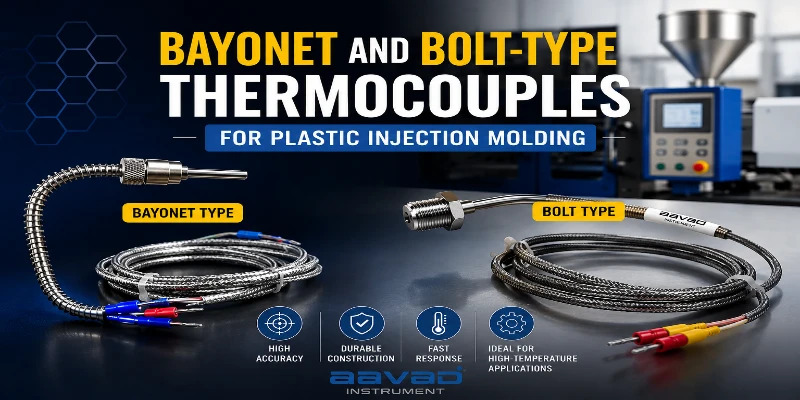
Designing Custom Bayonet and Bolt-Type Thermocouples for Plastic Injection Molding Machinery
Injection molding machinery doesn’t give a thermocouple much room to work with. Sensors need to sit flush against a curved barrel surface, survive constant vibration, and be swapped out in seconds during a production changeover — all while delivering an accurate reading from a point that’s often awkward to access. This is exactly the engineering problem that bayonet and bolt-type thermocouples were designed to solve. This guide covers how each style works, where they fit on injection molding machinery, and what to specify when designing a custom version for your equipment.
Why Standard Thermocouples Don’t Fit Injection Molding Machinery Well
A typical head-type or wire-type thermocouple, built for thermowell mounting on a process vessel, doesn’t translate well to injection molding equipment because:
- Barrel and nozzle surfaces are curved and space-constrained, leaving little room for a bulky connection head
- Machine vibration during operation can loosen standard threaded fittings over time
- Frequent maintenance access is often needed, requiring sensors that can be removed and reinstalled quickly without disturbing surrounding components
- Multiple heating zones (often 3–12+ per machine) make cost-per-point and ease of replacement important factors
Bayonet and bolt-type thermocouples directly address these constraints through their mounting design.
Bayonet Type Thermocouples: Design and Application
A bayonet thermocouple uses a spring-loaded mounting mechanism that pushes the sensing tip firmly against the process surface (typically a barrel or die wall) while a twist-lock bayonet cap secures it in place — similar in concept to a bayonet camera lens mount.
Key Design Features
- Spring-loaded tip maintains constant, positive contact pressure against the measurement surface, compensating for thermal expansion and minor surface irregularities
- Bayonet cap mounting (commonly single-pin or double-pin locking) allows quick installation and removal without tools
- Adjustable spring length accommodates varying barrel wall thicknesses and recess depths
- Compact tip diameter fits into standard machine-drilled sensor wells without requiring custom machining
Why Bayonet Design Suits Injection Molding
- Constant contact pressure ensures accurate surface temperature readings even as the machine heats, cools, and thermally expands during operation
- Fast sensor swaps during maintenance or changeovers — a technician can replace a bayonet sensor in seconds with a simple twist-and-pull motion
- Vibration resistance — the spring-loaded mechanism keeps the tip seated even under continuous machine vibration
- High-vibration environment suitability makes this the standard choice for barrel zone, die, and nozzle temperature monitoring on injection molding and extrusion equipment
Bolt Type Thermocouples: Design and Application
A bolt type (or “melt bolt”) thermocouple takes a different approach — the sensor is built into a threaded bolt body that screws directly into a tapped hole in the machine component being measured.
Key Design Features
- Threaded bolt connection (commonly M8 or similar) screws directly into the machine body
- Direct surface contact through the bolt’s contact face increases speed of response and measurement sensitivity compared to an air-gapped or indirect mounting
- Compact, low-profile design suited to tight mounting locations like extruder nozzles, motor housings, and pipe sections
- Simplex configuration for straightforward single-point measurement
Why Bolt-Type Design Suits Injection Molding
- Fast thermal response — direct contact through the threaded body improves response time versus sensors with an air gap or indirect contact path
- Compact footprint fits mounting locations where a bayonet’s spring mechanism or a head-type sensor’s bulk wouldn’t fit
- Suited to specific point measurements — extruder nozzle tips, drive motor housings, and pipe sections where a simple, direct-contact reading is needed
Bayonet vs Bolt Type: Side-by-Side Comparison
| Parameter | Bayonet Type | Bolt Type |
|---|---|---|
| Mounting mechanism | Spring-loaded with twist-lock bayonet cap | Threaded bolt screws directly into component |
| Contact method | Spring-pressed tip against surface | Direct threaded contact |
| Best for | Barrel zones, dies, surfaces needing constant contact pressure | Nozzles, motor housings, pipes — fixed-point direct contact |
| Replacement speed | Very fast (twist and pull) | Fast (unscrew and replace) |
| Vibration tolerance | Excellent (spring compensates for movement) | Good (rigid threaded mount) |
| Typical thermocouple type | K, J, T | J (commonly) |
Designing a Custom Bayonet or Bolt Thermocouple: Key Specifications
- Confirm your machine’s sensor well or tapped hole dimensions — tip OD, tip length, and thread size must match exactly for proper fit and contact.
- Select the correct thermocouple type based on your process temperature range — K type for higher-range barrel zones (0–600°C), J type for lower-range or general-purpose applications (0–400°C for bayonet, 0–250°C for bolt type).
- Specify spring length (bayonet) or thread engagement (bolt) to match your specific component’s depth and wall thickness.
- Choose bayonet cap locking style — single-pin or double-pin — to match your machine’s existing sensor mounting standard.
- Confirm cable length and insulation type — fiberglass-insulated, stainless steel-armored cable is standard for the high-heat, abrasive environment around extruder barrels.
- Decide on cable termination — connector, lead wire, or terminal block — based on how the sensor will integrate with your machine’s control wiring.
Common Applications on Injection Molding & Extrusion Machinery
| Location | Recommended Type |
|---|---|
| Barrel heating zones | Bayonet (spring-loaded, vibration-resistant) |
| Die and nozzle tips | Bayonet or Bolt, depending on mounting access |
| Extruder nozzle direct contact points | Bolt type |
| Drive motor housings | Bolt type |
| Hot runner manifolds | Bayonet (custom spring length for manifold depth) |
| Pipe and transfer line sections | Bolt type |
Aavad Instrument’s Bayonet & Bolt Thermocouple Range
Aavad Instrument Pvt. Ltd., based in Ahmedabad, Gujarat, manufactures both styles for plastic processing OEM and end-user applications:
- Bayonet Type Thermocouple (Model AJES-B) — Type J, 5mm tip OD, 40mm tip length, 100mm spring length, 14mm double-cut adapter, 0°C to 400°C range, fiberglass/fiberglass/SS-insulated 1-meter cable. Used across plastic extrusion and injection molding machinery, packaging and thermoforming equipment, automotive component manufacturing, and high-vibration industrial heating processes.
- Bolt Type Thermocouple (Model AJES) — Type J, simplex configuration, 0°C to +250°C range, SS 316 construction, compacted MgO insulation, M8 bolt sensor connection, 3-meter fiberglass-insulated cable. Suited to extruder nozzle, motor, and pipe temperature measurement.
Both styles are available in custom dimensions through Aavad’s Build Your Products service, where tip size, spring length, thread type, and cable specification can be engineered to match your exact machine design. Manufactured under an ISO 9001:2015 quality system with NABL-accredited calibration support, with deployments across plastic, rubber, and OEM machinery clients including Sintex.
Frequently Asked Questions
Q1. Which is better for injection molding — bayonet or bolt type? It depends on the mounting location. Bayonet thermocouples suit barrel zones and surfaces where constant spring-pressed contact is needed despite vibration and thermal expansion. Bolt type thermocouples suit fixed-point locations like nozzle tips, motor housings, and pipes where a simple direct-threaded contact is sufficient.
Q2. Can these thermocouples be customized for my specific machine? Yes — tip diameter, tip length, spring length, thread size, and cable specification can all be custom-engineered to match your exact machine’s sensor well or tapped hole dimensions.
Q3. How often do bayonet thermocouples need to be replaced on injection molding machinery? This depends on usage intensity, temperature exposure, and vibration levels, but the bayonet design’s quick-release mounting is specifically intended to make routine replacement fast and straightforward when needed.
Q4. What temperature range do these thermocouples typically cover? Aavad’s standard bayonet thermocouple (Type J) covers 0°C to 400°C, while the bolt type covers 0°C to +250°C — confirm your specific barrel, nozzle, or component’s actual operating temperature falls comfortably within the chosen sensor’s rated range.
Q5. Why is direct contact important for bolt-type thermocouples? Bolt sensors are generally screwed directly into the surface being measured, which increases the speed of response and sensitivity of the measurement compared to sensors with an indirect or air-gapped contact path — important for fast-cycling processes like injection molding.
Get a Custom Bayonet or Bolt Thermocouple for Your Machine
Aavad Instrument’s engineering team can design a bayonet or bolt-type thermocouple matched to your exact injection molding or extrusion machinery dimensions. Request a quote or view the Bayonet Type Thermocouple and Bolt Type Thermocouple product pages for complete specifications.