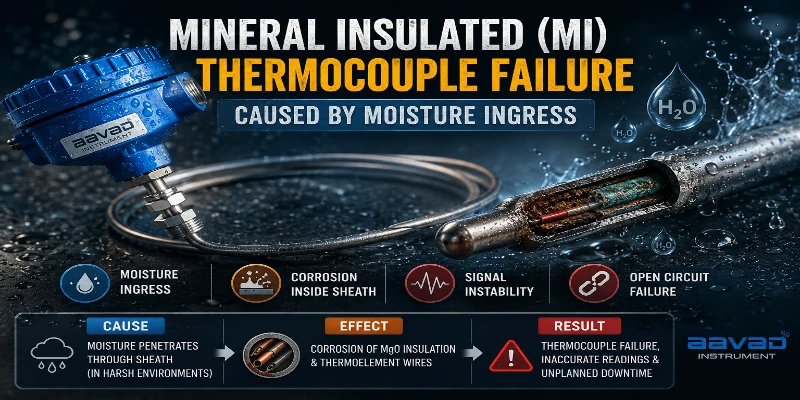
Troubleshooting Mineral Insulated (MI) Thermocouple Failure Caused by Moisture Ingress
Mineral Insulated (MI) thermocouples earn their reputation for durability honestly — a metal sheath packed with compacted magnesium oxide insulation around the sensing wires makes them resistant to vibration, mechanical stress, and high temperatures. But that same construction has one well-known vulnerability: moisture ingress. Once water finds its way past a compromised seal, the highly hygroscopic MgO insulation inside starts absorbing it, and the sensor’s performance can degrade in ways that are easy to misdiagnose as something else entirely. This guide walks through how to recognize, troubleshoot, and prevent MI thermocouple failure caused by moisture ingress.
What Is an MI Thermocouple, and Why Is Moisture a Specific Risk?
A Mineral Insulated (MI) thermocouple consists of thermocouple wires running through a metal sheath, with the space between the wires and sheath packed with compacted magnesium oxide (MgO) powder. This construction gives MI thermocouples excellent resistance to vibration, shock, and mechanical stress, along with the ability to be bent and formed into custom shapes.
The vulnerability: magnesium oxide is highly hygroscopic — it readily absorbs moisture if it has any path to reach it. Once moisture penetrates the sheath (through a damaged seal, a cracked weld, or a compromised termination), the MgO’s insulation properties degrade rapidly, since water dramatically lowers the insulation resistance between the thermocouple wires and the sheath.
Symptoms of Moisture-Related MI Thermocouple Failure
- Erratic or unstable temperature readings that don’t correlate with actual process conditions
- Reading drift over time, often worsening gradually as moisture continues to penetrate
- Sudden failure after washdown, rain exposure, or humid storage conditions
- Low insulation resistance when tested with a megohmmeter (a key diagnostic indicator — see below)
- Intermittent open-circuit or short-circuit behavior, especially in cold or damp conditions where condensation may form internally
- Failure correlating with a specific event — a leaking process seal, a damaged cable entry, or a previous repair that wasn’t properly resealed
How to Diagnose Moisture Ingress in an MI Thermocouple
1. Insulation Resistance Testing
This is the primary diagnostic tool. Using a megohmmeter, measure the insulation resistance between the thermocouple conductors and the outer sheath. A healthy MI thermocouple typically shows insulation resistance in the hundreds of megohms to gigohms range (consult your specific sensor’s datasheet for the exact acceptance threshold). A significantly reduced reading — dropping into the low megohm or even kilohm range — is a strong indicator of moisture contamination inside the MgO insulation.
2. Visual Inspection of Seals and Terminations
Check the connection head, cable entry gland, and any weld or seal points along the sheath for visible damage, cracks, or signs of past water ingress (corrosion staining, residue). Pay particular attention to:
- The transition point where the MI cable enters the connection head
- Any field-repaired or re-terminated sections
- Bent sections of the sheath, where repeated flexing can eventually crack the metal
3. Check Installation History and Environmental Exposure
Correlate the failure timing with any relevant events — a recent washdown cycle, exposure to rain or flooding, condensation in a cold storage application, or a prior repair/modification to the sensor.
4. Compare Against a Known-Good Reference Sensor
If available, compare insulation resistance and output readings against a new or known-good MI thermocouple of the same type and construction to confirm the suspected unit is genuinely degraded rather than reflecting a normal characteristic of that sensor design.
Common Entry Points for Moisture Ingress
| Entry Point | Why It’s Vulnerable |
|---|---|
| Cable entry gland / connection head seal | Gaskets and seals degrade over time, especially with repeated thermal cycling |
| End seal at the sensing tip | Manufacturing or field-repair seal failure allows moisture to wick into the MgO core |
| Weld points along the sheath | Microscopic weld defects can develop into moisture entry paths over time |
| Bent or flexed sections | Repeated bending can crack the sheath, especially on sensors not designed for that bend radius |
| Damaged sheath from mechanical impact | Dents, scrapes, or punctures compromise the sheath’s protective barrier |
How to Prevent Moisture Ingress in MI Thermocouples
1. Specify the Correct Protection Rating for Your Environment
Connection heads rated IP-67 or higher are appropriate for washdown, outdoor, or high-humidity environments. Confirm the rating matches your actual installation conditions, not just the general application category.
2. Avoid Exceeding the Sheath’s Rated Bend Radius
Mineral insulated thermocouples can be bent and formed, but exceeding the manufacturer’s specified minimum bend radius risks cracking the sheath and compromising its seal integrity.
3. Inspect Seals During Routine Maintenance
Include a visual inspection of cable entry seals, connection heads, and any visible sheath damage as part of routine preventive maintenance — catching a compromised seal before significant moisture ingress occurs can save the sensor.
4. Avoid Field Modifications Without Proper Resealing
If a sensor must be cut, re-terminated, or modified in the field, ensure the new termination point is properly resealed to manufacturer specifications — improvised repairs are a common source of subsequent moisture failures.
5. Store Spare Sensors Properly
Spare MI thermocouples should be stored in a dry environment with end caps or seals intact, since even an unused sensor’s exposed end can absorb ambient moisture if left uncapped for extended periods.
6. Use Insulated (Ungrounded) Junction Construction Where Appropriate
An insulated junction design — where the thermocouple junction doesn’t directly contact the sheath — provides an additional layer of electrical isolation and can reduce the impact of minor moisture presence compared to a grounded junction design, depending on the application.
When to Replace vs. Repair
In most cases, moisture-contaminated MI thermocouples should be replaced rather than repaired. Once the MgO insulation has absorbed significant moisture, drying it out in the field rarely restores full insulation resistance reliably, and the sensor’s long-term accuracy and safety margin remain compromised. Replacement with a correctly sealed, properly rated sensor is the more reliable path for process-critical applications.
Aavad Instrument’s MI Thermocouple Range
Aavad Instrument Pvt. Ltd., based in Ahmedabad, Gujarat, manufactures Mineral Insulated thermocouples engineered for durable, moisture-resistant industrial service:
- Industrial MI Thermocouple — featuring a 3/4″ cable entry connection, double cable entry option, and nickel-plated ceramic terminal block for reliable, low-noise connections, with a 6mm sheath OD.
- Mineral insulated construction throughout, featuring high-purity MgO insulation for excellent electrical isolation, protection against corrosion and contamination, and superior resistance to vibration, shock, and mechanical stress.
Manufactured under an ISO 9001:2015 quality system with calibration support from Aavad’s in-house NABL-accredited laboratory, these thermocouples are part of the broader Head Type Thermocouple Manufacturer range, with deployments across high-vibration and harsh-environment industrial clients including BHEL and ONGC.
Frequently Asked Questions
Q1. What insulation resistance value indicates moisture contamination in an MI thermocouple? A healthy MI thermocouple typically shows insulation resistance in the hundreds of megohms to gigohms range. A significant drop from this baseline — particularly into the low megohm or kilohm range — strongly suggests moisture has compromised the MgO insulation. Always check your specific sensor’s datasheet for its exact acceptance threshold.
Q2. Can a moisture-damaged MI thermocouple be dried out and reused? In most cases, no — once moisture has penetrated and been absorbed by the hygroscopic MgO insulation, reliably restoring full insulation resistance in the field is difficult. Replacement is generally the more reliable solution for process-critical applications.
Q3. Why is MgO insulation prone to moisture absorption in the first place? Magnesium oxide is highly hygroscopic by nature, meaning it readily absorbs moisture from any path that reaches it — which is precisely why an intact, properly sealed sheath and connection head are critical to the sensor’s long-term performance.
Q4. Does bending an MI thermocouple increase the risk of moisture ingress? Yes, if the bend exceeds the manufacturer’s specified minimum bend radius — this can crack the sheath and compromise its protective seal, creating a new entry point for moisture over time.
Q5. What protection class should I specify to prevent moisture ingress in washdown areas? IP-67-rated connection heads are generally recommended for washdown, outdoor, or high-humidity environments — confirm this matches your specific installation’s actual exposure conditions before specifying.
Get Help Diagnosing or Replacing an MI Thermocouple
Aavad Instrument’s engineering team can help you diagnose suspected moisture ingress issues and specify a properly sealed replacement sensor for your application. Request a quote or support or view the Industrial MI Thermocouple product page for complete specifications.