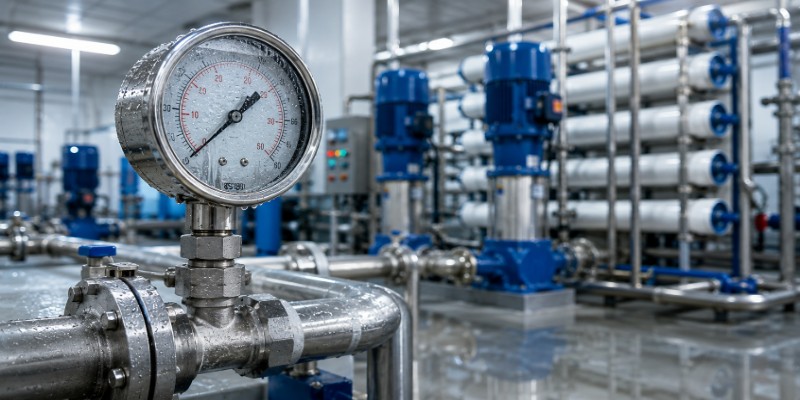
Why Liquid-Filled Gauges Are Essential for Commercial RO and Pumping Stations
Walk into the pump room of a commercial Reverse Osmosis plant or a municipal pumping station and you’ll notice something on almost every pressure tap: the gauge is liquid-filled — typically glycerine or silicone oil — rather than a standard dry-dial gauge. This isn’t just tradition or aesthetics. In high-pressure pump applications, liquid-filled gauges solve two specific problems that dry gauges fail at repeatedly: pointer vibration from pulsating pump pressure and rapid internal wear that accelerates in mechanical gauges exposed to continuous pressure cycling. This guide explains exactly why these environments demand liquid-filled gauges, and how to specify the right type.
The Two Core Problems Liquid Filling Solves
Problem 1: Pressure Pulsation and Pointer Oscillation
Pumps — centrifugal, multistage, or positive displacement alike — don’t deliver perfectly smooth pressure. Every pump cycle, every impeller rotation, generates small but rapid pressure pulses that transmit through the pipeline directly to any connected pressure gauge. In a dry-dial Bourdon tube gauge, this pulsation causes the pointer to oscillate rapidly around the true pressure value — making the gauge unreadable, accelerating wear on the Bourdon tube and pointer mechanism, and dramatically reducing service life.
Liquid filling (typically glycerine at 99.7% purity) dampens this oscillation by immersing the entire Bourdon tube and movement mechanism in a viscous fluid that resists rapid pointer movement, while still allowing the pointer to settle accurately on the true pressure reading. The result is a stable, readable display even on pulsating pump pressure lines.
Problem 2: Internal Condensation and Corrosion
In pump rooms, RO plant enclosures, and outdoor pumping stations, rapid temperature changes — especially between pump-on and pump-off cycles — create condensation inside a dry-dial gauge’s casing. Over time, this moisture causes internal corrosion of the Bourdon tube, movement mechanism, and dial, degrading accuracy and eventually causing failure.
The liquid fill in a glycerine or silicone-filled gauge displaces air inside the casing, eliminating the space where condensation would otherwise form and protecting internal components from moisture-related corrosion.
Why RO Plants Specifically Need Liquid-Filled Gauges
Commercial RO and water treatment plants present conditions that make these two problems particularly acute:
- High operating pressures — commercial RO membranes typically operate at anywhere from 10 to 70+ bar depending on feed water salinity and system design, meaning Bourdon tubes are under significant continuous stress
- Frequent pump cycling — pre-treatment pump controls, high-pressure pump starts and stops, and backwash cycles create regular and rapid pressure transitions
- Multiple measurement points — RO systems typically need pressure measurement at feed inlet, post-pre-treatment, high-pressure pump outlet, membrane inlet and outlet, and permeate/reject lines, meaning multiple gauges per system
- Continuous 24/7 operation — a commercial RO plant running continuously needs gauges that don’t need frequent replacement from accelerated pulsation wear
Vacuum Gauges in Pumping Station Applications
Beyond pressure gauges on the discharge side, pumping stations also frequently need vacuum gauges on suction lines — particularly for centrifugal pumps and self-priming pump systems where suction vacuum monitoring helps:
- Detect suction line blockage or insufficient NPSH (Net Positive Suction Head) conditions
- Monitor filter condition upstream of the pump (rising vacuum across a strainer indicates clogging)
- Confirm pump priming in self-priming configurations
Liquid-filled vacuum gauges offer the same pulsation-damping and condensation-protection advantages on suction measurement points as glycerine-filled pressure gauges do on discharge lines.
Sanitary vs Industrial Liquid-Filled Gauges: When Each Is Appropriate
| Application | Gauge Type | Why |
|---|---|---|
| Pharma, food, dairy RO systems | Sanitary pressure gauge | Stainless steel, crevice-free connection design meets hygienic requirements |
| Commercial water treatment RO | Industrial liquid-filled gauge | Standard connection, various pressure ranges, cost-effective |
| Municipal pumping stations | Industrial pressure or vacuum gauge | Robust construction for outdoor, continuous-duty installation |
| Chemical dosing lines (pre-RO treatment) | Sanitary or chemical-compatible liquid-filled gauge | Confirm wetted-part material compatibility with dosing chemicals |
Glycerine vs Silicone Fill: Which to Choose
| Fill Fluid | Best Suited For | Limitation |
|---|---|---|
| Glycerine (99.7%) | Most standard RO and pumping station applications | Not suitable where process temperatures consistently exceed ~60°C, since glycerine viscosity changes significantly with temperature |
| Silicone oil | High-temperature applications or where wider temperature range performance is needed | Higher cost than glycerine; confirm compatibility with any potential gauge failure exposure to your process |
For most commercial RO and standard industrial pumping station applications, glycerine fill is the practical standard.
Specification Checklist for RO Plant and Pumping Station Gauges
- Confirm your pressure range — select a gauge rated at roughly 1.5–2× your normal operating pressure to ensure the Bourdon tube operates in its accurate mid-range and isn’t stressed near its limit under normal conditions
- Specify liquid fill type — glycerine standard for most RO/pumping applications; silicone for elevated temperature environments
- Confirm wetted material compatibility — stainless steel Bourdon tube and socket for water service; confirm for any chemical dosing lines
- Choose connection type — bottom entry (most common for panel-mounted gauges) or back entry (for flush/panel mounting); confirm thread standard (BSP or NPT) to match existing taps
- Confirm dial size — larger dials (100mm, 160mm) are preferred for visibility in pump rooms; smaller (63mm) for space-constrained panel mounting
- Specify sanitary connection type if your application involves food, pharma, or dairy process water rather than standard industrial water
- Confirm IP/weather rating for outdoor pumping station installations exposed to rain or dust
Aavad Instrument’s Pressure and Vacuum Gauge Range
Aavad Instrument Pvt. Ltd., based in Ahmedabad, Gujarat, manufactures a comprehensive pressure gauge range suited to RO plant and pumping station applications:
- Sanitary Pressure Gauge — stainless steel construction specifically designed to meet demanding sanitary requirements for food, dairy, beverage, pharmaceutical, and biotech applications, exceeding the demanding safety requirements of hygienic process environments. Suitable for pharma and food-industry RO and process water systems.
- Industrial Vacuum Gauge — for suction line vacuum monitoring on pumping station centrifugal and self-priming pump installations.
- Full Pressure Gauge Manufacturer category including Industrial Pressure Gauge, Commercial Pressure Gauge, Safety Pressure Gauge, Diaphragm Seal Pressure Gauge, Compact Seal Pressure Gauge, Flush Diaphragm Pressure Gauge, Electric Contact Pressure Gauge, and Master Pressure Gauge variants.
All gauges are manufactured under an ISO 9001:2015 quality system and calibrated through Aavad’s in-house NABL-accredited laboratory.
Note on liquid-fill specification: Aavad manufactures gauges across multiple types and configurations — confirm your specific fill fluid requirement (glycerine or silicone), pressure range, connection type, and dial size directly with Aavad’s team when placing your order, as these specifications affect which catalogue configuration is right for your application.
Frequently Asked Questions
Q1. Can I use a standard dry-dial pressure gauge on an RO plant high-pressure pump line? Not recommended for continuous use — pulsating pump pressure causes rapid pointer oscillation in dry-dial gauges, making them unreadable and accelerating internal wear. Liquid-filled gauges are the standard and correct choice for pump applications with pulsating pressure.
Q2. What is the typical fill fluid in a liquid-filled pressure gauge for water treatment? Glycerine (99.7% purity) is the most commonly used fill fluid for standard water treatment and RO plant applications, offering good viscosity for pulsation damping at typical operating temperatures.
Q3. When should I use a silicone oil fill instead of glycerine? Where process temperatures regularly exceed approximately 60°C, or where a wider temperature operating range is needed, silicone oil fill is generally preferred over glycerine, since glycerine’s viscosity changes significantly at elevated temperatures.
Q4. What does a rising vacuum reading on a suction line gauge indicate? Rising vacuum on a pump suction line typically indicates increasing restriction upstream — either a partially blocked suction strainer/filter, developing blockage in the suction pipe, or insufficient available flow from the source. It’s an important early-warning signal for preventing pump cavitation or dry-running damage.
Q5. Do sanitary pressure gauges need different connections than standard industrial gauges? Yes — sanitary gauges typically use hygienic process connections (such as Tri-Clover/Tri-Clamp or other sanitary fitting standards) rather than standard BSP/NPT threads, to meet the crevice-free connection requirements of food, dairy, and pharmaceutical process environments. Confirm your existing piping connection standard before ordering.
Get the Right Pressure Gauge for Your RO Plant or Pumping Station
Aavad Instrument’s engineering team can help you specify the correct pressure range, fill fluid, connection type, and material for your RO or pumping station application. Request a quote or explore the full Pressure Gauge Manufacturer category for complete specifications.