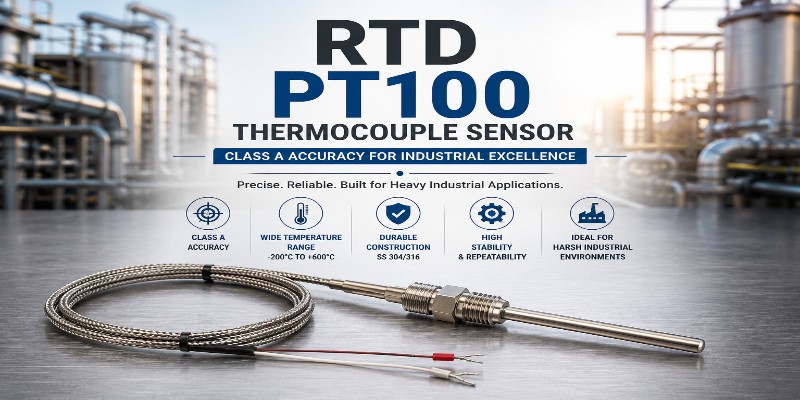
RTD PT100 Thermocouple Sensor: Why Class A Accuracy and 3-Wire Construction Matter for Chemical, Pharma & Oil/Gas Industries
You’ll see “PT100” listed on thousands of RTD sensor product pages across India, but the difference between a PT100 that consistently delivers traceable, audit-ready temperature data and one that drifts within six months often comes down to two specifications most buyers overlook: accuracy class and wiring configuration. This guide explains exactly what the Aavad APES-6×80 RTD PT100 thermocouple sensor delivers, why these two specifications determine real-world measurement quality, and which industries depend on them most.
What Is an RTD PT100 Thermocouple Sensor?
First, the terminology: “RTD PT100 thermocouple sensor” refers to a PT100 Resistance Temperature Detector (RTD) built in a compact, wire-terminated construction — similar in form factor to a thermocouple (hence the combined name on many manufacturer pages), but using a platinum resistance sensing element rather than a bimetallic junction.
A PT100 measures temperature through a precisely predictable change in electrical resistance. At 0°C, the platinum element measures 100 Ohms exactly. At 100°C, it measures 138.5 Ohms. This resistance–temperature relationship is defined and standardized by IEC 60751, which is why a PT100 from any quality manufacturer works with any properly calibrated industrial temperature controller or transmitter without custom configuration.
Full Specifications: Aavad APES-6×80 RTD PT100 Thermocouple Sensor
| Parameter | Specification | Practical Implication |
|---|---|---|
| Type | PT-100 | Standardized; works with any IEC 60751-compatible controller |
| Model | APES-6×80 | Aavad’s wire-type industrial RTD for direct process installation |
| Configuration | Simplex, 3-Wire | Single sensing element with lead-resistance compensation |
| Accuracy | Class A | ±(0.15 + 0.002 |
| Temperature range | -50°C to 400°C | Covers the full span of most chemical, pharma, food & HVAC applications |
| Material of construction | SS 316 | Corrosion-resistant; suitable for acids, alkalis, washdown |
| Insulation | Compacted MgO | Stable electrical isolation under continuous thermal cycling |
| Process connection | BSP 1/2″ (M) adjustable fitting | Standard industrial; adjustable for correct insertion depth |
| Cable length | 2 Meters (Teflon/Teflon/SS) | Teflon cable for chemical and heat resistance; SS braid for mechanical protection |
| Tip length | 75 mm | Active sensing region; confirm against your thermowell/installation depth |
| Sensor OD | 6 mm | Standard; fits most industrial thermowells and direct-insertion fittings |
Why “Class A” Matters and How It Compares to Class B
The IEC 60751 standard defines two main tolerance classes for industrial PT100 sensors:
- Class A: Tolerance = ±(0.15 + 0.002 × |t|) °C
- Class B: Tolerance = ±(0.30 + 0.005 × |t|) °C
At 100°C: Class A = ±0.35°C | Class B = ±0.80°C At 200°C: Class A = ±0.55°C | Class B = ±1.30°C
The implication is concrete: at a process setpoint of 200°C, a Class B sensor could be reading up to 1.3°C off from true temperature — which your controller treats as real, adjusting heaters or cooling systems to compensate for a sensor error rather than an actual process deviation. Over thousands of operating hours and batches, this systematic offset accumulates as wasted energy, batch inconsistency, or missed quality limits. Class A eliminates most of this error budget before it reaches the control system.
Why 3-Wire Configuration Is the Correct Default for Industrial Applications
A PT100 sensor works by measuring electrical resistance, which means anything with resistance in the measurement circuit — including the copper lead wires themselves — adds to the measured value. In a 2-wire configuration, both lead wires are in series with the sensing element, and the controller can’t distinguish their resistance from the element’s resistance. This produces a small but systematic temperature offset that grows with cable length.
A 3-wire configuration routes a third wire back to the measuring instrument on the opposite terminal, allowing the instrument to measure and subtract the lead wire resistance from the total measurement. For a 2-meter cable this offset might be small and correctable; for longer runs in plant cabling, or where measurement accuracy across the full -50°C to 400°C range matters, 3-wire provides a more defensible and accurate result with no correction or assumption required.
Recommendation: Default to 3-wire (as in the APES-6×80) for all standard industrial process control applications. Use 2-wire only where cable runs are very short and the lead resistance offset has been explicitly quantified and accepted. Use 4-wire only for laboratory-standard or calibration-reference accuracy requirements.
Critical Applications That Depend on Class A 3-Wire PT100 Accuracy
Chemical Reactors and Batch Processes
Exothermic reactions require tight bulk temperature monitoring to detect early-stage runaway conditions. A Class A sensor provides the tight baseline accuracy needed to distinguish a genuine 0.5°C rise from normal sensor variance — which can be the difference between a routine adjustment and a developing emergency that’s caught too late.
Oil and Gas Refinery Operations
Crude processing, distillation, and separation processes run specific cut points that depend on accurate temperature measurement throughout the column. Measurement error here doesn’t just affect quality — it affects yield and energy consumption across the entire unit.
Pharmaceutical Manufacturing (GMP Validation)
CDSCO-regulated pharmaceutical manufacturing requires documented, validated temperature measurements at critical control points. Class A accuracy and NABL-accredited calibration are specifically the data quality standard that supports GMP validation documentation and auditor scrutiny.
Laboratory Testing and Calibration Environments
Research labs, QC testing environments, and instrument calibration setups need sensors whose accuracy is both known and traceable. A Class A PT100 with NABL calibration certificate provides exactly that — a measurement whose uncertainty budget is documented and defensible.
HVAC and Building Automation Systems
Modern building management systems with tight energy optimization targets depend on accurate temperature data from zone sensors to avoid over-heating or over-cooling in response to sensor bias rather than real building conditions.
Machinery, Motors, and Bearing Temperature Monitoring
As covered in our ball mill RTD guide, bearing monitoring derives its value from detecting small deviations from a stable baseline. A Class A sensor’s tighter tolerance provides a more reliable basis for trending and alarm threshold setting than Class B.
The Teflon/Teflon/SS Cable: Why Material Matters
The APES-6×80’s cable uses Teflon (PTFE) insulation on both inner and outer conductors, with a stainless steel braid for mechanical protection. This combination matters for:
- Chemical resistance: PTFE is chemically inert against virtually all industrial solvents, acids, and alkalis that might contact a cable routed through a process area
- Heat resistance: PTFE insulation handles continuous cable surface temperatures significantly above what PVC insulation would survive near hot piping or equipment
- Mechanical protection: The SS braid provides abrasion resistance for cables routed in conduit or near moving equipment
PVC-insulated cables — the default on many budget RTD sensors — degrade in chemical contact and soften at relatively low temperatures, leading to insulation failure, moisture ingress, and eventual measurement error or short-circuit failure.
Aavad’s RTD PT100 Thermocouple Sensor in Context: Related Products
The APES-6×80 is one sensor in a coordinated family. Related products include:
- Aavad Temperature Sensor (APED-6×30) — 2-wire, 30mm active length, for compact direct-insertion applications
- Industrial Temperature Probe (APES-6×300) — same PT100/Class A platform but with 300mm insertion length and 5-meter cable for deeper vessel and pipeline installations
- Flameproof RTD Sensors — same Class A element in a flameproof, IP-67 connection head for hazardous area installations
- Triclover RTD Sensor — sanitary connection variant for food, dairy, and pharmaceutical CIP systems
Manufacturer Profile: Why Aavad Is the #1 RTD Sensor Manufacturer Choice
Aavad Instrument Pvt. Ltd., Chandkheda, Ahmedabad, Gujarat:
- ISO 9001:2015 certified manufacturing facility
- In-house NABL-accredited calibration lab — calibration certificate included, traceable to national standards
- 15+ years of manufacturing experience across temperature, flow, and pressure instrumentation
- 38M+ successful installations | 2,900+ customers | 12+ countries
- Trusted by: BHEL, ONGC, HAL, BARC, NALCO, Indian Railways, Indian Oil, Bharat Petroleum, NPCIL, L&T, Torrent Pharma, Piramal Glass, Aditya Birla Group, Atul Ltd., Sintex, PepsiCo, Kohler, Saint-Gobain, Cera, MIDHANI, RVUN
- Custom configurations available through Build Your Products
Frequently Asked Questions
Q1. What does PT100 mean, and why is 100 Ohms significant? PT100 stands for Platinum (Pt) with 100 Ohms resistance at 0°C. The fixed, standardized starting resistance means your PT100 sensor from any calibrated manufacturer produces the same resistance at the same temperature, making it directly interchangeable with any IEC 60751-compatible temperature controller or transmitter.
Q2. Why is there a thermocouple sensor mentioned in the name “RTD PT100 thermocouple sensor”? This product uses a PT100 RTD sensing element, not a thermocouple junction. The “thermocouple sensor” in the name refers to its physical construction style — a compact, wire-terminated probe similar in form to a thermocouple — not to its sensing technology. The measurement principle is RTD (resistance), not thermocouple (millivolt).
Q3. How long does the 2-meter cable run work before 3-wire compensation becomes necessary? There’s no absolute cutoff — it depends on the cable’s specific resistance per meter and your accuracy requirement. As a practical guide, if measurement accuracy across the full temperature range matters (not just near a fixed setpoint), or if your cable run is longer than approximately 2–3 meters, specify 3-wire rather than 2-wire to eliminate the lead-resistance offset cleanly.
Q4. What is the BSP 1/2″ adjustable fitting, and how does it work? BSP (British Standard Pipe) is a standard industrial thread type. The “adjustable fitting” allows you to set the correct insertion depth of the sensor by tightening a compression gland at any desired depth along the sensor’s sheath, rather than being fixed at a single depth — useful when your specific installation requires a non-standard insertion length to reach the process centre.
Q5. Does this sensor work with my existing PLC or temperature controller? Any controller or transmitter compatible with PT100 (IEC 60751) 3-wire input will work with the APES-6×80 directly. This includes virtually all major Indian and international brands of temperature controllers and transmitters. Confirm your controller’s input type configuration before connecting.
Q6. Can I get this sensor with a longer or shorter cable than 2 meters? Yes — custom cable lengths are available through Aavad’s Build Your Products service. Specify your required length, cable type, and any other custom requirements when requesting a quote.
Request a Quote for the Aavad RTD PT100 Thermocouple Sensor
View the product page for the downloadable datasheet (APES-6×75) and 2D drawing, or contact Aavad Instrument to discuss your specific application requirements and get a price.
📞 +91 90996 22823 | ✉ hrg@aavadinstrument.com | ISO 9001:2015 | NABL Accredited | Ahmedabad, Gujarat