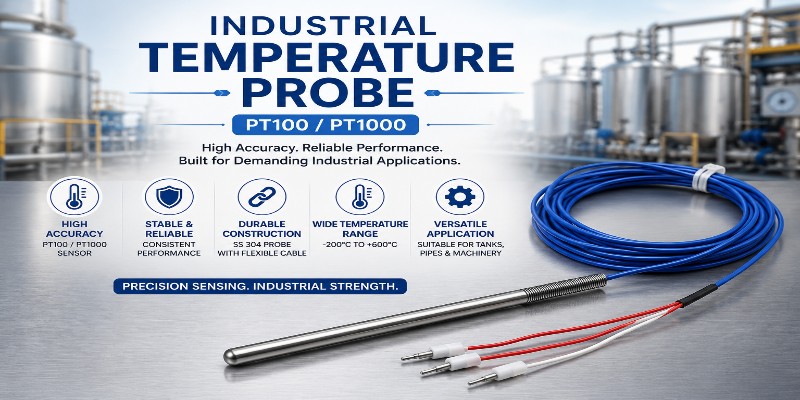
Industrial Temperature Probe: Complete Selection Guide for Tanks, Vessels, Pipelines & Process Automation
When your process involves a large vessel, a deep storage tank, or a long pipeline immersion point, a short-body direct-insertion sensor often doesn’t physically reach the process. You need a temperature probe — a longer, robust sensing rod that reaches the true process centre, away from wall effects, stratification zones, and thermal boundary layers that would distort a surface or shallow reading. This guide covers everything that determines whether an industrial temperature probe performs the way your process needs it to, with full specifications drawn from Aavad Instrument’s APES-6×300 industrial probe.
What Separates an Industrial Temperature Probe from a Standard RTD Sensor
The distinction is more than just length. A standard wire-type RTD sensor might be 30–80mm below its connection point — fine for pipes and compact direct-insertion points. An industrial temperature probe is engineered for:
- Greater insertion depth (commonly 150mm to 500mm+) to reach process centre in vessels, large tanks, or deep pipeline tappings
- Mechanical strength along the full probe length to resist flow-induced vibration and bending stress without deflecting out of position
- Consistent measurement along the active zone to represent the true bulk process temperature rather than a near-wall value
- Process compatibility across the full wetted length, since the entire probe is in contact with the process medium, not just the tip
Full Specifications: Aavad APES-6×300 Industrial Temperature Probe
| Parameter | Specification | What It Means |
|---|---|---|
| Type | PT-100 / PT-1000 | Available in both sensing standards — confirm which your controller requires |
| Model | APES-6×300 | Aavad industrial probe: 300mm active sensing length |
| Configuration | Simplex, 3-Wire | Single element with lead-resistance compensation for accurate readings |
| Accuracy | Class A / Class B | Class A (±0.15°C at 0°C) for precision; Class B (±0.3°C at 0°C) for general monitoring |
| Temperature range | -50°C to 400°C | Covers chemical, food, pharma, HVAC, water treatment, and most process industries |
| Sheath material | SS 316 | Corrosion-resistant for acids, alkalis, and process chemicals |
| Insulation | Compacted MgO | Stable electrical isolation under continuous thermal cycling |
| Cable length | 5 Meter | Extended run for deep-in-plant installations; custom lengths available |
| Cable colour code | Blue | Colour-coded for field identification |
| Cable insulation | Teflon/Teflon | Chemical and heat-resistant cable jacket |
| OD | 6 mm | Standard; compatible with most industrial thermowell and compression fitting designs |
| Length below spring | 300 mm | Active probe length below the process connection — the measurement zone |
PT100 vs PT1000: Choosing the Right Sensing Standard for Your Application
Both PT100 and PT1000 are platinum RTDs using the same physical sensing principle — the number refers to the nominal resistance at 0°C (100 Ohms for PT100; 1,000 Ohms for PT1000). The choice matters for your signal chain:
| Factor | PT100 | PT1000 |
|---|---|---|
| Industry standard | By far the most common; supported by virtually all industrial controllers in India | Less universal; confirm your specific controller supports it before specifying |
| Signal level | Lower resistance change per °C — more sensitive to lead-wire resistance in long runs | Higher resistance change — inherently less sensitive to lead-wire resistance error |
| Controller compatibility | Nearly universal in Indian industrial automation | Specify only when your controller explicitly requires PT1000 |
| Cost | Identical — same sensing technology, different resistance value |
Default recommendation: Specify PT100 unless your controller specifically calls for PT1000 and you’ve confirmed compatibility.
Class A vs Class B: Matching Accuracy to the Application Stakes
| Measurement Scenario | Recommended Accuracy Class |
|---|---|
| Critical process control: reactor bulk temperature, pharma CCP monitoring, distillation column | Class A |
| General process monitoring: tank level-only temperature cross-check, ambient monitoring | Class B |
| HVAC zone sensing, general equipment temperature | Class B may be acceptable |
| Any application subject to regulatory audit or GMP documentation | Class A |
The cost difference between Class A and Class B in a standard industrial probe is small relative to the process consequence of a measurement that’s 0.5°C–1.3°C off across the process temperature range. When in doubt, specify Class A — it’s the correct industrial default for process-critical applications.
Where a 300mm Insertion Length Probe Is the Right Choice
Large Storage Tanks and Process Vessels
A 300mm probe reaches past the thermal boundary layer near the tank wall, where the fluid temperature is influenced by ambient conditions and the tank’s own thermal mass, into the bulk process fluid — where the true process temperature is. This distinction matters particularly in chemical storage, pharmaceutical holding tanks, and food process vessels where temperature directly affects product stability, viscosity, or safety.
Industrial Pipeline Temperature Monitoring
For pipelines with larger nominal diameters (typically DN80 and above), a short sensor tip doesn’t project far enough into the pipe cross-section to measure the representative bulk flow temperature. A 300mm probe combined with an appropriate thermowell configuration positions the measurement point at or near the pipe centre, where the temperature reflects the actual bulk fluid — not a wall-influenced near-surface value.
Heat Exchangers — Inlet and Outlet Monitoring
Inlet and outlet temperature differential across a heat exchanger is the primary indicator of heat transfer performance. Accurate, repeatable inlet and outlet readings from full-insertion probes give a reliable thermal efficiency calculation — inaccurate readings from under-inserted sensors introduce systematic error into the differential that makes performance trend monitoring meaningless.
Boilers, Furnaces, and High-Temperature Process Equipment
Where the process medium fills a large enclosed space and the temperature needs to be representative of the volume being controlled, a probe with adequate insertion depth provides a more defensible measurement than a shallow sensor influenced primarily by the vessel wall or feed inlet conditions.
Pharmaceutical Vessels and Mixing Tanks
GMP requires that monitored temperatures are representative of the product being controlled — not the vessel wall or a surface-adjacent zone. A 300mm probe ensures the measurement point is positioned where it measures what it claims to measure, supporting the validation documentation that regulators review.
Water Treatment and Wastewater Plants
Biological treatment stages, chlorination systems, and sludge processing all involve large vessel or pond volumes where a short probe at a nozzle point doesn’t represent the bulk process condition. A longer probe, combined with strategic positioning, provides a more representative and useful measurement.
The 5-Meter Cable: Why Length Matters for Industrial Probe Installations
The APES-6×300 comes standard with a 5-meter Teflon/Teflon cable — a deliberate choice for deep-vessel or remote-process-point applications where the nearest panel or junction box may not be immediately adjacent to the measurement point. Key reasons this longer cable matters:
- Avoids mid-run field splices that introduce additional connection resistance and potential moisture-ingress points
- Provides routing flexibility for large equipment where the process connection and the signal cable tray may be separated by significant distance
- Teflon insulation handles chemical splash, steam, and process heat along the cable path without degrading like PVC-insulated cable
Custom cable lengths beyond 5 meters are available through Aavad’s Build Your Products service.
Thermowell Integration: When and Why to Use One with a 300mm Probe
A thermowell is a closed-end tube installed permanently in the process pipe or vessel, into which the temperature probe is inserted. The probe is not in direct contact with the process fluid — the thermowell acts as the wetted interface. Key advantages for a 300mm probe installation:
- Sensor replacement without process shutdown — withdraw the probe from the thermowell, replace, reinsert; the process remains sealed
- Additional mechanical protection for the probe against flow-induced vibration in high-velocity pipelines
- Reduced probe wear from abrasive or erosive process media
Confirm thermowell inner bore diameter is compatible with your 6mm OD probe, and that the thermowell’s installed length (U-length) is matched to your 300mm active sensing length for correct positioning. Aavad also manufactures a comprehensive Thermowell range to pair with this probe.
Installation Best Practices for Industrial Temperature Probes
- Confirm insertion depth before ordering — your probe’s active length below the process connection must place the sensing tip in the true process fluid, not in a dead zone or close to the vessel wall
- Align probe axis with flow direction in pipelines — inserting perpendicular to flow minimizes flow-induced vibration stress on the probe sheath
- Use compression fitting adjustment to set correct depth — the adjustable BSP fitting on Aavad probes allows field adjustment before final tightening
- Route cable away from heat sources and abrasion points — Teflon cable handles heat and chemical splash well, but mechanical abrasion from sharp edges or clamp-down points should still be avoided
- Confirm 3-wire connections are correctly terminated at the receiver — a 3-wire PT100 incorrectly connected as 2-wire (shorting two of the three leads together) loses the lead-resistance compensation benefit and introduces systematic error
Why Aavad Instrument Is Trusted for Industrial Temperature Probes Across India
Aavad Instrument Pvt. Ltd., based in Chandkheda, Ahmedabad, Gujarat, manufactures the Industrial Temperature Probe (APES-6×300) and a complete ecosystem of industrial temperature measurement solutions:
Manufacturing credentials:
- ISO 9001:2015 certified production facility
- In-house NABL-accredited calibration laboratory
- 15+ years of temperature instrumentation manufacturing
- 38M+ successful installations | 2,900+ customers | 12+ countries
Client roster: BHEL, ONGC, HAL, BARC, NALCO, Indian Railways, Indian Oil, Bharat Petroleum, NPCIL, L&T, Torrent Pharma, Piramal Glass, Aditya Birla Group, Atul Ltd., Sintex, PepsiCo, Kohler, Saint-Gobain, Cera, MIDHANI, RVUN
Customization available: Probe length (150mm to 1,000mm+), OD, sheath material, accuracy class (A or B), PT100 or PT1000 element, cable length, cable insulation type, and process connection standard — all configurable through Build Your Products
Related products in the same family:
- Aavad Temperature Sensor (APED-6×30) — 30mm, 2-wire for compact installations
- RTD PT100 Thermocouple Sensor (APES-6×80) — 75mm, 3-wire, BSP for standard process connections
- PT100 Sensor — NABL-approved lab
- Weld Pad RTD Sensor — surface-mounting variant
- Thrust RTD Sensor
Frequently Asked Questions
Q1. What is the difference between a temperature probe and a temperature sensor? The terms overlap in common use, but in industrial practice, “temperature probe” typically implies a longer insertion length (150mm+) designed to reach deep into vessels, tanks, or large pipelines. “Temperature sensor” is a broader term covering any device that measures temperature, including short-body direct-insertion types, surface-mount sensors, and head-type models with process connections.
Q2. Why does insertion depth matter for temperature measurement in a vessel or tank? Near the vessel wall, the measured fluid temperature is influenced by the thermal mass of the wall itself and ambient conditions outside the vessel — it may differ significantly from the true bulk process temperature at the vessel centre. A correctly inserted probe positions the sensing tip in the representative bulk fluid, not in this near-wall boundary zone.
Q3. Can I use this probe without a thermowell for direct immersion in my process? Yes — the APES-6×300 can be used for direct immersion where the process conditions (pressure, flow velocity, chemical compatibility, and temperature) are within the probe’s rated parameters. A thermowell adds mechanical protection and allows sensor replacement without a process shutdown, but isn’t mandatory for all applications.
Q4. What’s the maximum process temperature this probe can handle? The APES-6×300 is rated for -50°C to 400°C. This covers the vast majority of industrial process temperature applications. For applications above 400°C, a thermocouple-based probe with an appropriate high-temperature sheath material is typically a better choice.
Q5. Is PT1000 available in the same probe dimensions as PT100? Yes — Aavad’s APES-6×300 is available in both PT100 and PT1000 sensing elements in the same physical construction. Confirm which standard your temperature controller or transmitter requires before ordering.
Q6. How is this probe compatible with PLC/SCADA systems? A 3-wire PT100 RTD output is a standard analog input type supported by virtually all industrial PLCs, temperature transmitters, and SCADA system analog input modules. Connect the three wire leads to the PT100 input terminals as specified by your controller’s wiring diagram.
Get a Quote for the Aavad Industrial Temperature Probe
View the full product specification and 2D drawing or contact Aavad’s engineering team to discuss your vessel, pipeline, or process automation temperature probe requirements.
📞 +91 90996 22823 | ✉ hrg@aavadinstrument.com | ISO 9001:2015 | NABL Accredited | Ahmedabad, Gujarat