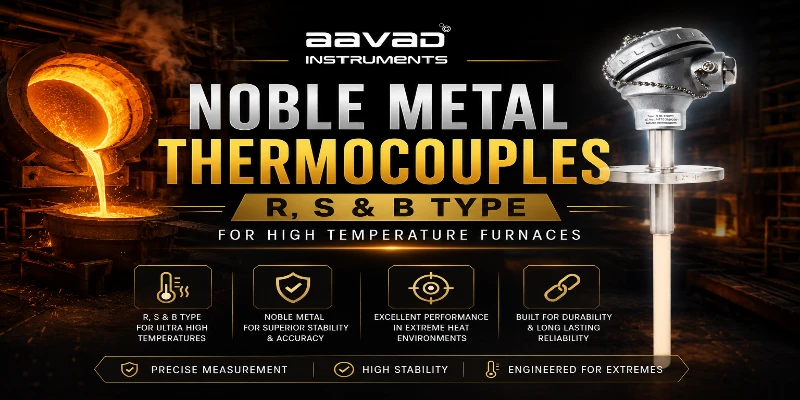
Noble Metal Thermocouples (R, S, B Type): India’s Complete Manufacturer Guide for All Industries Above 1,200°C
India’s industrial base includes some of the world’s most demanding high-temperature processes: glass melting at 1,400°C–1,600°C in the furnaces of Firozabad and Bharuch, iron smelting in blast furnaces at 1,500°C+ in Bhilai and Jamshedpur, ceramic firing at 1,200°C in Morbi’s vast tile manufacturing cluster, and materials testing at ISRO and BARC where temperatures push against the physical limits of metallic instruments. Noble metal thermocouples — built from platinum and platinum-rhodium alloys, protected by high-purity alumina ceramic tubes — are the only class of sensor that can deliver reliable, continuous temperature measurement in these environments.
This is India’s most comprehensive guide to noble metal thermocouples: what they are, why they are constructed the way they are, the full specification of Aavad’s R Type Noble Metal Thermocouple (ARIS), how R, S, and B types compare, and where they are used across every relevant Indian industry.
What Are Noble Metal Thermocouples?
Noble metal thermocouples are temperature sensors built from precious metal alloy conductors — specifically Platinum (Pt) and Platinum-Rhodium (Pt-Rh) combinations — rather than the base-metal alloys used in K, J, N, and T type thermocouples. The term “noble” refers to the exceptional chemical stability of platinum and its alloys: they resist oxidation, corrosion, and chemical attack at temperatures that destroy any base-metal alloy.
Noble metal thermocouple types manufactured per ANSI MC 96.1 / IEC 60584:
- Type R: Pt13%Rh (positive) / Pt (negative) — up to 1,450°C–1,480°C
- Type S: Pt10%Rh (positive) / Pt (negative) — up to 1,500°C–1,600°C
- Type B: Pt30%Rh (positive) / Pt6%Rh (negative) — 600°C to 1,704°C
All three types require ceramic protection tubes surrounding the sensing element — unlike base-metal thermocouples that can use metallic sheaths alone — because the noble metal wires are vulnerable to contamination from metallic vapors, silica, sulfur compounds, and other high-temperature species present in industrial furnace atmospheres.
Full Specifications: Aavad ARIS R Type Noble Metal Thermocouple
| Parameter | Specification | Engineering Significance |
|---|---|---|
| Type | R (Pt.Rh 13%/Pt) | Platinum-13% Rhodium/Platinum noble metal pair |
| Make | Aavad Instrument | ISO 9001:2015 |
| Model | ARIS | Standard R Type noble metal ceramic assembly |
| SKU | ARWS-S650 | Standard configuration model reference |
| Element | Pt. Rh (13%)/Pt | Noble metal conductors |
| Element diameter | 0.40 mm | Standard noble metal wire gauge |
| Calibration standard | ANSI MC 96.1 | International thermocouple accuracy standard |
| Configuration | Simplex | Single element, 2-wire output |
| Insulation | Twin hole ceramic Ker-710 | 99.7% alumina; electrically isolates conductors at extreme temperatures |
| Hot junction | Un-grounded | Electrically isolated from sheath — eliminates furnace ground loop interference |
| Terminal block | Ceramic with nickel-plated brass terminals | High-temperature terminal construction |
| Head | Die-cast aluminum weatherproof ANSI, Blue, threaded cover and chain | IP-67 rated |
| Protection class | IP-67 | Sealed against dust and water ingress |
| Cable entry | 1/2″ (F) NPT | Standard cable entry |
| Holding tube MOC | SS 310 | High-temperature stainless transition tube |
| Holding tube diameter | 21 mm | Outer metallic tube diameter |
| Holding tube length | 150 mm | Metallic section length |
| Ceramic tube length | 500 mm | Primary ceramic protection zone |
| No. of protection | Single protection | Outer ceramic protection tube |
| Outer ceramic diameter | 15 × 10 mm ID, Ker-710 | High-purity alumina outer ceramic tube |
| Process connection | 2″ 300#RF fixed welded flange | Heavy-duty furnace wall mounting flange |
| Total length | 650 mm | Overall assembly length |
| Range | Up to 1,450°C | R type rated operating range |
The Science of Platinum-Rhodium: Why Noble Metal Conductors Are Required Above 1,200°C
Why Base Metals Fail Above 1,200°C
Base-metal thermocouple alloys — Chromel, Alumel, Iron, Constantan — are all subject to oxidation in high-temperature atmospheres. At temperatures above approximately 1,000°C–1,200°C, this oxidation becomes rapid and progressive, changing the alloy composition at the wire surface and shifting the thermoelectric output. The sensor doesn’t just become less accurate — its calibration curve continuously changes, making all readings meaningless against any fixed calibration table. Practically, a K-type thermocouple at 1,300°C in a glass furnace would fail within hours to days, not months.
Why Platinum and Platinum-Rhodium Are Stable
Platinum is a noble metal — chemically it is among the most inert elements at high temperature. The addition of rhodium to form Pt-Rh alloys improves the mechanical stability of the wire (pure platinum is quite soft at high temperatures) while maintaining the noble metal’s resistance to oxidation. The result is a thermocouple conductor that maintains its composition, and therefore its calibration, across thousands of hours of service at extreme temperatures — the fundamental property that no base-metal alloy can replicate.
Why Ceramic Protection Tubes Are Mandatory
Platinum and platinum-rhodium, while noble, are not immune to contamination. Specific species found in industrial furnace atmospheres — silicon vapor, reducing gases, certain metallic vapors (iron, chromium), sulfur compounds, and phosphorus — can contaminate the surface of platinum wires at high temperatures, altering their thermoelectric properties irreversibly. High-purity alumina ceramic protection tubes (Ker-710, 99.7% Al₂O₃) provide a physical barrier between the sensing element and these contaminants, protecting sensor integrity throughout the service interval.
R Type vs S Type vs B Type: Choosing the Right Noble Metal Thermocouple
| Type | Element | Range | Key Characteristics | Best Specified For |
|---|---|---|---|---|
| R (ARIS) | Pt13%Rh/Pt | Up to 1,450°C | Excellent stability; 3% more Rh than S gives slightly better performance at same range | Preferred over S type in some European and process industry standards; steel, glass, ceramics |
| S (ASWS) | Pt10%Rh/Pt | Up to 1,500°C | Gold accuracy standard; most widely calibrated worldwide | Glass, ceramics, steel, power plant; widest third-party calibration support |
| B (ABHS) | Pt30%Rh/Pt6%Rh | 600°C to 1,704°C | Widest range; lowest cold-junction error; near-zero output below 50°C; not suitable below 600°C | Applications requiring >1,500°C; blast furnace; specialist high-temperature metallurgy |
Practical rule for Indian buyers:
- If your maximum process temperature is below 1,450°C and you prefer the R type specification: specify ARIS (R type)
- If your maximum is up to 1,500°C and S type is your standard: specify ASWS (S type)
- If your process exceeds 1,500°C or you need the widest possible range: specify ABHS (B type)
Why Ceramic Ker-710 (Alumina 99.7%) Is Specified — Not Generic Refractory
A common procurement error is substituting lower-purity alumina or other refractory ceramics for the specified Ker-710 alumina 99.7%. The consequences of this substitution are severe in noble metal thermocouple service:
- Lower-purity alumina contains silica (SiO₂) and other oxides that react with platinum at high temperatures, contaminating the noble metal wires through the ceramic wall
- Lower-purity refractories have lower maximum service temperatures and lower dielectric strength — failing electrically at the temperatures they’re supposedly protecting against
- 99.7% purity alumina is specifically the grade that provides the combination of chemical inertness toward platinum, sufficient mechanical strength, and high-temperature stability required for continuous noble metal thermocouple service
Aavad’s Ker-710 ceramic is 99.7% alumina specifically — not a generic refractory, not a lower-grade “alumina” — and this specification is non-negotiable for applications where sensor longevity and accuracy are required.
Industries and Applications Across India
Glass Melting and Processing — Across All Segments
Container glass: Firozabad (UP), Kolkata (WB), Nashik (Maharashtra) Float/flat glass: Bharuch (Gujarat), Hyderabad (Telangana), Roorkee (Uttarakhand) Specialty/technical glass: Bharuch, Surat (Gujarat), Pune (Maharashtra) Glass bangles: Firozabad (UP) — largest single concentration of glass manufacturing in India
R and S type noble metal thermocouples are the standard measurement instruments for all glass melting furnace temperature monitoring — crown, waist, regenerator, refiner, and working end zones.
Steel and Iron Metallurgy
SAIL plants: Bhilai (CG), Rourkela (Odisha), Durgapur (WB), Bokaro (Jharkhand), Burnpur (WB) Private mills: Jamshedpur (Tata Steel), Hazira (Essar/ArcelorMittal), Vijayanagar/Hospet (JSW) Mini mills and induction furnace operators: Across Gujarat, Maharashtra, Rajasthan, AP
Soaking pit temperature measurement, continuous casting tundish temperature, induction furnace bath temperature, and heat-treatment furnace calibration — all requiring noble metal thermocouples for the temperature ranges involved.
Ceramics, Tiles, and Technical Ceramics
Morbi, Gujarat — India’s #1 ceramic manufacturing cluster producing ceramic floor tiles, wall tiles, and sanitary ware for domestic and global export. Morbi’s tunnel kilns represent one of the largest concentrated demands for noble metal thermocouple assemblies in India.
Technical ceramics, refractories: Jabalpur (MP), Rajkot (Gujarat), Belagavi (Karnataka), Wankaner (Gujarat)
Petrochemical and Refinery Furnaces
Hubs: Jamnagar (Reliance, HPCL) | Vadodara (IOCL) | Visakhapatnam (HPCL) | Mangaluru (MRPL) | Chennai (CPCL) | Kochi (BPCL) | Mumbai (BPCL Trombay)
Fired heater zones exceeding 1,200°C in petroleum refining and petrochemical processing where noble metal thermocouples replace K or N type at the highest-temperature measurement points.
Power Generation
Hubs: Korba (CG) | Ramagundam (AP) | Singrauli (MP) | Rihand, Obra (UP) | Ennore (TN) | Chandrapur (Maharashtra)
High-temperature boiler and combustion zone monitoring using noble metal assemblies at power plant zones where base-metal sensors approach their operating limits.
Research, Aerospace, and Nuclear
Hubs: Bengaluru (ISRO, HAL, NAL, DRDO) | Thiruvananthapuram (VSSC, LPSC) | Hyderabad (DRDL) | Trombay (BARC) | Pune (ARDE)
Propulsion testing, high-temperature materials research, nuclear fuel testing, and calibration laboratories use R and S type noble metal thermocouples as reference and process instruments.
Aluminium Industry
Hubs: Angul, Hirakud (Odisha — NALCO) | Renukoot (UP — HINDALCO) | Mettur (Tamil Nadu)
Holding furnace temperatures, anode baking furnace monitoring, and molten metal temperature measurement in aluminium operations.
India-Wide Coverage
Aavad Instrument supplies Noble Metal Thermocouples PAN India from Ahmedabad, Gujarat, with active deployments in every state listed above and beyond:
Gujarat: Ahmedabad, Vadodara, Surat, Rajkot, Morbi, Bharuch, Jamnagar, Ankleshwar, Vapi, Dahej, Gandhinagar, Hazira, Porbandar, Bhavnagar, Wankaner
Maharashtra: Pune, Nashik, Mumbai, Aurangabad, Nagpur, Chandrapur, Raigad
UP: Firozabad, Agra, Renukoot, Noida, Kanpur, Lucknow
Odisha: Bhubaneswar, Rourkela, Angul, Hirakud, Paradip, Sambalpur
WB: Kolkata, Durgapur, Asansol, Howrah, Burnpur, Bardhaman
Jharkhand: Jamshedpur, Bokaro, Ranchi, Dhanbad
Chhattisgarh: Raipur, Bhilai, Korba | MP: Indore, Bhopal, Jabalpur, Singrauli
Rajasthan: Jaipur, Chittorgarh, Beawar, Kota, Bhilwara, Alwar
Tamil Nadu: Chennai, Coimbatore, Mettur, Ennore, Hosur, Tuticorin
Karnataka: Bengaluru, Ballari/Hospet, Belagavi, Mysuru, Mangaluru
Telangana & AP: Hyderabad, Ramagundam, Visakhapatnam, Nalgonda
Delhi NCR: Noida, Gurugram, Faridabad, Ghaziabad | Haryana & Punjab: Gurugram, Ludhiana
Kerala: Kochi, Thiruvananthapuram | HP & Uttarakhand: Baddi, Haridwar, Roorkee
Assam: Guwahati, Numaligarh | Goa: Panaji, Vasco
Aavad Instrument: India’s #1 Noble Metal Thermocouple Manufacturer
Aavad Instrument Pvt. Ltd., Chandkheda, Ahmedabad, Gujarat:
- ISO 9001:2015 certified | NABL-accredited calibration laboratory
- 15+ years | 38M+ installations | 2,900+ customers | 12+ countries
- Trusted by BHEL, ONGC, HAL, BARC, NALCO, Indian Railways, NPCIL, L&T, MIDHANI, Piramal Glass, Aditya Birla Group, Saint-Gobain, Cera, RVUN
- Complete Ceramic Tube Thermocouple Manufacturer category
Frequently Asked Questions
Q1. What are noble metal thermocouples and why are they more expensive than K type?
Noble metal thermocouples use platinum and platinum-rhodium conductors instead of base-metal alloys like Chromel and Alumel. Platinum and rhodium are precious metals — significantly more expensive per gram than base metals — and the combination of noble metal conductors, high-purity alumina ceramic protection tubes, and the specialized manufacturing required creates a sensor with significantly higher unit cost than a K-type. The cost premium is justified by performance: stable, reliable operation at temperatures where no base-metal thermocouple can function.
Q2. What is the difference between R type, S type, and B type noble metal thermocouples?
All three use platinum-rhodium alloy conductors. R type (Pt13%Rh/Pt) operates up to ~1,450°C. S type (Pt10%Rh/Pt) operates up to ~1,500°C. B type (Pt30%Rh/Pt6%Rh) operates from 600°C to 1,704°C. The key practical differences: R and S differ primarily in rhodium content and are interchangeable in most applications, with preference depending on regional or application standards; B type extends the maximum range but cannot be used below 600°C due to near-zero output at low temperatures.
Q3. Why must noble metal thermocouples be used with ceramic protection tubes?
Platinum and platinum-rhodium alloys, while chemically noble, are susceptible to contamination from specific high-temperature species — silicon vapor, metallic vapors, reducing gases, and sulfur compounds — that permanently alter their thermoelectric properties. High-purity alumina ceramic protection tubes provide the barrier that prevents this contamination, maintaining sensor accuracy throughout its service life.
Q4. What is the significance of Ker-710 (99.7% alumina) vs lower-purity ceramic?
Ker-710 is 99.7% pure Al₂O₃ — specifically the grade that provides chemical inertness toward platinum, maintains high electrical resistivity at extreme temperatures, and resists thermal shock during furnace cycling. Lower-purity alumina contains silica and other impurities that can react with and contaminate platinum at high temperatures. For noble metal thermocouples, 99.7% alumina is the minimum acceptable purity specification.
Q5. How long do noble metal thermocouples last in continuous high-temperature service?
Service life varies significantly based on furnace atmosphere cleanliness, operating temperature, and the specific ceramic protection quality. In clean, well-maintained glass or ceramic furnaces with double-protection ceramic assemblies, noble metal thermocouples can provide 6–24 months or more of continuous service before replacement. Contaminating atmospheres or temperatures at the upper range limit reduce service intervals. Discuss your specific application conditions with Aavad’s team for a realistic service life estimate.
Q6. Is NABL calibration available for noble metal thermocouples?
Yes. Aavad’s in-house NABL-accredited calibration laboratory issues traceable calibration certificates for all noble metal thermocouple types (R, S, B), providing the documentation required for ISO quality systems, regulatory audits, and applications where measurement traceability is required.
Q7. Can noble metal thermocouples be used in reducing furnace atmospheres?
No. Noble metal thermocouples must only be used in oxidizing or inert atmospheres. Reducing atmospheres (oxygen-deficient) cause rapid contamination of platinum and platinum-rhodium elements, permanently damaging the sensor. Confirm your furnace atmosphere at the measurement point before specifying any noble metal thermocouple.
Q8. Does Aavad supply noble metal thermocouples across all Indian states?
Yes — PAN India supply from Ahmedabad with active deployments across all major Indian industrial states, defence establishments, and research institutions.
Buy Noble Metal Thermocouples from India’s #1 Manufacturer
View the R Type Noble Metal Thermocouple product page and download datasheet ARIS_15×650 or contact Aavad Instrument for a quote.
📞 +91 90996 22823 | ✉ hrg@aavadinstrument.com | ISO 9001:2015 | NABL Accredited | Ahmedabad, Gujarat | PAN India Supply