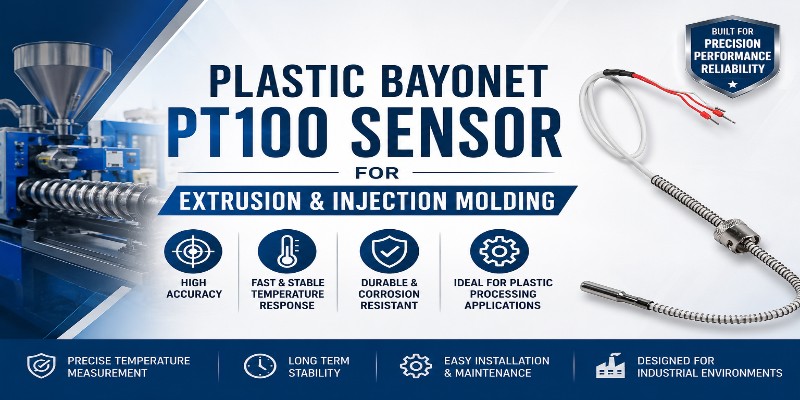
Plastic Bayonet PT100 RTD Sensor: Why RTD Outperforms Thermocouple for Precision Temperature Control in Plastic Extruders
Walk through a plastic processing plant in Ahmedabad, Rajkot, Pune, or Noida and you’ll find two types of barrel sensors on injection molding machines and extruders: thermocouples and PT100 RTD sensors. Both mount via bayonet assemblies. Both measure barrel zone temperature. But the better-performing plants — the ones running tighter tolerances, less scrap, and more consistent product quality — are increasingly specifying Plastic Bayonet PT100 RTD sensors rather than the bayonet thermocouples that dominated earlier machine generations. This guide explains exactly why, with the complete specification of Aavad’s APES_5X45 Plastic Bayonet PT100 Sensor and a thorough technical case for when RTD accuracy changes production outcomes.
What Is a Plastic Bayonet PT100 Sensor?
A Plastic Bayonet PT100 Sensor is a PT100 Resistance Temperature Detector (RTD) built into a bayonet mounting assembly specifically engineered for plastic extrusion and injection molding machinery. It combines:
- A PT100 sensing element (Class A, 3-wire) providing superior accuracy over thermocouples in the plastics processing temperature range
- A spring-loaded bayonet assembly with a 200mm threaded spring that maintains constant contact pressure between the sensor tip and the barrel sensor well across thermal cycling and vibration
- A 1/4″ BSP adapter matching the standard threaded fitting on most plastic extrusion barrel heater zones
- A single-pin locking bayonet cap (14.10mm OD, 12mm ID) compatible with standard machine sensor sockets
- Teflon/Teflon insulated 2-metre cable for chemical and heat resistance in the extrusion environment
Full Specifications: Aavad APES_5X45 Plastic Bayonet PT100 Sensor
| Parameter | Specification | Engineering Significance |
|---|---|---|
| Assembly | Bayonet | Spring-loaded, twist-lock for fast, secure mounting |
| Type | PT-100 | 100 Ohms at 0°C; IEC 60751 standardised resistance curve |
| Make | Aavad Instrument | ISO 9001:2015 |
| Accuracy | Class A | ±(0.15 + 0.002 |
| Configuration | Simplex | Single element |
| No. of wires | 3-wire | Lead-resistance compensation for full accuracy |
| Temperature range | -50 to 250°C | Precisely matched to commodity plastic processing range |
| Material | SS 316 | Corrosion and chemical resistant sheath |
| Wire insulation | Teflon/Teflon | Chemical and heat resistant — no PVC degradation near hot barrels |
| Wire length | 2 metre | Standard for most machine panel wiring |
| Adapter | 1/4″ BSP | Most common barrel heater zone thread standard |
| Tip diameter | 5 mm | Compact for standard machine sensor wells |
| Tip length | 75 mm | Standard insertion depth |
| Bayonet cap | 14.10mm OD, 12mm ID, 1-pin locking | Standard single-pin bayonet cap |
| Spring | 200mm threaded spring (adjustable) | Maintains contact pressure; compensates for thermal expansion |
| Datasheet | APES_5X45 | Available for download from product page |
Why RTD (PT100) Outperforms a Thermocouple for Plastic Barrel Temperature Control
This is the question plastic processing engineers ask most when evaluating bayonet sensor upgrades — and the answer comes down to three specific performance differences that directly affect production quality.
Advantage 1: Higher Accuracy in the Plastics Processing Temperature Range
Most commodity thermoplastics process between 160°C and 250°C. A standard J-type or K-type thermocouple at 200°C has an error tolerance of ±2°C–4°C (Class 1 or Class 2) — a 1%–2% of reading error that translates directly into barrel temperature setpoint uncertainty. A Class A PT100 RTD at 200°C has an error tolerance of approximately ±(0.15 + 0.002 × 200) = ±0.55°C — more than three times more accurate than a Class 1 thermocouple at the same temperature.
In practice: the controller maintaining a 220°C setpoint with a thermocouple may actually be controlling anywhere between 217°C and 223°C depending on sensor tolerance. With a Class A PT100, that range narrows to 219.5°C–220.5°C. For a colour-critical moulding or a dimensionally-sensitive engineering plastic component, this difference is real and measurable in scrap rate and colour consistency.
Advantage 2: Superior Long-Term Stability and Drift Resistance
RTDs have excellent long-term stability — the platinum resistance element maintains its calibration over thousands of operating hours with minimal drift. Thermocouples, particularly J-type sensors in plastic processing environments where organic vapors and reducing conditions from the plastic degradation products can affect the Iron conductor, drift more significantly over time. A thermocouple that read correctly at installation may be reading 3°C–5°C high after six months in a busy extrusion environment — a systematic error that causes the controller to run 3°C–5°C cooler than intended (the controller reduces heating to “correct” for the falsely high reading).
Advantage 3: Better Noise Immunity in Busy Machine Panels
Plastic processing machines have multiple servo drives, heating element SCR controllers, and motor drives all operating in the same electrical environment as the temperature sensor signals. RTD resistance signals are inherently less susceptible to electromagnetic interference from this equipment than the millivolt thermocouple signals. Over a 2-metre cable run from the barrel zone to the temperature controller in a typical machine panel, this difference reduces temperature reading noise that can cause unnecessary heater switching and reduced element life.
The 200mm Threaded Spring: The Engineering That Ensures Contact Accuracy
The spring-loaded assembly on the APES_5X45 uses a 200mm threaded spring — longer than typical bayonet thermocouple springs — providing a larger adjustment range and a more forgiving pre-load that compensates for:
- Thermal expansion differences between the SS 316 sensor body and the carbon steel or stainless steel barrel it sits in — as the barrel heats from ambient to 220°C, it expands differently than the sensor, and the spring automatically accommodates this difference without losing contact
- Varying barrel sensor well depths across different extruder models — the longer threaded spring allows the same sensor to be correctly pre-loaded in wells of different depth geometries
- Vibration from the extruder screw rotation — the spring-loaded contact maintains sensor tip pressure even as machine vibration is transmitted through the barrel to the sensor well
Correct pre-loading is critical: The spring must be in compression during operation (approximately 10–15mm shorter than fully extended when locked) to maintain positive tip contact. An under-compressed spring provides no contact force, effectively turning the “spring-loaded” sensor into a loose-contact sensor and reintroducing the air-gap error that the spring mechanism exists to prevent.
Fixed Length vs Adjustable: What “Fixed Length” Means for This Product
The product title specifies “Fixed Length” — this refers to the tip length (75mm) being a fixed, defined dimension rather than an adjustable insertion depth. The sensor’s active tip extends a fixed 75mm below the bayonet adapter face, meaning the installer positions the sensor by choosing the correct pre-load depth of the threaded spring rather than by adjusting a sliding sensor body depth.
This is the standard construction for most OEM-specified plastic extruder bayonet RTD sensors — the machine’s barrel sensor well is drilled to a specific depth matched to a 75mm tip, and the spring pre-load handles the remaining fine-positioning. If your machine’s sensor well requires a different tip length, specify through Aavad’s Build Your Products service.
Class A vs Class B: Why Class A is Standard for Plastic Bayonet RTDs
The product page specifies Class A accuracy — not Class B, the lower-tolerance alternative. For plastic extrusion and injection molding barrel monitoring:
- Class B (±0.30°C at 0°C, ±0.80°C at 100°C) has tolerances that are often wider than the typical process control window in precision injection molding or blown film extrusion
- Class A (±0.15°C at 0°C, ±0.55°C at 200°C) provides the measurement precision that allows tight temperature control and meaningful comparison of data between sensors at different barrel zones
Class A is the correct default for plastic processing applications — specify Class B only where cost is specifically more important than measurement quality.
Industries and Applications Across India
Plastic Extrusion — Films, Pipes, Profiles, Cables
Hubs: Ahmedabad, Rajkot, Vadodara (Gujarat) | Pune, Nashik (Maharashtra) | Noida, Greater Noida (UP) | Ludhiana (Punjab) | Chennai, Hosur (Tamil Nadu) | Hyderabad (Telangana) | Bengaluru (Karnataka)
Extruder barrel zones, die temperature monitoring, screen pack area temperature, and downstream process sensors on blown film lines, pipe extrusion, cable extrusion, and profile extrusion machinery. Every extruder zone controller requires a bayonet-mounted sensor; as machines age and thermocouple sensors are replaced, upgrading to PT100 bayonet RTDs improves zone-to-zone temperature consistency.
Injection Molding — Precision Moldings and Engineering Plastics
Hubs: Rajkot, Ahmedabad (Gujarat) | Pune, Nashik, Aurangabad (Maharashtra) | Noida, Faridabad (NCR) | Ludhiana (Punjab) | Chennai (TN) | Hyderabad (Telangana)
Precision injection molding of engineering plastics — polyamide (PA), polycarbonate (PC), POM, PBT — where material processing temperatures are tight and melt quality is critical. PT100 Class A bayonet RTDs provide the accuracy to maintain these tight setpoints reliably.
Rubber Processing Machinery
Hubs: Faridabad, Ballabhgarh (Haryana) | Vadodara, Ahmedabad (Gujarat) | Pune (Maharashtra) | Kottayam (Kerala)
Rubber extruders, internal mixers, and two-roll mill temperature monitoring — where bayonet-mounted sensors provide secure contact against vibrating rubber processing machinery.
Packaging Machinery
Nationwide: Form-fill-seal machines, shrink tunnel ovens, and thermoforming equipment in the food, pharma, and FMCG packaging sectors — typically operating in the 100°C–200°C range well within the -50°C to 250°C APES_5X45 rating.
OEM Replacement Sensors
Nationwide: Thousands of plastic processing machines across India use bayonet-type RTD sensors as OEM-specified sensors. As original sensors fail or drift over time, the APES_5X45 provides a like-for-like replacement for any machine using a 5mm tip, 75mm length, 1/4″ BSP, 1-pin locking bayonet RTD sensor.
India-Wide Coverage
Aavad Instrument supplies Plastic Bayonet PT100 Sensors PAN India from Ahmedabad, Gujarat:
Gujarat: Ahmedabad, Vadodara, Surat, Rajkot, Ankleshwar, Vapi, Morbi, Bharuch, Gandhinagar, Jamnagar, Mehsana, Bhavnagar
Maharashtra: Pune, Nashik, Mumbai, Aurangabad, Nagpur, Kolhapur, Solapur
Delhi NCR: Noida, Greater Noida, Faridabad, Gurugram, Ghaziabad, Delhi
Haryana: Faridabad, Ballabhgarh, Gurugram, Manesar, Bahadurgarh, Panipat
Tamil Nadu: Chennai, Coimbatore, Hosur, Tiruppur, Sriperumbudur
Karnataka: Bengaluru, Mysuru, Hubballi, Tumakuru, Belagavi
Telangana & AP: Hyderabad, Sangareddy, Visakhapatnam, Vijayawada
Rajasthan: Jaipur, Bhiwadi, Alwar, Neemrana, Kota
UP: Noida, Greater Noida, Lucknow, Kanpur, Agra, Varanasi
Punjab: Ludhiana, Amritsar, Jalandhar, Mohali
Kerala: Kochi, Kottayam, Thrissur, Thiruvananthapuram
WB, MP, CG, Jharkhand, Odisha, Bihar, HP, Uttarakhand, Goa, Assam: PAN India
Aavad Instrument: India’s #1 Plastic Bayonet PT100 Sensor Manufacturer
Aavad Instrument Pvt. Ltd., Chandkheda, Ahmedabad, Gujarat:
- ISO 9001:2015 certified | NABL-accredited calibration laboratory
- 15+ years | 38M+ installations | 2,900+ customers | 12+ countries
- Trusted by Sintex, PepsiCo, Kohler, Cera, BHEL, ONGC, L&T, Aditya Birla Group, Saint-Gobain
Frequently Asked Questions
Q1. What is a Plastic Bayonet PT100 Sensor and how does it differ from a bayonet thermocouple?
A Plastic Bayonet PT100 Sensor uses a platinum resistance element (RTD) rather than a bimetallic thermocouple junction. RTDs provide higher accuracy (Class A: ±0.55°C at 200°C vs thermocouple Class 1: ±2°C at 200°C), better long-term stability, and better noise immunity in the 0°C–250°C range of commodity plastic processing — making them the preferred sensor for precision-controlled extrusion and injection molding applications.
Q2. Why is the spring 200mm long on the Plastic Bayonet PT100?
The 200mm threaded spring provides a larger adjustment range than shorter bayonet springs, accommodating varying sensor well depths across different extruder models and maintaining correct spring pre-load contact pressure as the barrel heats and expands during operation.
Q3. What does “fixed length” mean for this sensor?
Fixed length refers to the tip length (75mm) being a defined, fixed dimension — unlike adjustable-insertion designs where the sensor body slides. The correct installation depth is set by the spring pre-load position rather than by adjusting a sliding sensor body.
Q4. What is the advantage of Teflon/Teflon cable insulation vs PVC on an extruder?
Teflon (PTFE) insulation does not degrade from heat or chemical exposure from plastic processing vapors, oils, and cleaning solvents commonly found near extruder barrels. PVC cable near hot barrels softens, absorbs chemicals, and eventually cracks — creating insulation failures that compromise signal quality and eventually cause cable faults.
Q5. Can the APES_5X45 replace an existing bayonet thermocouple on my extruder?
It is a like-for-like dimensional replacement if your machine uses a 5mm tip, 75mm tip length, 1/4″ BSP adapter, and 1-pin locking bayonet cap. However, ensure your temperature controller supports PT100 RTD input — if it is currently calibrated for a J or K type thermocouple, you will need to change the controller’s input configuration (or replace the controller) to accept PT100 RTD.
Q6. Is NABL calibration available for bayonet PT100 sensors?
Yes — Aavad’s in-house NABL-accredited calibration laboratory provides traceable calibration certificates on request.
Q7. Are PT100 or PT1000 bayonet sensors available?
The product page specifies PT100, and the product description notes PT1000 availability. Confirm your controller’s input type requirement before ordering.
Buy Plastic Bayonet PT100 Sensors from India’s #1 Manufacturer
View the product page and download datasheet APES_5X45 or contact Aavad Instrument for a quote.
📞 +91 90996 22823 | ✉ hrg@aavadinstrument.com | ISO 9001:2015 | NABL Accredited | Ahmedabad, Gujarat | PAN India Supply