Weld Pad Thermocouple: What Is the Best Stick-On Sensor for Furnace Tubes, Boilers & Pipelines?
Across India’s refining and power generation corridor — from the crude distillation units at Jamnagar and Vadodara in Gujarat, to the fired heaters of Panipat, Mathura, and Barauni, to the boiler tube banks of NTPC’s Korba, Ramagundam, Vindhyachal, and Sipat stations, and the chemical process lines running through Ankleshwar, Dahej, Vapi, and Nandesari — one measurement challenge repeats itself on almost every high-temperature asset: how do you get an accurate, drift-free surface temperature reading on a pipe, tube, or vessel you cannot afford to penetrate? The sensor engineered specifically for this job is the Weld Pad Thermocouple, also known across the industry as a stick-on surface temperature thermocouple or tube skin thermocouple.
What Is a Weld Pad Thermocouple?
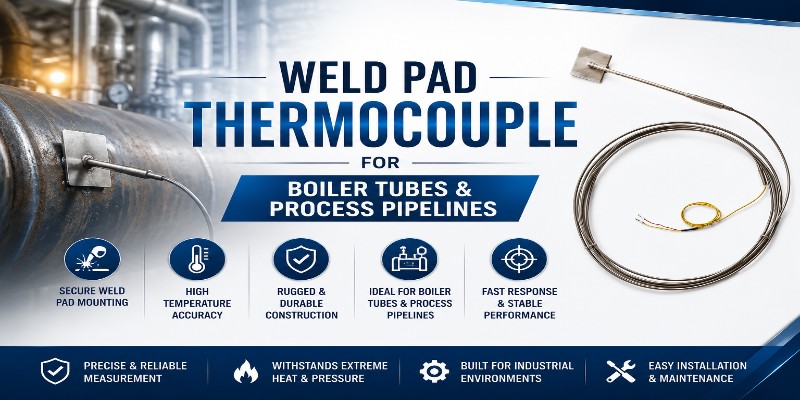
A Weld Pad Thermocouple is a Type K temperature sensor terminated in a small stainless-steel pad that is welded directly onto the external surface of a pipe, tube, header, or pressure vessel. Rather than penetrating the process boundary, it measures the skin (surface) temperature of the metal — a value that tracks internal process temperature closely enough to be used for continuous monitoring, trending, and early hot-spot detection.
Its defining characteristics for high-temperature, continuous-duty service:
- Permanent weld-pad termination: eliminates the loose-contact drift and reading lag typical of clamp-on or strap-on sensors
- 0°C to 400°C measurement range: covers the skin temperature of most fired heater tubes, boiler headers, and process piping
- SS 310 sheath and pad: built to hold up under sustained high-temperature exposure and thermal cycling
- Compacted MgO insulation: improves response time and keeps the signal electrically stable as the tube heats and cools
Full Specifications: Aavad AKES-6X50 Weld Pad Thermocouple
| Parameter | Specification | Engineering Significance |
|---|---|---|
| Type | K (Chromel/Alumel) | Standard high-temperature thermocouple type; wide compatible instrumentation base |
| Make | Aavad Instrument | ISO 9001:2015 |
| Model | AKES | Standard weld-pad wire-type thermocouple |
| Datasheet | AKES-6X50 | Available for download from product page |
| Configuration | Simplex | Single measuring junction |
| Temperature range | 0°C to 400°C | Covers most refinery, boiler and process piping skin temperatures |
| Material of construction | SS 310 | High-temperature strength; resists scaling and oxidation |
| Insulation | Compacted MgO | Fast response, stable insulation resistance under thermal cycling |
| Cable length | 5 metres | Standard; custom lengths available |
| Weld pad size | 50 x 50 x 3 mm | Sized for stable, low-stress weld attachment to curved pipe surfaces |
| Sensor OD | 6 mm | Standard fit for most junction box and transmitter terminations |
Why Weld Pad Mounting Outperforms Clamp-On and Strap-On Sensors
1. No Air-Gap Error
Clamp-on and strap-on sensors rely on mechanical pressure to hold contact against the pipe surface. Any gap — caused by pipe surface irregularity, insulation settling, or loosening over time — introduces a lag and a temperature offset between the sensor and the true skin temperature. A welded pad has zero air gap by construction; the sensing tip is metallurgically fused to the surface it is measuring.
2. Immunity to Vibration and Thermal Cycling
Furnace tubes and rotating-equipment-adjacent piping experience continuous mechanical vibration and repeated thermal expansion/contraction cycles. Bolted or strapped sensors work loose over months of this cycling; a welded joint does not. This is precisely why refineries and power plants specify weld pad thermocouples for permanent, unattended installations rather than temporary clamp-on units.
3. Reliable Signal for Safety-Critical Monitoring
Where a temperature reading feeds a Safety Instrumented System (SIS) or emergency shutdown (ESD) logic, intermittent contact from a loose sensor can cause false trips or, worse, mask a real excursion. The welded, vibration-resistant construction of a weld pad thermocouple reduces this risk considerably compared to non-welded surface sensors.
Weld Pad Thermocouple vs. Other Surface & Insertion Sensors
| Method | Contact Reliability | Vibration Resistance | Process Penetration Required | Best Use Case |
|---|---|---|---|---|
| Weld Pad Thermocouple | Excellent (fused) | Excellent | No | Furnace tubes, boiler headers, continuous-duty piping |
| Bolt Type Thermocouple | Good (mechanical) | Moderate | No (surface-mounted) | Flat surfaces, molds, removable/replaceable installations |
| Clamp-On / Strap-On Sensor | Moderate (can loosen) | Poor to Moderate | No | Temporary or low-vibration monitoring |
| Insertion Thermowell | Excellent (internal) | Excellent | Yes | When bore penetration is permitted and process contact is required |
If your application allows a bore penetration and needs direct process-fluid contact, a thermowell-mounted sensor is the right call. If you cannot penetrate the pipe — or need a permanent, drift-free surface reading — the weld pad thermocouple is the standard industry choice.
Industries and Applications Across India
Oil Refineries
Refinery clusters: Jamnagar, Vadodara, Koyali (Gujarat) | Panipat (Haryana) | Mathura (UP) | Mumbai, Chembur (Maharashtra) | Vizag, Visakhapatnam (Andhra Pradesh) | Chennai, Manali (Tamil Nadu) | Barauni (Bihar) | Numaligarh, Digboi, Guwahati (Assam) | Kochi (Kerala) | Bina (MP)
Fired heater tubes, crude distillation unit (CDU) piping, and process furnace outlets are prime weld pad thermocouple locations — continuous skin-temperature monitoring here catches coking, fouling, and flame impingement before tube rupture becomes a safety event.
Power Plants — Boilers, Superheaters & Reheaters
Thermal power hubs: Korba, Sipat (Chhattisgarh) | Ramagundam (Telangana) | Vindhyachal, Rihand, Singrauli (UP/MP border) | Talcher (Odisha) | Simhadri (Andhra Pradesh) | Mundra, Kawas (Gujarat) | Chandrapur, Koradi (Maharashtra) | Neyveli, Tuticorin (Tamil Nadu)
Superheater and reheater tube banks develop localized overheating well before it registers in average steam temperature readings. Distributing weld pad thermocouples across tube banks lets plant engineers pinpoint the specific tube trending hot — protecting against creep failure and extending asset life.
Chemical & Petrochemical Processing
Chemical process hubs: Ankleshwar, Vapi, Dahej, Nandesari, Panoli (Gujarat) | Panipat (Haryana) | Vizag (Andhra Pradesh) | Mangaluru (Karnataka) | Manali, Cuddalore (Tamil Nadu)
Corrosive media and continuous-duty cycles make internal sensor insertion risky on many chemical lines. Weld pad sensors avoid any process-side contact — no seals to fail, no penetration to maintain, no leak path at the mounting point.
Fired Heaters and Process Heating Systems
Continuous process heater and fired heater installations across fertilizer, cement, and petrochemical plants use weld pad thermocouples to track tube-metal temperature trends and support predictive maintenance scheduling ahead of turnaround shutdowns.
Weld Pad Thermocouple vs. Bolt Type Thermocouple: Key Distinction
Buyers sometimes compare the Weld Pad Thermocouple (AKES-6X50) with the Bolt Type Thermocouple. Both mount to a surface rather than penetrating the process — the key differences:
| Feature | Weld Pad Thermocouple (AKES-6X50) | Bolt Type Thermocouple |
|---|---|---|
| Mounting method | Permanently welded | Bolted/screwed, removable |
| Vibration resistance | Excellent | Good |
| Best for | Furnace tubes, headers, continuous-duty, permanent installations | Flat machine surfaces, molds, dies where periodic sensor replacement is expected |
| Serviceability | Requires cutting/re-welding to replace | Sensor can be unbolted and swapped without hot work |
Weld Pad Thermocouple: permanent, welded skin-temperature monitoring on curved pipe and vessel surfaces
Bolt Type Thermocouple: removable surface sensing on flat equipment surfaces where periodic replacement or recalibration swap-out is preferred
India-Wide Coverage
Aavad Instrument supplies Weld Pad Thermocouples PAN India from Ahmedabad, Gujarat:
Gujarat: Ahmedabad, Vadodara, Surat, Jamnagar, Ankleshwar, Vapi, Bharuch, Dahej, Nandesari, Rajkot
Maharashtra: Mumbai, Chembur, Pune, Nagpur, Chandrapur, Nashik
Uttar Pradesh: Mathura, Noida, Kanpur, Lucknow
Haryana & Delhi NCR: Panipat, Faridabad, Gurugram, Delhi
Andhra Pradesh & Telangana: Visakhapatnam, Ramagundam, Simhadri, Hyderabad
Tamil Nadu: Chennai, Manali, Cuddalore, Tuticorin
Odisha: Talcher, Bhubaneswar, Cuttack
Chhattisgarh: Korba, Sipat, Raipur
Karnataka: Mangaluru, Bengaluru
Kerala: Kochi, Kozhikode
Bihar & Assam: Barauni, Numaligarh, Digboi, Guwahati
Madhya Pradesh: Bina, Indore, Bhopal
Punjab, Rajasthan, West Bengal, and all other states: PAN India delivery available
Aavad Instrument: India’s Trusted Weld Pad Thermocouple Manufacturer
Aavad Instrument Pvt. Ltd., Chandkheda, Ahmedabad, Gujarat:
- ISO 9001:2015 certified | NABL-accredited calibration laboratory
- 15+ years | 38M+ installations | 2,900+ customers | 12+ countries
- Trusted by BHEL, ONGC, Indian Oil, Bharat Petroleum, NPCIL, L&T, HAL, BARC, NALCO, Aditya Birla Group, Torrent Pharma, Indian Railways
Frequently Asked Questions
Q1. What is a weld pad thermocouple used for?
A weld pad thermocouple is used to measure the surface (skin) temperature of pipes, tubes, headers, and vessels by welding the sensor’s pad directly onto the metal — commonly used in refinery furnace tubes, boiler superheaters/reheaters, and chemical process piping where internal insertion isn’t practical.
Q2. What is the difference between a weld pad thermocouple and a stick-on surface thermocouple?
They refer to the same sensor. “Stick-on” and “weld pad” both describe a thermocouple permanently mounted (welded) onto an external surface rather than inserted into the process stream — also called a tube skin or skin-type thermocouple.
Q3. What temperature range does Aavad’s weld pad thermocouple cover?
The standard AKES-6X50 model covers 0°C to 400°C using a Type K (Chromel/Alumel) element with compacted MgO insulation. Custom ranges are available through Aavad’s Build Your Products service.
Q4. What material is the weld pad thermocouple made of?
Aavad’s weld pad thermocouples use SS 310 construction for both the sensing sheath and the weld pad itself, selected for its resistance to scaling and its strength in sustained high-temperature service.
Q5. Can weld pad thermocouples be customized?
Yes. Aavad manufactures both standard and fully custom weld pad thermocouples — including custom pad size, cable length, sensor type, and sheath material — to match specific piping diameters and process conditions.
Q6. Is a weld pad thermocouple accurate for measuring internal process temperature?
Since the pad is welded directly to the pipe or vessel wall, it measures tube skin temperature that closely correlates with internal process temperature, making it a reliable indirect measurement — particularly effective for trending and detecting hot spots over time.
Q7. Which industries commonly use weld pad thermocouples?
Oil refineries, power plants (boilers, superheaters, reheaters), chemical and petrochemical processing plants, fired heater operators, and pipeline/vessel operators requiring continuous, high-reliability surface temperature monitoring.
Q8. Does Aavad supply weld pad thermocouples across India?
Yes — PAN India from Ahmedabad, with active supply into refinery, power plant, and chemical process hubs across Gujarat, Maharashtra, UP, Haryana, Andhra Pradesh, Telangana, Tamil Nadu, Odisha, Chhattisgarh, Karnataka, Kerala, Madhya Pradesh, Assam, Bihar, and all other Indian states.
Buy Weld Pad Thermocouples from India’s Trusted Manufacturer
View the product page and download datasheet AKES-6X50 or contact Aavad Instrument for refinery, boiler, and process piping sensor requirements.
📞 +91 90996 22823 | ✉ hrg@aavadinstrument.com | ISO 9001:2015 | NABL Accredited | Ahmedabad, Gujarat | PAN India Supply