Freezer Probe RTD: What Is the Best Temperature Sensor for Cold Storage, Food Freezers & Pharmaceutical Cold Chain?
Across India’s expanding cold chain infrastructure — from frozen food warehouses in Pune and Vapi to pharmaceutical cold rooms in Ahmedabad and Hyderabad, from aquaculture refrigeration facilities in coastal Andhra Pradesh to blood bank storage at hospitals across every major city — one operational requirement sits at the centre of compliance, product safety, and energy management: continuous, accurate temperature monitoring at sub-zero to near-zero temperatures. The sensor that does this job reliably, with stable output over the months-long continuous monitoring cycles typical of cold storage environments, is the Freezer Probe RTD — a PT100 resistance temperature detector specifically suited to cold and sub-zero temperature measurement applications.
What Is a Freezer Probe RTD?
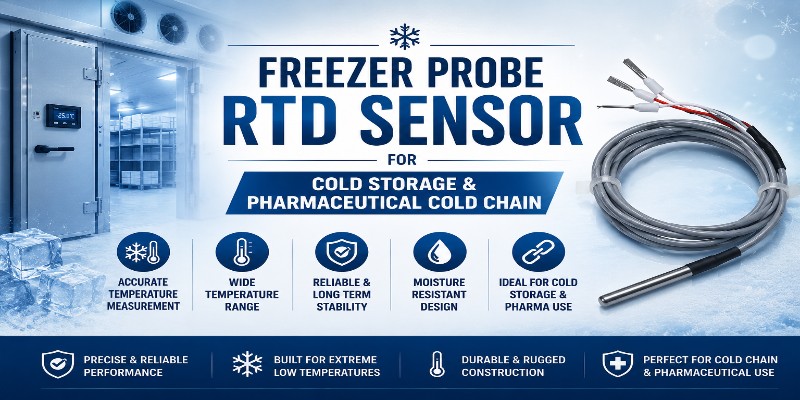
A Freezer Probe RTD is a compact PT100 resistance temperature detector — in Aavad’s APES model, a 6mm OD, 50mm sensing length probe with Teflon/Teflon insulated cable — designed for temperature measurement in cold storage chambers, food processing freezers, laboratory freezers, refrigerated transport, and pharmaceutical cold chain monitoring environments.
Its key characteristics for cold-environment use:
- PT100 measurement technology: Resistance-based signal with excellent noise immunity — resists the electrical interference from refrigeration compressors, fan motors, and temperature controllers sharing the cold room environment
- -50°C lower range: Covers ultra-low freezer temperatures (-20°C to -25°C standard food frozen storage, -80°C blast freezers excluded but deeper cold chain ranges within -50°C covered)
- SS 316 probe body: Resists the moisture, condensation, frost, and defrost cycle exposure typical of cold room environments
- Teflon/Teflon cable: Unlike PVC cable, Teflon remains flexible and does not become brittle at cold temperatures — essential for cables in cold storage areas that are handled during inspection and maintenance
Full Specifications: Aavad APES_6X70 Freezer Probe RTD
| Parameter | Specification | Engineering Significance |
|---|---|---|
| Type | PT-100 | Standardised 100 Ohms at 0°C; IEC 60751 resistance curve |
| Make | Aavad Instrument | ISO 9001:2015 |
| Model | APES | Standard wire-type RTD probe |
| Datasheet | APES_6X70 | Available for download from product page |
| Configuration | Simplex | Single PT100 element |
| Total wires | 3-wire | Lead-resistance compensation for accurate cold-temperature measurement |
| Accuracy | Class B | ±(0.30 + 0.005 |
| Temperature range | -50 to 400°C | Lower range covers most food and pharmaceutical cold chain temperatures |
| Material | SS 316 | Corrosion-resistant; handles cold room condensation and frost-defrost cycles |
| Insulation | Compacted MgO | Maintains stable electrical isolation across temperature cycling |
| Cable length | 3 metres | Standard; custom lengths available |
| Cable type | Teflon/Teflon | Remains flexible at cold temperatures; moisture-resistant |
| Sensor OD | 6 mm | Standard for most cold room sensor ports and insertion points |
| Sensor length | 50 mm | Compact active sensing length |
Why RTD (PT100) Outperforms Thermocouple in Cold Storage Applications
At temperatures from -50°C to +8°C — the range that covers the vast majority of Indian cold chain and food storage applications — a PT100 RTD has three specific advantages over a thermocouple:
1. Superior Accuracy at Cold Temperatures
The millivolt output of a K or T type thermocouple at cold temperatures is very small — and the measurement sensitivity per degree is lower than at higher temperatures. A PT100 RTD’s resistance changes at approximately 0.385 Ohms/°C regardless of temperature, providing consistent measurement sensitivity across the cold temperature range. Class B accuracy of ±(0.30 + 0.005×50) = approximately ±0.55°C at -50°C is adequate for most cold chain monitoring; Class A provides ±0.25°C at the same point for pharmaceutical or more critical applications.
2. Better Noise Immunity in Refrigeration Environments
Cold rooms contain refrigeration compressors, condenser fans, evaporator fans, and defrost heater elements — all generating electrical noise that can affect the millivolt-level signals from thermocouples. The resistance-based PT100 signal is significantly less susceptible to this noise, providing cleaner, more stable temperature readings on a continuous monitoring system.
3. Long-Term Stability for Continuous Cold Chain Monitoring
Cold chain monitoring is typically continuous — the sensor must produce a consistent, calibration-stable reading across months of uninterrupted operation. RTDs have excellent long-term stability; thermocouples, particularly T-type which is historically used for cold temperatures, can drift more significantly over extended continuous service.
Why Teflon/Teflon Cable Is Essential for Cold Storage Environments
Standard PVC cable insulation becomes progressively stiffer and more brittle as temperature drops. In a cold room environment, a PVC-insulated cable that is regularly moved, bent, or handled during inspection becomes a flex-failure risk — particularly at the cable exit point from the probe body where repeated flexing in the cold concentrates mechanical stress. Teflon (PTFE) insulation remains flexible and mechanically stable across the full -50°C to 400°C temperature range, making it the correct cable insulation for cold chain applications where cable movement and handling at low temperatures is routine.
Cold Storage Temperature Ranges Across Indian Industries
Understanding which temperature zone your cold storage application falls into helps confirm sensor specification:
| Cold Storage Category | Temperature Zone | APES_6X70 Coverage |
|---|---|---|
| Chilled food storage (dairy, fresh produce, meat) | +2°C to +8°C | ✅ Fully within -50 to 400°C range |
| Frozen food storage | -18°C to -25°C | ✅ Fully covered |
| Ice cream and deep-freeze storage | -25°C to -30°C | ✅ Covered |
| Pharmaceutical cold storage (+2°C to +8°C) | +2°C to +8°C | ✅ Covered |
| Blood bank and plasma storage (-20°C to -30°C) | -20°C to -30°C | ✅ Covered |
| Vaccine cold chain (WHO recommended +2°C to +8°C) | +2°C to +8°C | ✅ Covered |
| Ultra-low biomedical (-70°C to -80°C) | -70°C to -80°C | ❌ Outside -50°C lower limit — specify an extended-range sensor |
Where Freezer Probe RTD Sensors Are Used Across India
Pharmaceutical and Healthcare Cold Chain
Cold storage hubs: Ahmedabad, Vadodara, Ankleshwar, Vapi (Gujarat) | Aurangabad, Pune, Nashik (Maharashtra) | Hyderabad, Sangareddy (Telangana) | Baddi, Nalagarh (HP) | Noida (UP)
Hospital blood banks and pharmaceutical distributors: All major Indian cities with tertiary hospital infrastructure — Delhi, Mumbai, Bengaluru, Chennai, Hyderabad, Kolkata, Pune, Ahmedabad, Jaipur, Lucknow, Bhopal, Chandigarh, Kochi
WHO-recommended cold chain compliance for vaccines and biologics (+2°C to +8°C), blood product storage (-20°C to -30°C), and pharmaceutical active storage (+2°C to +8°C or -20°C) all require continuous, documented temperature monitoring with calibrated sensors. NABL-traceable calibration certificates for the RTD support GDP (Good Distribution Practice) compliance documentation.
Food and Beverage Cold Chain
Integrated cold chain warehouses: Mumbai, Pune (Maharashtra) | Delhi NCR | Bengaluru (Karnataka) | Hyderabad (Telangana) | Chennai (TN) | Kolkata (WB) | Ahmedabad, Rajkot (Gujarat) | Ludhiana, Amritsar (Punjab) | Kochi (Kerala)
Food processing and freezing plants: Anand, Mehsana (Gujarat — dairy) | Ludhiana (Punjab — food processing) | Mangaluru, Udupi (Karnataka — seafood) | Kochi, Thrissur (Kerala — seafood export)
FSSAI and AGMARK compliance for temperature-controlled food storage requires continuous monitoring. Major cold chain operators — Snowman, ColdEx, Frigorific, WaveCrest, Kausar, Precimax — all require temperature sensors across their nationwide cold room infrastructure.
Aquaculture and Seafood Processing
Coastal processing hubs: Visakhapatnam, Kakinada, Ongole, Nellore (AP — India’s largest prawn export zone) | Kochi, Alappuzha, Thiruvananthapuram (Kerala — seafood processing) | Mangaluru, Karwar (Karnataka) | Chennai, Nagapattinam (Tamil Nadu) | Veraval, Porbandar (Gujarat — fish landing and processing) | Mumbai (Maharashtra)
Export-quality seafood processing requires pre-chilling, blast freezing, and cold storage at defined temperature profiles. Temperature monitoring at each stage — from catch landing through to container loading — requires reliable sub-zero RTD sensors with calibration documentation for export compliance.
Dairy Industry
Major dairy hubs: Anand, Mehsana, Gandhinagar (Gujarat — AMUL supply chain) | Ludhiana, Amritsar (Punjab — Verka, Punjab dairy) | Jaipur (Rajasthan — Saras) | Delhi NCR (Mother Dairy) | Bengaluru (Karnataka Milk Federation)
Milk chilling at collection centres (+2°C to +4°C), pasteurized product cold storage (+2°C to +8°C), and frozen dairy dessert storage (-18°C to -25°C) — all continuous, regulatory-monitored temperature points across India’s extensive dairy infrastructure.
HVAC Chiller Systems and Cold Utilities
Commercial buildings and industrial utilities: All major Indian cities
Chilled water supply and return monitoring, cooling coil temperature monitoring, and water chiller performance monitoring — where the -50°C lower range of the APES_6X70 provides ample headroom below the +4°C to +10°C chilled water temperature range.
Laboratories and Research
University labs, CSIR research institutes, NABL testing labs: Bengaluru | Mumbai (BARC, IIT Bombay) | Hyderabad | Pune | Chennai (IIT Madras) | Delhi (NPL, IIT Delhi)
Laboratory freezer temperature monitoring for biological sample storage, reaction mixture temperature control, and environmental chamber calibration.
Freezer Probe RTD vs Waterproof RTD: Key Distinction
Buyers sometimes compare the Freezer Probe RTD (APES_6X70) with the Waterproof RTD (APES-5X75). Both are PT100 sensors with TF cable and SS 316 construction rated to -50°C — the key differences:
| Feature | Freezer Probe RTD (APES_6X70) | Waterproof RTD (APES-5X75) |
|---|---|---|
| OD | 6mm | 5mm |
| Tip length | 50mm | 75mm |
| Process connection | No NPT fitting | 1/4″ NPT male (direct pipe/tank fitting) |
| Accuracy | Class B | Class A |
| Cable | TF/TF (no braid) | TF/TF/SS (with SS braid) |
| Best for | Freely suspended cold room monitoring, general cold storage | Direct immersion in liquid, pipe or tank installation |
Freezer Probe RTD: suspended inside the cold room on a bracket or inserted loosely into a sensor port — not designed for pressurised pipe immersion
Waterproof RTD: screwed directly into a pipe or tank tee via the 1/4″ NPT fitting — immersed in a liquid under pressure
India-Wide Coverage
Aavad Instrument supplies Freezer Probe RTD Sensors PAN India from Ahmedabad, Gujarat:
Gujarat: Ahmedabad, Vadodara, Surat, Rajkot, Ankleshwar, Vapi, Bharuch, Jamnagar, Gandhinagar, Mehsana, Bhavnagar, Anand, Veraval, Porbandar
Maharashtra: Pune, Nashik, Mumbai, Aurangabad, Nagpur, Nashik, Kolhapur, Navi Mumbai
Delhi NCR: Delhi, Noida, Greater Noida, Faridabad, Gurugram, Ghaziabad
Punjab: Ludhiana, Amritsar, Jalandhar, Mohali, Patiala | Haryana: Gurugram, Faridabad, Panipat
Karnataka: Bengaluru, Mysuru, Mangaluru, Hubballi, Udupi, Karwar
Tamil Nadu: Chennai, Coimbatore, Madurai, Nagapattinam, Tuticorin, Tiruchirappalli
Telangana & AP: Hyderabad, Sangareddy, Visakhapatnam, Kakinada, Nellore, Ongole
Kerala: Kochi, Thiruvananthapuram, Alappuzha, Thrissur, Kozhikode, Kottayam
Rajasthan: Jaipur, Kota, Jodhpur, Udaipur, Alwar, Bhilwara
UP: Noida, Lucknow, Kanpur, Agra, Varanasi | MP: Indore, Bhopal, Gwalior, Jabalpur
WB: Kolkata, Howrah, Siliguri, Durgapur, Haldia | Bihar: Patna, Muzaffarpur, Gaya
Odisha: Bhubaneswar, Cuttack, Berhampur | Jharkhand: Jamshedpur, Ranchi
HP: Baddi, Nalagarh, Shimla | Uttarakhand: Haridwar, Dehradun, Rishikesh
Assam & North-East: Guwahati, Dibrugarh, Shillong, Agartala, Imphal
Chandigarh, Goa, J&K: PAN India
Aavad Instrument: India’s #1 Freezer Probe RTD Manufacturer
Aavad Instrument Pvt. Ltd., Chandkheda, Ahmedabad, Gujarat:
- ISO 9001:2015 certified | NABL-accredited calibration laboratory
- 15+ years | 38M+ installations | 2,900+ customers | 12+ countries
- Trusted by Torrent Pharma, Piramal Glass, BHEL, ONGC, HAL, BARC, NALCO, Indian Railways, L&T, PepsiCo, Kohler, Saint-Gobain, Aditya Birla Group, Cera
Frequently Asked Questions
Q1. What is a Freezer Probe RTD and what temperature range does it cover?
A Freezer Probe RTD is a PT100 resistance temperature detector optimised for cold storage, food freezer, and pharmaceutical cold chain monitoring. Aavad’s APES_6X70 is rated -50°C to 400°C, covering standard food frozen storage (-18°C to -25°C), pharmaceutical cold chain (+2°C to +8°C), blood product storage (-20°C to -30°C), and dairy cold chain temperatures.
Q2. Why is PT100 RTD preferred over thermocouple for cold storage monitoring?
PT100 RTDs provide better accuracy and noise immunity at cold temperatures than thermocouples, and exhibit better long-term stability during the months-long continuous monitoring cycles typical of cold chain applications. The resistance-based signal is also less susceptible to electrical interference from refrigeration compressors, fans, and defrost heaters common in cold room environments.
Q3. Why does the cable matter for a cold room sensor?
Teflon/Teflon cable insulation remains flexible at cold temperatures, unlike PVC which stiffens and eventually cracks under repeated flexing in the cold. For sensors that are regularly moved or handled during cold room inspections and calibration checks, Teflon insulation is the correct specification.
Q4. Is Class B accuracy sufficient for pharmaceutical cold chain monitoring?
Class B (±0.30°C at 0°C, ±0.55°C at -50°C) is adequate for most pharmaceutical cold chain monitoring where the alarm thresholds are typically ±2°C from setpoint. For applications specifically requiring the tighter Class A tolerance (±0.15°C at 0°C) — such as calibration reference measurement or critical validation point monitoring — specify Class A when ordering through Aavad’s Build Your Products service.
Q5. What is the difference between Freezer Probe RTD and a standard waterproof RTD probe?
The Freezer Probe RTD (APES_6X70) is a 6mm, Class B probe without an NPT process connection — designed for general cold room monitoring on brackets or in loose sensor ports. The Waterproof RTD (APES-5X75) has a 1/4″ NPT male fitting for direct immersion in liquid-filled pipes or tanks under pressure, Class A accuracy, and SS braid cable. Choose Freezer Probe RTD for ambient cold room monitoring; Waterproof RTD for pipe or tank immersion.
Q6. Does the APES_6X70 cover ultra-low freezer temperatures (-70°C to -80°C)?
No — the APES_6X70 is rated to -50°C. For ultra-low biomedical freezer applications (-70°C to -80°C), specify an extended-range sensor by contacting Aavad’s engineering team directly.
Q7. Is NABL calibration available for the Freezer Probe RTD?
Yes — Aavad’s in-house NABL-accredited calibration laboratory issues traceable calibration certificates on request, supporting GDP, FSSAI, and ISO quality system documentation requirements for cold chain compliance.
Q8. Does Aavad supply Freezer Probe RTD sensors across India?
Yes — PAN India from Ahmedabad with active deployments across all major cold chain, food processing, pharmaceutical, dairy, and seafood processing locations including Gujarat, Maharashtra, Delhi NCR, Punjab, Karnataka, Tamil Nadu, AP, Telangana, Kerala, Rajasthan, UP, WB, Bihar, and all other Indian states.
Buy Freezer Probe RTD Sensors from India’s #1 Manufacturer
View the product page and download datasheet APES_6X70 or contact Aavad Instrument for cold chain sensor requirements.
📞 +91 90996 22823 | ✉ hrg@aavadinstrument.com | ISO 9001:2015 | NABL Accredited | Ahmedabad, Gujarat | PAN India Supply