Plug & Jack RTD Sensor: What Is the Best Quick-Disconnect PT100 Probe for Panels, Motors & Calibration Work?
Across India’s electrical panel manufacturing and rotating-equipment maintenance base — from motor and switchgear panel builders in Ahmedabad and Rajkot, to calibration and testing labs in Mumbai, Bengaluru, and Pune, to the maintenance teams servicing pumps, compressors, and motor bearings in every industrial cluster in the country — one recurring frustration comes up whenever a sensor needs replacing: having to open a terminal box, identify the correct wires, and re-terminate them just to swap out one probe. The Plug & Jack RTD Sensor removes that step entirely by terminating the RTD in a plug-and-socket connector instead of bare wire leads.
What Is a Plug & Jack RTD Sensor?
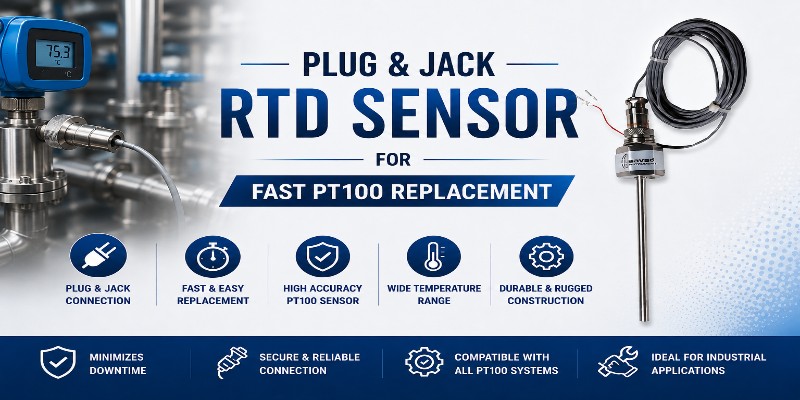
A Plug & Jack RTD Sensor is a PT100 resistance temperature detector fitted with a mating plug-and-jack connector pair instead of (or in addition to) a standard wired termination. The sensor plugs directly into a corresponding jack mounted on a panel, junction box, or instrument housing, allowing the entire probe to be disconnected and replaced in seconds — no screwdriver, no terminal identification, no risk of miswiring during replacement.
Its defining characteristics for quick-disconnect duty:
- Plug-and-jack termination: insert/remove the sensor without accessing internal wiring terminals
- PT100 element with Class A accuracy: precise, repeatable readings for process and calibration use
- 150 mm sensor length: suited to standard panel, motor bearing, and general insertion-depth applications
- SS 316 construction: durable, corrosion-resistant sheath for continuous industrial service
Full Specifications: Aavad APES-PJ Plug & Jack RTD Sensor
| Parameter | Specification | Engineering Significance |
|---|---|---|
| Type | PT-100 | Standardised 100 Ohms at 0°C; IEC 60751 resistance curve |
| Make | Aavad Instrument | ISO 9001:2015 |
| Model | APES-PJ | Standard plug-and-jack terminated RTD probe |
| Configuration | Simplex | Single measuring element |
| Total no. of wires | 3-wire | Lead-resistance compensation for accurate readings |
| Accuracy | Class A | Tighter tolerance for reliable process and calibration readings |
| Temperature range | -50°C to 400°C | Covers most panel, motor, and general process monitoring applications |
| Material of construction | SS 316 | Corrosion-resistant, durable sheath for continuous industrial service |
| Insulation | Compacted MgO | Fast response and stable insulation resistance under thermal cycling |
| Cable length | 3 metres | Standard; custom lengths available |
| Cable type | Teflon/Teflon | Heat- and moisture-resistant lead insulation |
| Sensor OD | 6 mm | Standard fit for most process ports and panel glands |
| Sensor length | 150 mm | Suited to standard panel, motor bearing, and process insertion depths |
Why Plug & Jack Termination Matters for Maintenance-Heavy Applications
1. Faster Sensor Replacement, Less Downtime
Where a sensor sits behind a control panel or in a location that’s inconvenient to access repeatedly, a plug-and-jack connection lets maintenance staff swap a failed or out-of-calibration probe in seconds — instead of powering down, opening a terminal enclosure, and re-wiring.
2. Eliminates Miswiring Risk During Replacement
Manually re-terminating RTD leads always carries a small risk of reversed or incorrectly landed wires, which can produce erroneous readings or damage connected instrumentation. A keyed plug-and-jack connector removes that risk by ensuring the sensor can only be connected one correct way.
3. Ideal for Routine Calibration Swap-Outs
Facilities that rotate sensors in and out for periodic calibration — sending one probe to the lab while a spare is installed in its place — benefit directly from a connector-based design that avoids repeated wire termination and re-termination cycles, which can degrade cable and terminal integrity over time.
4. Simplifies Spare Parts Management
Standardizing on plug & jack terminated RTDs across a facility’s panels and motor housings means a single spare sensor design can serve multiple installation points, simplifying inventory and reducing the chance of an incompatible spare on hand when a sensor fails.
Plug & Jack RTD Sensor vs. Standard Wired RTD Sensor
| Feature | Plug & Jack RTD Sensor (APES-PJ) | Standard Wired RTD Sensor |
|---|---|---|
| Termination | Plug-and-jack connector | Bare wire leads, direct terminal connection |
| Replacement speed | Seconds, no tools required | Minutes, requires terminal access and re-wiring |
| Miswiring risk on replacement | None (keyed connector) | Possible if leads are mislabeled or reversed |
| Best for | Panels, motor bearings, calibration swap-out points | Fixed, rarely-serviced installations where wired termination is standard |
If your installation is a permanent, rarely-serviced measurement point, a standard wire-type RTD sensor is perfectly adequate and often more cost-effective. Where the sensor needs to come out regularly — for calibration, maintenance, or troubleshooting — the plug & jack design pays for itself in reduced downtime.
Industries and Applications Across India
Electrical Panel & Switchgear Manufacturing
Panel manufacturing hubs: Ahmedabad, Rajkot, Vadodara (Gujarat) | Faridabad, Delhi NCR | Pune, Mumbai (Maharashtra) | Bengaluru (Karnataka)
Panel builders specify plug & jack RTD sensors where a sensor needs to be field-replaceable without requiring the end customer to open and re-wire the panel’s internal terminal blocks.
Motor & Rotating Equipment Bearing Monitoring
Bearing temperature monitoring on motors, pumps, compressors, and fans across manufacturing and process plants benefits from quick-disconnect sensors that can be swapped during scheduled maintenance windows without extended equipment downtime.
Calibration & Testing Laboratories
Calibration lab hubs: Mumbai, Bengaluru, Pune, Hyderabad, Chennai, Ahmedabad, Delhi NCR
NABL-accredited and in-house calibration labs use plug & jack RTDs where sensors are routinely removed for periodic calibration checks and replaced with a calibrated spare, minimizing process interruption.
General Industrial Process Monitoring
Any facility that values fast, tool-minimal sensor replacement — including chemical processing, power generation, and general manufacturing plants — can standardize on plug & jack RTD sensors at points where downtime for sensor service needs to be minimized.
Export Markets
Aavad Instrument also exports Plug & Jack RTD Sensors internationally, including to markets in Kenya, Canada, and the United States, supporting overseas process plants and panel manufacturers with the same ISO 9001:2015 quality standard.
Plug & Jack RTD Sensor vs. Handle Type RTD Sensor: Key Distinction
Buyers sometimes compare the Plug & Jack RTD Sensor (APES-PJ) with the Handle Type RTD Sensor. Both are designed around ease of use, but for different purposes:
| Feature | Plug & Jack RTD Sensor (APES-PJ) | Handle Type RTD Sensor |
|---|---|---|
| Primary benefit | Fast electrical disconnect/reconnect via connector | Ergonomic handheld grip for portable, manual spot-checks |
| Typical installation | Fixed in a panel, motor housing, or process point with a mating jack | Carried and applied manually to different measurement points |
| Best for | Facilities needing fast, repeatable sensor swap-out at a fixed point | Technicians taking portable, manual surface or immersion readings |
Plug & Jack RTD Sensor: fixed-location installation designed for fast electrical disconnection during maintenance or calibration swap-out
Handle Type RTD Sensor: portable, hand-held probe designed for technicians taking manual spot-check readings across multiple locations
India-Wide Coverage
Aavad Instrument supplies Plug & Jack RTD Sensors PAN India from Ahmedabad, Gujarat, and exports internationally:
Gujarat: Ahmedabad, Rajkot, Vadodara, Surat, Ankleshwar
Maharashtra: Mumbai, Pune, Nagpur, Nashik
Delhi NCR & Haryana: Delhi, Faridabad, Gurugram, Noida
Karnataka: Bengaluru, Mysuru
Telangana: Hyderabad
Tamil Nadu: Chennai, Coimbatore
West Bengal: Kolkata
Rajasthan, Punjab, Madhya Pradesh, and all other states: PAN India delivery available
Export markets: Kenya, Canada, United States, and 12+ countries worldwide
Aavad Instrument: India’s Trusted Plug & Jack RTD Sensor Manufacturer
Aavad Instrument Pvt. Ltd., Chandkheda, Ahmedabad, Gujarat:
- ISO 9001:2015 certified | NABL-accredited calibration laboratory
- 15+ years | 38M+ installations | 2,900+ customers | 12+ countries
- Trusted by BHEL, ONGC, Indian Oil, Bharat Petroleum, NPCIL, L&T, HAL, BARC, NALCO, Aditya Birla Group, Torrent Pharma
Frequently Asked Questions
Q1. What is a plug & jack RTD sensor used for?
A plug & jack RTD sensor is a PT100 probe terminated in a plug-and-socket connector, used wherever fast sensor replacement without accessing internal wiring terminals is important — commonly in electrical panels, motor bearing monitoring points, and calibration swap-out applications.
Q2. How is a plug & jack RTD sensor different from a standard wired RTD?
A standard wired RTD terminates in bare leads that must be manually connected to terminal blocks, while a plug & jack RTD terminates in a keyed connector that plugs directly into a matching jack — allowing sensor replacement in seconds without tools or re-wiring.
Q3. What temperature range does Aavad’s plug & jack RTD sensor cover?
The standard APES-PJ model covers -50°C to 400°C using a PT100 element with Class A accuracy and a 150 mm sensor length.
Q4. Why use a plug & jack connector instead of direct wiring?
The connector eliminates the risk of miswiring during sensor replacement, speeds up maintenance and calibration swap-outs, and reduces equipment downtime, since the sensor can be disconnected and reconnected without opening a terminal enclosure.
Q5. Can the plug & jack RTD sensor be customized?
Yes. Aavad manufactures both standard and fully custom plug & jack RTD sensors — including custom sensor length, cable length, and connector type — through the Build Your Products service.
Q6. Which industries commonly use plug & jack RTD sensors?
Electrical panel and switchgear manufacturing, motor and rotating equipment bearing monitoring, calibration and testing laboratories, and general industrial process monitoring points where fast sensor replacement matters.
Q7. Does Aavad export plug & jack RTD sensors internationally?
Yes — Aavad Instrument exports Plug & Jack RTD Sensors to international markets including Kenya, Canada, and the United States, in addition to supplying across India.
Q8. Does Aavad supply plug & jack RTD sensors across India?
Yes — PAN India from Ahmedabad, with active supply into panel manufacturing, motor maintenance, and calibration lab hubs across Gujarat, Maharashtra, Delhi NCR, Haryana, Karnataka, Telangana, Tamil Nadu, West Bengal, and all other Indian states.
Buy Plug & Jack RTD Sensors from India’s Trusted Manufacturer
View the product page and request a quote for APES-PJ or contact Aavad Instrument for panel, motor, and calibration sensor requirements.
📞 +91 90996 22823 | ✉ hrg@aavadinstrument.com | ISO 9001:2015 | NABL Accredited | Ahmedabad, Gujarat | PAN India Supply | Exporting to 12+ Countries