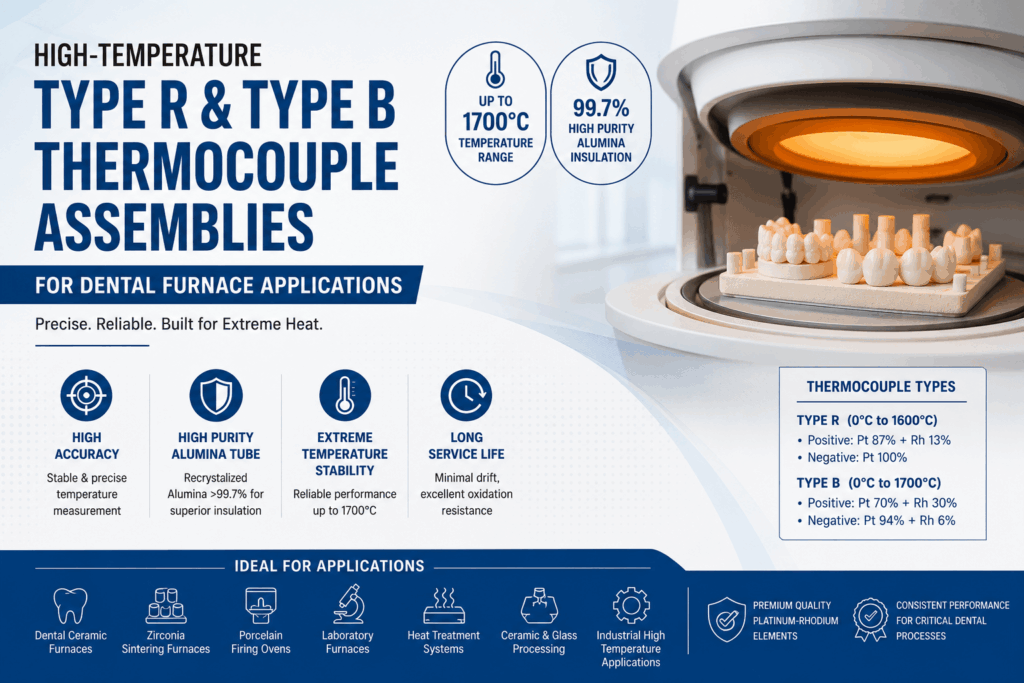
High-Temperature Type R & Type B Thermocouple Assemblies for Precision Dental Furnace Applications
Modern dental laboratories demand extremely precise temperature control during ceramic firing, zirconia sintering, porcelain baking, and heat treatment processes. Even a small temperature deviation can affect the strength, color, translucency, and dimensional accuracy of dental restorations.
To achieve consistent firing cycles, manufacturers rely on Type R and Type B Platinum-Rhodium Thermocouple Assemblies protected by high-purity recrystallized alumina ceramic tubes. These premium temperature sensors are specifically designed for continuous operation in high-temperature furnaces where conventional thermocouples fail.
In this article, we’ll explore the construction, working principle, applications, advantages, and selection criteria of Type R and Type B thermocouple assemblies used in dental furnace systems.
Why Accurate Temperature Measurement is Critical in Dental Furnaces
Dental furnaces operate at temperatures ranging from 800°C to 1700°C, depending on the process.
Critical applications include:
- Zirconia sintering
- Dental ceramic firing
- Porcelain furnace applications
- Glass ceramic crystallization
- Press furnace technology
- Heat treatment of dental materials
- Laboratory ceramic research
- Dental crown and bridge manufacturing
A temperature error of even ±5°C can cause:
- Incorrect shade formation
- Surface defects
- Reduced mechanical strength
- Cracking
- Improper shrinkage
- Inconsistent product quality
Therefore, premium noble metal thermocouples are preferred.
What are Type R and Type B Thermocouples?
Type R and Type B thermocouples belong to the Platinum-Rhodium Thermocouple family.
These sensors are designed for:
- Extremely high temperatures
- Excellent long-term stability
- Low drift
- High measurement accuracy
- Oxidizing furnace atmospheres
Unlike base metal thermocouples, platinum-based sensors maintain excellent performance even after thousands of heating cycles.
Type R Thermocouple Construction
Type R consists of:
Positive Leg
- Platinum 87%
- Rhodium 13%
Negative Leg
- Pure Platinum (100%)
Typical Operating Temperature
- 0°C to 1600°C
Best Applications
- Dental furnaces
- Ceramic furnaces
- Laboratory furnaces
- Heat treatment equipment
- Glass processing
Type B Thermocouple Construction
Type B uses a higher rhodium content.
Positive Leg
- Platinum 70%
- Rhodium 30%
Negative Leg
- Platinum 94%
- Rhodium 6%
This composition provides exceptional stability at ultra-high temperatures.
Operating Range
- 0°C to 1700°C
Ideal for continuous high-temperature applications.
Importance of High-Purity Alumina Protection Tubes
The thermocouple wires are insulated using Recrystallized Alumina (Alsint 99.7%) Ceramic Tubes.
Typical properties include:
- Purity greater than 99.7%
- Excellent electrical insulation
- High mechanical strength
- Outstanding thermal shock resistance
- Excellent chemical resistance
- Very low contamination
- Long operating life
These ceramic tubes prevent direct contact between platinum wires while maintaining accurate temperature response.
Common Assembly Features
High-temperature thermocouple assemblies generally include:
- Simplex construction
- Exposed hot junction
- Platinum-Rhodium sensing element
- Bare wire termination
- High-purity alumina insulation
- Two-hole ceramic insulator
- Precision element diameter
- Tight dimensional tolerance
- High-temperature compatibility
- Laboratory-grade construction
Benefits of Platinum-Rhodium Thermocouple Assemblies
Excellent Accuracy
Provides highly stable temperature measurement throughout repeated firing cycles.
-
Long Service Life: Platinum-Rhodium elements exhibit minimal drift compared to base-metal thermocouples.
-
High Temperature Capability: Suitable for continuous operation up to 1700°C.
-
Superior Oxidation Resistance: Excellent performance in oxidizing furnace atmospheres.
-
Stable EMF Output: Maintains repeatable thermoelectric output during long operating hours.
-
Low Maintenance: Reduced replacement frequency lowers maintenance costs.
Why High-Purity Alumina Matters
Low-grade ceramic insulation may introduce contamination or mechanical failure.
Premium alumina offers:
- Better insulation resistance
- Lower thermal expansion
- High dimensional stability
- Better dielectric strength
- Reduced thermal stress
- Improved sensor life
Applications
These thermocouple assemblies are widely used in:
- Dental ceramic furnaces
- Zirconia sintering furnaces
- Porcelain firing ovens
- Laboratory furnaces
- Ceramic research laboratories
- Glass processing equipment
- High-temperature calibration furnaces
- Heat treatment systems
- Industrial kilns
- Precision thermal processing equipment
Selection Parameters
When choosing a high-temperature thermocouple, consider:
- Thermocouple type (R or B)
- Maximum operating temperature
- Element diameter
- Hot junction configuration
- Alumina purity
- Ceramic tube dimensions
- Sensor length
- Bare wire termination
- Furnace atmosphere
- Required measurement accuracy
- Service life expectation
Advantages of Using Type R and Type B Thermocouples
- Excellent measurement repeatability
- Stable performance over long durations
- High corrosion resistance
- Low drift
- Excellent furnace reliability
- Improved process consistency
- Reduced downtime
- Better product quality
- Suitable for continuous production
- High-temperature capability up to 1700°C
Why Manufacturers Prefer Platinum Thermocouples
High-value thermal processes require sensors that maintain accuracy for years.
Platinum-Rhodium thermocouples offer:
- Reliable temperature control
- Consistent production quality
- Long calibration stability
- Excellent repeatability
- Premium furnace performance
- Low lifecycle cost despite higher initial investment
Maintenance Tips
To maximize sensor life:
- Avoid mechanical shock.
- Prevent contamination from metals or chemicals.
- Use only high-purity ceramic insulation.
- Replace damaged ceramic tubes immediately.
- Calibrate periodically for critical processes.
- Handle platinum elements carefully during installation.
Conclusion
Type R and Type B thermocouple assemblies with high-purity recrystallized alumina protection tubes are the preferred solution for precision temperature measurement in dental furnaces and other high-temperature thermal processing systems. Their exceptional stability, oxidation resistance, and long service life make them ideal for demanding applications where consistent furnace performance and product quality are essential.
For manufacturers and laboratories operating high-temperature furnaces, selecting premium platinum-rhodium thermocouple assemblies with quality alumina insulation helps improve process reliability, reduce maintenance, and ensure repeatable thermal performance over extended operating cycles.