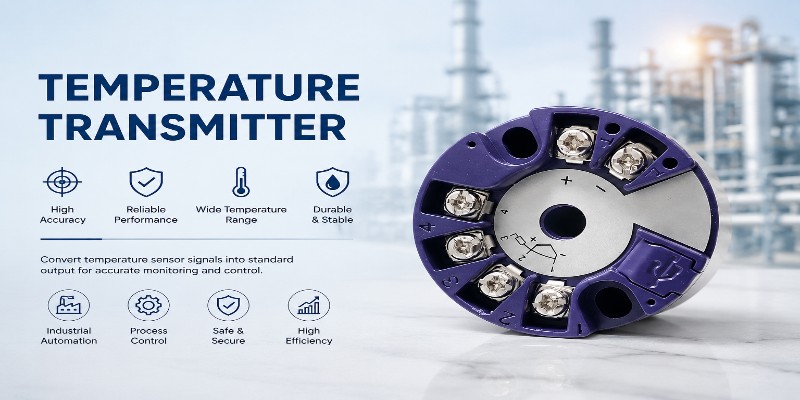
A temperature transmitter is a device that takes the raw signal from a temperature sensor — an RTD or a thermocouple — and converts it into a standardized, long-distance signal, almost always a 4-20 mA current loop, that a control system, PLC, or SCADA can actually read reliably.
Without a transmitter, a sensor’s raw output (a few millivolts from a thermocouple, or a changing resistance from an RTD) degrades badly over cable runs of any real length, picks up electrical noise, and can’t be read directly by most control systems. The transmitter solves this at the source: it linearizes the signal, amplifies it, and pushes it out as a robust current loop that stays accurate over hundreds of meters of cable and is immune to the voltage drop that would otherwise corrupt a raw millivolt signal. If you’re specifying or troubleshooting a plant’s temperature measurement loop, understanding the transmitter is just as important as understanding the sensor feeding it.
This guide covers what a temperature transmitter does, how it works, the main types you’ll be choosing between, the specs that actually matter on a datasheet, and where each type fits — including the head-mounted transmitter, the workhorse of most industrial plants.
How a Temperature Transmitter Works
A temperature transmitter sits between the sensor and the control system and does three jobs in sequence:
- Signal acquisition — it reads the raw input from an RTD (resistance, e.g., Pt100) or a thermocouple (millivolt EMF).
- Linearization and conditioning — RTD resistance and thermocouple voltage are not linear with temperature; the transmitter’s internal electronics correct for this so the output tracks temperature accurately across the full range, and it also performs cold-junction compensation for thermocouple inputs.
- Output conversion — the corrected reading is converted into a standardized 4-20 mA signal (in most industrial transmitters), where 4 mA represents the low end of the calibrated range and 20 mA represents the high end. Many modern transmitters overlay digital HART communication on the same two wires, allowing configuration, diagnostics, and secondary variables to be read without extra wiring.
Because the current loop is proportional and self-checking (a reading below 4 mA or above 20 mA typically flags a fault), transmitters also give you a built-in first layer of sensor-failure detection — a broken RTD or open thermocouple usually drives the output to a defined failure state (commonly low, around 3.9 mA, or high, depending on configuration) rather than failing silently.
Why Use a Temperature Transmitter Instead of Wiring the Sensor Directly?
- Signal integrity over distance — a 4-20 mA current loop doesn’t degrade with cable length the way a raw millivolt or resistance signal does.
- Noise immunity — current loops are far less susceptible to electrical interference than the raw sensor signal, which matters heavily near VFDs, motors, and switchgear.
- Standardization — nearly every PLC, DCS, and indicator on the market accepts a 4-20 mA input, so the transmitter makes the sensor “speak a language” your control system already understands, regardless of sensor type.
- Diagnostics — HART-enabled transmitters let you check sensor health, trim calibration, and read diagnostics remotely without opening the head or pulling the sensor.
- Simplified wiring — one standard 2-wire loop replaces the need to run RTD or thermocouple extension cable (with its own compensation and cost issues) all the way back to the control room.
Types of Temperature Transmitters
1. Head Mounted Temperature Transmitter
A head mount temperature transmitter is built to fit directly inside the connection head of an RTD or thermocouple sensor assembly, converting the signal to 4-20 mA right at the measurement point. This is the most widely used transmitter type in industrial plants because it eliminates long runs of RTD/thermocouple extension wire — you only need to run standard two-core cable from the head back to the control system, which cuts both installation cost and the noise/error that comes with long sensor-grade cable runs. It accepts both RTD and thermocouple inputs, so the same transmitter design can serve either sensor type depending on the internal configuration.
2. DIN Rail / Panel Mount Temperature Transmitter
Mounted in a control panel or junction box rather than at the sensor head, DIN rail transmitters are used when the sensor signal is already being brought back to a central panel, or where panel-based signal conditioning is preferred for easier access and maintenance.
3. Field / Remote Mount Temperature Transmitter
Housed in its own explosion-proof or weatherproof enclosure and mounted near — but separate from — the sensor, a field-mount transmitter is used where the sensor head itself doesn’t have room for a head-mount unit, or where hazardous-area housing requirements call for a dedicated enclosure.
4. Dual-Input / Redundant Temperature Transmitter
Accepts two sensor inputs (often for redundancy or differential measurement) and can be configured to output the average, the difference, or switch to a backup sensor automatically if the primary fails — used in safety-critical and high-reliability loops.
RTD vs Thermocouple Input: What the Transmitter Needs to Handle
| Factor | RTD Input | Thermocouple Input |
|---|---|---|
| Signal type | Resistance (e.g., Pt100) | Millivolt EMF |
| Accuracy | Higher, more stable | Slightly lower, wider range |
| Temperature range | Generally lower/moderate range | Very high temperature capable |
| Cold-junction compensation | Not required | Required — built into the transmitter |
| Typical use | Precision process control | High-temp furnaces, kilns, exhaust |
A good head-mount transmitter is configurable for either input type, so the same transmitter model can be paired with whichever sensor the application calls for — this is one of the first things to confirm on a datasheet before ordering.
Key Specifications to Check on a Temperature Transmitter Datasheet
- Input type supported — RTD (2/3/4-wire), thermocouple type (J, K, T, etc.), or both
- Output signal — 4-20 mA analog, HART-overlaid, or fieldbus (Foundation Fieldbus/Profibus PA)
- Accuracy — typically expressed as %FS (percent of full scale); confirm this against your process’s required measurement tolerance, not just the headline number
- Response time — how fast the transmitter reflects a real process temperature change; matters for fast-cycling processes
- Power supply range — loop-powered transmitters typically operate across a wide DC voltage window (commonly 12–40V DC)
- Ambient working temperature range — the transmitter’s own electronics have a rated operating window, separate from the process temperature being measured
- Ingress protection (IP rating) — IP66/IP67 for outdoor or washdown-prone installations
- Hazardous area certification — required for flammable-atmosphere installations (ATEX/IECEx/PESO as applicable)
- Fault/alarm behavior — how the transmitter signals a sensor break or out-of-range condition (commonly a defined high or low current, e.g., 3.9 mA)
- Vibration/shock rating — relevant for transmitters mounted directly on rotating or high-vibration equipment
Where Temperature Transmitters Are Used
- Oil, gas, and petrochemical processing
- Power generation — boilers, turbines, steam systems
- Chemical and pharmaceutical manufacturing
- Food and beverage processing
- HVAC and building automation
- Water and wastewater treatment
- Cement, steel, and heavy process industries
- Any pipeline, vessel, or reactor already fitted with a thermowell and RTD/thermocouple assembly
Temperature Transmitter Selection Checklist
Before ordering, confirm these with your instrumentation engineer:
- Sensor input type — RTD, thermocouple, and specific sub-type (Pt100, Type K, etc.)
- Required output — plain 4-20 mA analog vs HART digital communication
- Measurement range and required accuracy — matched to the process, with margin
- Mounting style — head-mount (most common), DIN rail, or remote field enclosure
- Area classification — safe area vs hazardous/explosive atmosphere requiring certified housing
- Environmental rating — IP rating and ambient temperature range for the installation location
- Loop power availability — confirm supply voltage at the transmitter location supports the transmitter’s rated power range
- Compatibility with existing sensor assembly — if retrofitting, confirm head size and thread/connection match your existing head type RTD sensor or head type thermocouple assembly
Aavad Instrument’s Head Mounted Temperature Transmitter
Aavad’s head mount temperature transmitter is built for exactly this kind of at-source signal conversion — accepting RTD or thermocouple input and delivering a clean, loop-powered 4-20 mA output that’s ready to wire straight back to your control system. Key specs at a glance:
| Parameter | Specification |
|---|---|
| Input | RTD / Thermocouple |
| Output signal | 4-20 mA |
| Accuracy | 0.1% FS |
| Response time | ≤ 1 second |
| Power supply | 12V to 40V DC |
| Working temperature | -40°C to 85°C |
| Protection rating | IP-66 (mounted) |
| Earthquake/vibration resistance | 4g, 2 to 150 Hz |
| Fault/alarm current | 3.9 mA (sensor damage/disconnect) |
That 0.1% FS accuracy and sub-1-second response time put it in a genuinely competitive range for general industrial process duty, while the IP-66 rating and wide power window make it a straightforward fit for outdoor and plant-floor installations without extra protective housing.
Why Choose Aavad Instrument as Your Temperature Transmitter Manufacturer
- ISO 9001:2015 certified manufacturing with NABL-accredited calibration support
- Full temperature-loop portfolio — transmitters, RTD and thermocouple sensors, thermowells, connectors, and indicators from a single temperature transmitter manufacturer, so a full measurement loop can be sourced from one vendor
- Custom configuration support — input type, range, and output can be matched to your exact process rather than forcing a catalog-standard spec
- Proven industrial track record — long-standing supply relationships with BHEL, ONGC, NPCIL, Indian Oil, BPCL, L&T, and other major industrial and public-sector accounts
- Pairs directly with Aavad’s thermowells and RTD/thermocouple sensors for a complete, single-source temperature measurement assembly
If you’re specifying a new temperature loop or replacing an ageing transmitter, get a quote from Aavad’s engineering team — share your sensor type, required range, output signal, and area classification, and they’ll recommend the right configuration rather than just selling a catalog part number.
Frequently Asked Questions (FAQ)
1. What does a temperature transmitter do? A temperature transmitter converts the raw signal from an RTD or thermocouple sensor — resistance or millivolt EMF — into a standardized 4-20 mA current signal that can travel long distances and be read directly by a PLC, DCS, or indicator.
2. What is the difference between a temperature sensor and a temperature transmitter? The sensor (RTD or thermocouple) is what physically measures temperature. The transmitter is a separate electronic device that takes the sensor’s raw, weak, distance-limited signal and converts it into a robust, standardized 4-20 mA signal suitable for control systems.
3. What is a head mount temperature transmitter? It’s a transmitter small enough to fit inside the connection head of an RTD or thermocouple sensor assembly, converting the signal to 4-20 mA right at the measurement point, which avoids running long, error-prone sensor-grade cable back to the control room.
4. Can one transmitter accept both RTD and thermocouple input? Yes — many head mount transmitters, including Aavad’s, are configurable for either RTD or thermocouple input, so the same transmitter model can serve either sensor type depending on configuration.
5. What does 4-20 mA output mean on a transmitter? It’s an industry-standard current loop signal where 4 mA represents the lowest calibrated temperature in the measurement range and 20 mA represents the highest, with every value in between mapped proportionally. It’s used because current loops resist signal loss and electrical noise over long cable runs, unlike raw sensor signals.
6. What is HART protocol on a temperature transmitter? HART overlays a digital communication signal on top of the same two wires carrying the 4-20 mA analog output, allowing configuration, diagnostics, and additional data to be read from the transmitter without extra wiring — most modern smart transmitters support it.
7. How accurate is a typical industrial temperature transmitter? Accuracy is usually expressed as a percentage of full scale (%FS). A well-specified industrial transmitter, such as Aavad’s head mount unit, typically achieves around 0.1% FS, which is suitable for most standard process control applications.
8. What happens if the sensor connected to a transmitter fails? Most transmitters are designed to drive their output to a defined fault state — commonly a fixed low current like 3.9 mA — when the sensor is damaged, disconnected, or out of range, so the control system can flag the fault rather than reading a false temperature.
9. Do I need a hazardous-area rated transmitter? Only if the transmitter will be installed in a classified flammable or explosive atmosphere (e.g., certain oil & gas or chemical plant zones) — in that case you need a transmitter with the appropriate ATEX/IECEx/PESO certification for that zone, not a general-purpose unit.
10. How do I choose the right temperature transmitter for my application? Confirm four things first: sensor input type (RTD or thermocouple), required output (plain 4-20 mA or HART), the process temperature range and accuracy you need, and the installation environment (mounting style, IP rating, hazardous-area classification). Share these with a transmitter manufacturer’s engineering team for a proper recommendation rather than choosing from a catalog by price alone.
Have a specific loop to spec out? Contact Aavad Instrument’s engineering team with your sensor type, range, and output requirements for a free recommendation.