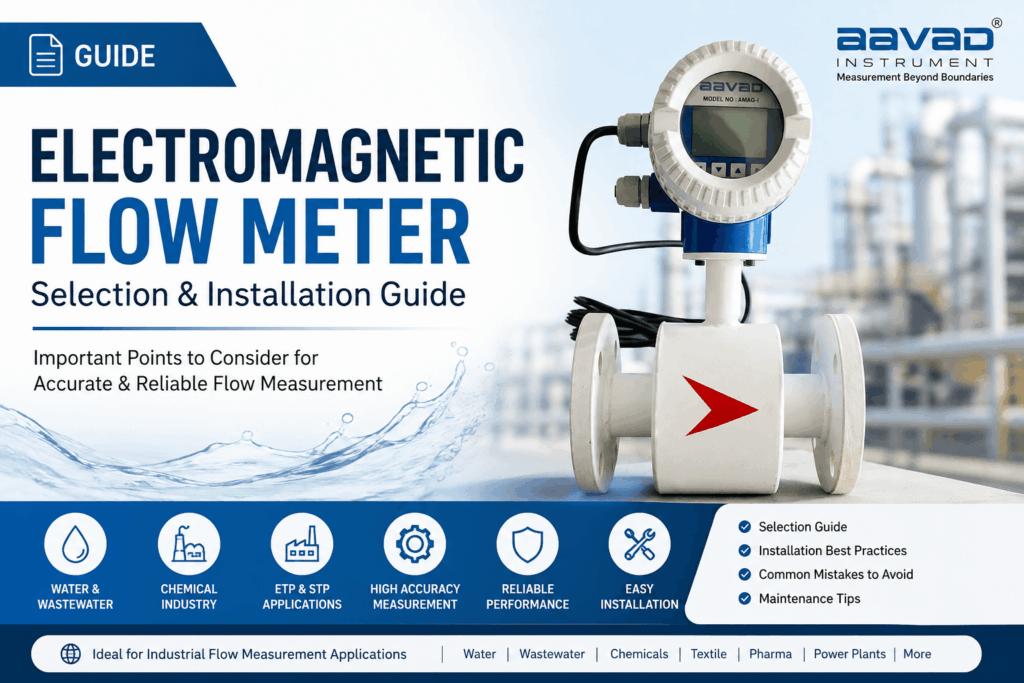
How to Select and Install an Electromagnetic Flow Meter Correctly
Electromagnetic Flow Meter selection and installation are critical for achieving accurate, reliable, and long-term flow measurement in industrial applications. Also known as a Magnetic Flow Meter or Mag Flow Meter, an electromagnetic flow meter is widely used for measuring the flow of conductive liquids such as water, wastewater, effluent, chemicals, process liquids, sewage, and slurry.
Choosing a flow meter based only on pipe size is not enough. Important parameters such as fluid conductivity, flow rate, flow velocity, pipe size, liner material, electrode material, operating temperature, pressure, accuracy, output signal, and installation conditions must be evaluated before selecting the right instrument.
Similarly, even a high-quality electromagnetic flow meter can provide unstable or inaccurate readings if it is not installed correctly.
This complete guide explains the most important points to consider when selecting, installing, commissioning, and maintaining an Electromagnetic Flow Meter.
What is an Electromagnetic Flow Meter?
An Electromagnetic Flow Meter is an industrial flow measurement instrument that measures the volumetric flow rate of electrically conductive liquids using the principle of Faraday’s Law of Electromagnetic Induction.
When a conductive liquid passes through a magnetic field generated inside the flow meter, a small electrical voltage is induced in the liquid. The electrodes installed inside the measuring tube detect this voltage, and the transmitter processes the signal to calculate the liquid flow rate.
Unlike many mechanical flow meters, electromagnetic flow meters generally have no moving parts inside the measuring tube. This makes them suitable for many industrial applications where reliable and low-maintenance flow measurement is required.
Basic Working Principle
Conductive Liquid Flow → Magnetic Field → Electrical Signal → Signal Processing → Flow Rate
Electromagnetic flow meters are commonly used for:
- Water flow measurement
- Wastewater flow measurement
- Effluent flow measurement
- Sewage flow measurement
- Chemical process liquids
- Industrial process water
- STP and ETP applications
- Water treatment plants
- Textile processing
- Pharmaceutical industries
- Power plants
- Rainwater harvesting systems
- Slurry and suspended-solid applications
Why is Proper Electromagnetic Flow Meter Selection Important?
Selecting the correct electromagnetic flow meter is essential for achieving accurate and stable flow measurement.
An incorrectly selected flow meter can result in:
- Inaccurate flow readings
- Unstable output signals
- Poor low-flow performance
- Empty-pipe alarms
- Electrode coating
- Liner damage
- Incorrect totalized flow
- Frequent maintenance
- Reduced service life
- Process control problems
Therefore, the flow meter should always be selected according to the actual process conditions and application requirements.
Important Points to Consider When Selecting an Electromagnetic Flow Meter
1. Identify the Type of Fluid
The first step in selecting an electromagnetic flow meter is to identify the liquid being measured.
Examples include:
- Raw water
- Treated water
- Wastewater
- Effluent
- Sewage
- RO reject water
- Chemical solutions
- Process liquids
- Slurry
- Industrial utility water
The chemical characteristics of the liquid directly influence the selection of the liner and electrode materials.
Before ordering a flow meter, provide the manufacturer with the exact fluid name and, wherever possible, its chemical composition.
2. Check Fluid Conductivity
Electrical conductivity is one of the most important parameters for electromagnetic flow meter selection.
Electromagnetic flow meters are designed for electrically conductive liquids. The minimum conductivity requirement varies depending on the flow meter design and manufacturer.
If the liquid conductivity is below the instrument’s specified operating range, the flow meter may not be able to generate a reliable measurement signal.
Before selecting the meter, check:
- Minimum conductivity
- Normal conductivity
- Conductivity variation
- Chemical composition of the liquid
Important: Electromagnetic flow meters are generally not suitable for non-conductive liquids such as many oils, fuels, and hydrocarbon-based liquids.
3. Check the Pipe Size
Pipe size is an important consideration, but the flow meter should not always be selected solely by matching the existing pipe diameter.
For proper sizing, evaluate:
- Pipe diameter
- Minimum flow
- Normal flow
- Maximum flow
- Required flow velocity
- Application accuracy
- Installation arrangement
For example, if the process pipeline is DN100, a DN100 electromagnetic flow meter may be suitable, but the final selection should also be verified against the actual operating flow range.
4. Check Minimum, Normal and Maximum Flow Rate
Do not select an electromagnetic flow meter based only on maximum flow.
Always collect three important values:
Minimum Flow → Normal Flow → Maximum Flow
For example:
- Minimum Flow: 10 m³/hr
- Normal Flow: 50 m³/hr
- Maximum Flow: 80 m³/hr
These values help determine the appropriate meter size and measuring range.
A properly sized meter provides better measurement performance across the actual operating range.
5. Consider Flow Velocity
Flow velocity is another important parameter when selecting an electromagnetic flow meter.
Very low flow velocity can make low-flow measurement more challenging, while excessively high velocity can increase pressure loss and potentially contribute to liner wear depending on the application.
Therefore, the actual minimum, normal, and maximum flow conditions should be evaluated against the manufacturer’s recommended velocity range.
Flow velocity depends on:
- Pipe diameter
- Flow rate
- Meter diameter
The objective should be to select a meter size that provides an appropriate velocity over the normal operating range.
6. Select the Correct Liner Material
The liner is in direct contact with the process liquid, making liner selection extremely important.
Common liner materials include:
- PTFE
- PFA
- EPDM
- Hard rubber
- Soft rubber
- Other application-specific materials
The appropriate liner depends on:
- Chemical compatibility
- Fluid temperature
- Fluid concentration
- Abrasiveness
- Operating pressure
- Application conditions
Example
PTFE and PFA liners can be suitable for many chemically aggressive or higher-temperature applications, while rubber and EPDM liners are commonly used in various water and wastewater applications.
The final liner selection should always be confirmed based on the actual fluid and manufacturer’s chemical compatibility recommendations.
7. Select the Correct Electrode Material
Electrodes are exposed to the process liquid and therefore must be selected according to the fluid characteristics.
Common electrode materials may include:
- SS316L
- Hastelloy
- Titanium
- Tantalum
- Platinum-based materials
The selection depends on:
- Fluid chemistry
- pH
- Corrosiveness
- Chloride concentration
- Temperature
- Chemical compatibility
Incorrect electrode selection can result in corrosion, coating, unstable measurement, or premature failure.
8. Check Operating Temperature
The electromagnetic flow meter must be suitable for the actual process temperature.
Before selection, determine:
- Minimum process temperature
- Normal process temperature
- Maximum process temperature
- Ambient temperature
- Liner temperature rating
- Electronics temperature rating
For high-temperature applications, the appropriate sensor and transmitter configuration should be selected according to the manufacturer’s specifications.
9. Check Operating Pressure
The flow meter’s pressure rating must be suitable for the maximum pressure in the pipeline.
Check:
- Normal operating pressure
- Maximum operating pressure
- Pressure fluctuations
- Pressure surges
- Water hammer
- Flange pressure class
The selected electromagnetic flow meter should have a suitable pressure rating for the actual process conditions.
10. Select the Correct Process Connection
Electromagnetic flow meters are available with different process connection arrangements.
Common options include:
- Flanged connection
- Wafer connection
- Threaded connection
- Application-specific connections
Before ordering, verify:
- Nominal pipe size
- Flange standard
- Pressure rating
- Bolt arrangement
- Face-to-face dimensions
- Installation space
Incorrect connection specifications can create installation problems at the site.
11. Consider Required Accuracy
Different applications require different levels of measurement accuracy.
For example, the accuracy requirement for general process monitoring may differ from applications where flow measurement is used for process control, water management, or commercial measurement.
Consider:
- Required accuracy
- Repeatability
- Measuring range
- Calibration requirements
- Process control requirements
Always communicate the required accuracy to the flow meter manufacturer before finalizing the model.
12. Select the Required Output and Communication
Modern electromagnetic flow meters can provide several output and communication options.
Depending on the application, you may require:
- 4–20 mA output
- Pulse output
- Frequency output
- Relay output
- RS-485
- Modbus RTU
- Digital communication
If the flow meter will be connected to a PLC, SCADA, DCS, telemetry system, or industrial automation system, the required communication protocol should be confirmed before purchase.
13. Check Power Supply
Verify the available power supply before selecting the flow meter.
Common options may include:
- 24 VDC
- 230 VAC
- Other application-specific power supplies
The selected transmitter should be compatible with the available electrical supply.
Power quality, electrical noise, and proper grounding should also be considered in industrial environments.
14. Check Enclosure and Protection Rating
The installation environment determines the required enclosure protection.
For outdoor, wastewater, chemical, and wet-area applications, an appropriate IP protection rating should be selected.
For hazardous locations, additional requirements may include:
- Flameproof construction
- Hazardous-area certification
- Appropriate cable glands
- Applicable area classification
Always verify the site requirements before selecting the transmitter configuration.
Electromagnetic Flow Meter Installation Guide
Correct installation is just as important as correct selection.
Even a properly specified flow meter may provide unstable readings if it is installed incorrectly.
The following installation points should be carefully considered.
1. Select the Correct Installation Location
Install the flow meter at a location where the measuring tube can remain properly filled with liquid.
The installation location should ideally:
- Maintain a full pipe
- Minimize air accumulation
- Avoid excessive vibration
- Provide sufficient maintenance access
- Protect the electronics from unsuitable environmental conditions
- Minimize electrical interference
Avoid locations where the pipe may regularly become empty.
2. Maintain a Full Pipe
A properly filled measuring tube is important for reliable electromagnetic flow measurement.
Avoid installing the meter at locations where:
- The pipe is partially filled
- Air can accumulate
- The pipe opens to atmosphere immediately downstream
- The pipe can drain during normal operation
- The meter is installed at a high point where air may collect
For difficult piping arrangements, consult the flow meter manufacturer before installation.
3. Follow the Correct Flow Direction
Most electromagnetic flow meters have a flow direction arrow marked on the body.
During installation, ensure that the arrow corresponds to the actual process flow direction.
Incorrect orientation can lead to commissioning and measurement problems depending on the instrument configuration.
4. Maintain Appropriate Straight Pipe Length
Straight pipe sections help establish a stable flow profile before and after the flow meter.
Where required by the manufacturer, provide appropriate straight pipe lengths upstream and downstream.
Avoid installing the meter immediately after:
- Elbows
- Pumps
- Control valves
- Reducers
- Tees
- Other major flow disturbances
The exact straight-run requirement depends on the flow meter design and piping configuration. Always follow the manufacturer’s installation manual.
5. Avoid Air Bubbles
Air bubbles inside the measuring tube can affect flow measurement stability.
To reduce the possibility of air entering the flow meter:
- Maintain a full pipe
- Avoid high points where air can accumulate
- Check pump suction conditions
- Avoid unnecessary pressure drops
- Use suitable piping arrangements
This is particularly important for water and wastewater systems.
6. Ensure Proper Grounding and Earthing
Grounding is one of the most important aspects of electromagnetic flow meter installation.
Proper grounding helps provide a stable electrical reference and reduce the influence of electrical noise.
Depending on the pipe material, liner, fluid and flow meter design, the installation may require:
- Grounding connections
- Grounding rings
- Grounding electrodes
- Proper protective earth connection
Always follow the manufacturer’s grounding diagram for the specific flow meter model.
7. Avoid Electrical Interference
Electromagnetic flow meters work with relatively small electrical signals. Strong electrical interference can therefore affect measurement stability.
During installation:
- Keep signal cables away from high-voltage cables
- Avoid unnecessary parallel routing with power cables
- Use appropriate shielding
- Follow the manufacturer’s grounding instructions
- Consider VFD and motor-related electrical noise
Signal cables should not be unnecessarily bundled together with high-power cables.
8. Check Flange Alignment
For flanged electromagnetic flow meters, proper pipe and flange alignment is essential.
Incorrect alignment may cause:
- Mechanical stress
- Leakage
- Gasket problems
- Liner damage
- Excessive stress on the meter body
Never use the flow meter to force misaligned pipes into position.
The pipeline should be properly aligned before the flow meter is installed.
9. Avoid Excessive Pipe Stress
The flow meter should not be used as a structural support for the pipeline.
Ensure that:
- Pipes are properly supported
- The meter is not carrying unnecessary pipe weight
- Thermal expansion is properly managed
- Mechanical stress is minimized
This is especially important for large-diameter flow meters.
10. Consider Valve Location
Control valves can create disturbances in the flow profile.
Where practical, the flow meter should be installed in a piping arrangement that provides a stable flow profile.
The final valve location should be determined according to the process design and the flow meter manufacturer’s recommendations.
11. Select the Correct Installation Orientation
Electromagnetic flow meters can be installed in different orientations depending on the application and manufacturer recommendations.
For liquids containing suspended solids, an installation arrangement that helps maintain a full measuring tube can be beneficial.
The display orientation should also be considered for easy reading and maintenance.
12. Install Signal and Power Cables Correctly
Cable installation is important for stable flow meter operation.
Follow these practices:
- Use the specified cable type
- Maintain recommended cable length
- Keep signal cables away from high-power cables
- Properly terminate cable shields
- Use suitable cable glands
- Prevent moisture ingress
- Follow the transmitter wiring diagram
For remote-type flow meters, the sensor-to-transmitter cable must meet the manufacturer’s specifications.
Electromagnetic Flow Meter Commissioning Checklist
After mechanical and electrical installation, verify the following points before commissioning.
Mechanical Checklist
- Correct flow meter size
- Correct flow direction
- Proper flange alignment
- Correct gasket installation
- Proper bolt tightening
- No excessive pipe stress
- Proper pipe support
- Easy access for maintenance
Process Checklist
- Correct fluid
- Suitable conductivity
- Full pipe condition
- No excessive air bubbles
- Temperature within specified limits
- Pressure within specified limits
- Flow velocity within recommended range
Electrical Checklist
- Correct power supply
- Proper grounding
- Correct signal wiring
- Correct cable shielding
- Correct 4–20 mA connection
- Correct pulse output connection
- Correct RS-485/Modbus wiring where applicable
- PLC/SCADA configuration verified
Common Electromagnetic Flow Meter Installation Mistakes
Avoiding common installation mistakes can significantly improve measurement reliability.
1. Installing the meter where the pipe is not always full
A partially filled pipe can result in unstable or incorrect flow readings.
2. Installing immediately after an elbow or pump
Strong flow disturbances may affect measurement performance.
3. Poor grounding
Incorrect grounding can increase electrical noise and create unstable output.
4. Incorrect liner selection
Chemically incompatible liquids can damage the liner.
5. Incorrect electrode selection
Corrosive process liquids can damage unsuitable electrode materials.
6. Ignoring fluid conductivity
Insufficient conductivity can prevent reliable electromagnetic measurement.
7. Incorrect meter sizing
A poorly sized meter may not provide the desired performance across the actual operating flow range.
8. Routing signal cables alongside high-power cables
Electrical interference may affect the measurement signal.
9. Ignoring pressure and temperature
The selected meter must be suitable for the actual operating conditions.
10. Incorrect flange alignment
Mechanical stress can damage the liner or cause leakage.
Electromagnetic Flow Meter Maintenance Tips
Electromagnetic flow meters generally require limited routine maintenance because they typically do not have moving parts in the measuring tube.
However, periodic inspection is recommended.
Recommended maintenance checks include:
- Inspect cable connections
- Check grounding connections
- Check flange leakage
- Verify flow readings
- Check transmitter display
- Inspect alarms and diagnostic messages
- Check output signals
- Inspect electrodes where applicable
- Check liner condition during scheduled maintenance
- Verify calibration according to application requirements
For critical process applications, periodic calibration or verification can help maintain measurement confidence.
Applications of Electromagnetic Flow Meter
Electromagnetic flow meters are widely used across multiple industries.
Water and Wastewater Industry
Common applications include:
- Raw water measurement
- Treated water
- Wastewater
- Sewage
- STP
- ETP
- Water treatment plants
- Industrial water supply
Chemical Industry
Electromagnetic flow meters can be used for compatible conductive chemical liquids in:
- Chemical processing
- Process lines
- Utility systems
- Chemical treatment
- Effluent systems
Textile Industry
Applications include:
- Process water
- Dyeing plants
- Chemical processing
- Effluent treatment
- Water management
Pharmaceutical Industry
Applications may include:
- Process water
- Utility water
- Wastewater
- Water treatment systems
Other Industrial Applications
Electromagnetic flow meters are also used in:
- Power plants
- Paper industries
- Food and beverage industries
- Mining applications
- Slurry handling
- Manufacturing plants
- Rainwater harvesting systems
- Industrial automation systems
How to Select the Right Electromagnetic Flow Meter?
Before requesting a quotation or placing an order, prepare the following application information.
| Parameter | Information Required |
|---|---|
| Fluid | Water / Wastewater / Chemical / Slurry etc. |
| Conductivity | Minimum / Normal |
| Pipe Size | DN / NB |
| Minimum Flow | m³/hr or LPM |
| Normal Flow | m³/hr or LPM |
| Maximum Flow | m³/hr or LPM |
| Temperature | °C |
| Pressure | bar / kg/cm² |
| Liner | Application dependent |
| Electrode | Application dependent |
| Connection | Flange / Wafer etc. |
| Accuracy | Required accuracy |
| Output | 4–20 mA / Pulse / RS-485 etc. |
| Power Supply | AC / DC |
| Installation | Indoor / Outdoor |
| Hazardous Area | Required / Not Required |
Providing complete application information allows the manufacturer or supplier to recommend a suitable electromagnetic flow meter configuration.
Electromagnetic Flow Meter Selection Checklist
Before purchasing an electromagnetic flow meter, consider the following questions:
Fluid & Process
- What liquid needs to be measured?
- Is the liquid electrically conductive?
- What is the minimum conductivity?
- What are the minimum, normal and maximum flow rates?
- What is the pipe size?
- What is the operating temperature?
- What is the operating pressure?
Material Selection
- Which liner material is suitable?
- Which electrode material is suitable?
- Is the material chemically compatible with the liquid?
Instrument Configuration
- What accuracy is required?
- What output is required?
- Is RS-485/Modbus communication required?
- What power supply is available?
- Is a remote or integral transmitter required?
Installation
- Can the pipe remain full?
- Is sufficient straight pipe available?
- Is proper grounding possible?
- Is the installation exposed to vibration?
- Are electrical interference sources nearby?
Environment
- Is the meter installed indoors or outdoors?
- What IP protection is required?
- Is hazardous-area certification required?
Answering these questions before purchasing can significantly reduce the risk of incorrect flow meter selection.
Why Application-Based Selection is Better Than Pipe-Size-Based Selection
One of the most common mistakes in flow meter purchasing is selecting a meter simply because its diameter matches the pipeline.
For example:
DN100 Pipe ≠ Automatically DN100 Flow Meter
The correct meter size should be evaluated using the actual flow rate and application conditions.
A professional flow meter selection should consider:
Pipe Size + Flow Rate + Flow Velocity + Conductivity + Temperature + Pressure + Fluid Compatibility + Accuracy + Installation Conditions
This approach helps ensure that the selected electromagnetic flow meter is suitable for the actual process.
Conclusion
Selecting and installing an Electromagnetic Flow Meter correctly is essential for achieving accurate, stable, and reliable flow measurement.
During the selection stage, important parameters such as fluid conductivity, pipe size, minimum/normal/maximum flow rate, flow velocity, liner material, electrode material, temperature, pressure, accuracy, process connection, output, power supply and environmental conditions should be carefully evaluated.
During installation, special attention should be given to full pipe conditions, flow direction, straight pipe requirements, grounding, earthing, air bubbles, electrical interference, flange alignment, pipe support and cable routing.
A correctly selected and properly installed electromagnetic flow meter can provide reliable measurement with low maintenance requirements across a wide range of industrial applications.
Whether the requirement is for water, wastewater, ETP, STP, chemical processing, textile, pharmaceutical, power plant, industrial process or rainwater harvesting, application-based selection is the key to achieving dependable flow measurement.
Need Help Selecting an Electromagnetic Flow Meter?
If you are looking for an Electromagnetic Flow Meter for water, wastewater, ETP, STP, chemical processing, textile, pharmaceutical, power plant or industrial applications, providing complete application details can help determine the most suitable configuration.
Share the following details for selection:
- Fluid name
- Pipe size
- Minimum flow
- Normal flow
- Maximum flow
- Operating temperature
- Operating pressure
- Fluid conductivity
- Required accuracy
- Liner requirement
- Electrode requirement
- Output/communication
- Power supply
- Installation location
Based on these parameters, the appropriate flow meter size, liner, electrode material, process connection, transmitter configuration and output can be evaluated.
->Releted Blog Content: Are Your Flow Meters CGWA Compliant? Full India Guide
Frequently Asked Questions About Electromagnetic Flow Meters
1. What is an Electromagnetic Flow Meter?
An Electromagnetic Flow Meter is an industrial instrument used to measure the flow of electrically conductive liquids using electromagnetic induction.
2. How does an Electromagnetic Flow Meter work?
It works on Faraday’s Law of Electromagnetic Induction. A conductive liquid moving through a magnetic field generates a voltage that is detected by electrodes and converted into a flow measurement.
3. Can an Electromagnetic Flow Meter measure wastewater?
Yes. Electromagnetic flow meters are widely used for wastewater, sewage, effluent, STP and ETP applications when the liquid meets the meter’s conductivity and material compatibility requirements.
4. Does an Electromagnetic Flow Meter require a full pipe?
A properly filled measuring tube is generally important for reliable electromagnetic flow measurement.
5. Why is grounding important for an Electromagnetic Flow Meter?
Proper grounding provides an appropriate electrical reference and helps reduce the influence of electrical noise on the measurement signal.
6. How do I select the correct Electromagnetic Flow Meter size?
Meter size should be selected based on the pipe size, minimum/normal/maximum flow rate and recommended flow velocity, rather than pipe size alone.
7. Can an Electromagnetic Flow Meter measure chemical liquids?
Yes, provided the liquid is sufficiently conductive and the selected liner and electrode materials are compatible with the chemical.
8. What outputs are available in an Electromagnetic Flow Meter?
Depending on the model, outputs may include 4–20 mA, pulse, frequency, relay, RS-485 and Modbus communication.
9. What are the common applications of Electromagnetic Flow Meters?
Common applications include water treatment, wastewater, ETP, STP, chemical processing, textile processing, pharmaceutical industries, power plants, industrial utilities and rainwater harvesting systems.
10. What information is required to select an Electromagnetic Flow Meter?
The most important information includes fluid type, conductivity, pipe size, flow range, temperature, pressure, liner, electrode, accuracy, process connection, output, power supply and installation conditions.