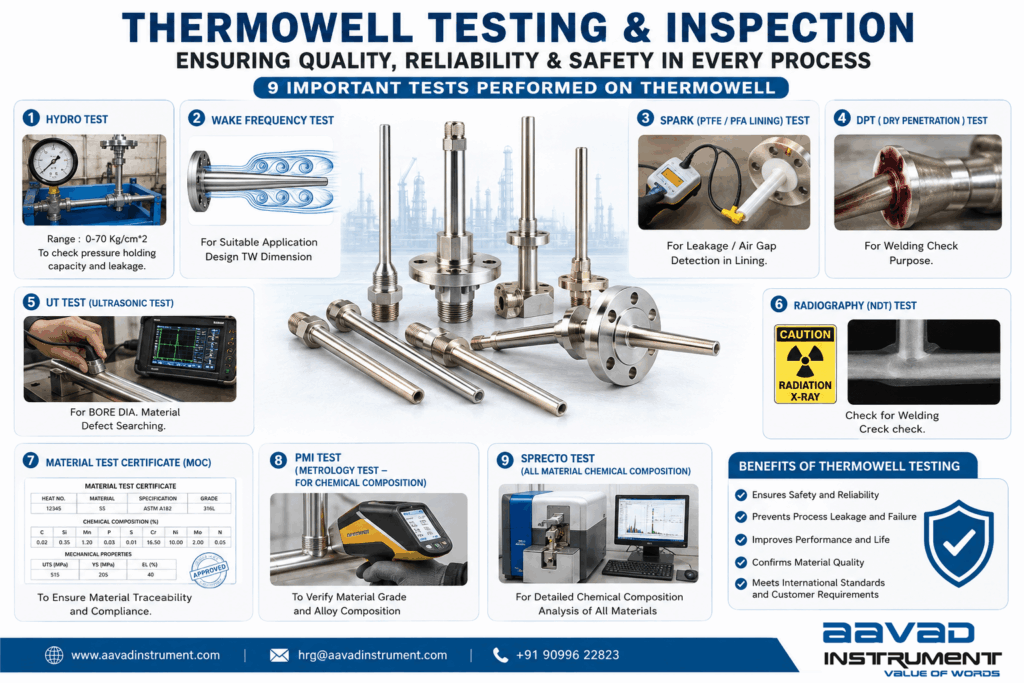
Thermowell Testing & Inspection: Complete Guide to Hydro, NDT, PMI, UT, RT and Wake Frequency Tests
Introduction
A Thermowell is an important mechanical component used to protect temperature sensors such as RTD and Thermocouples from high pressure, high temperature, corrosive fluids and harsh industrial process conditions.
Thermowells are widely used in chemical plants, pharmaceutical industries, refineries, petrochemical plants, power plants, oil & gas industries, steel plants, cement plants, food processing industries and process manufacturing plants.
Since a Thermowell is directly exposed to process pressure, temperature, flow and vibration, its mechanical strength, material quality, welding quality and dimensional suitability are extremely important.
For critical applications, simply manufacturing a Thermowell according to the required dimensions is not enough. Various destructive and non-destructive testing (NDT) methods, material verification tests and design validation tests may be performed to ensure that the Thermowell is suitable for its intended application.
The major Thermowell tests include:
- Hydro Test
- Wake Frequency Test
- Spark Test for PTFE/PFA Lining
- DPT – Dye Penetrant Testing
- UT – Ultrasonic Testing
- Radiography Testing
- Material Test Certificate (MTC/MOC)
- PMI – Positive Material Identification
- Spectro Testing for Chemical Composition
Let’s understand each test in detail.
1. Hydro Test of Thermowell
A Hydrostatic Pressure Test, commonly called a Hydro Test, is performed to verify the pressure integrity and leakage resistance of a Thermowell.
In this test, the Thermowell is subjected to hydraulic pressure using a suitable test medium, normally water, at a specified test pressure.
Typical Test Range
Hydro Test Range: 0–70 kg/cm²
The actual test pressure should be selected according to the Thermowell design, material, process pressure, applicable specification and customer requirement.
Purpose of Hydro Test
The Hydro Test helps verify:
- Pressure resistance
- Leakage protection
- Mechanical integrity
- Welding and joint integrity
- Manufacturing defects
- Pressure containment capability
For high-pressure applications, Hydro Testing becomes particularly important because Thermowell failure can result in process leakage and serious equipment or personnel safety risks.
2. Wake Frequency Test for Thermowell
The Wake Frequency Test is one of the most important engineering checks for Thermowell design.
When a Thermowell is installed inside a flowing process line, fluid flow can generate vortices around the Thermowell. These alternating vortices can produce vibration.
If the vortex shedding frequency approaches the natural frequency of the Thermowell, resonance can occur.
This may lead to:
- Excessive vibration
- Fatigue stress
- Cracking
- Mechanical failure
- Sensor damage
- Thermowell breakage
Purpose of Wake Frequency Analysis
The Wake Frequency Test/Analysis is used to determine whether the proposed Thermowell dimensions are suitable for the application.
Important parameters can include:
- Thermowell insertion length
- Bore diameter
- Tip diameter
- Shank diameter
- Process velocity
- Fluid density
- Fluid viscosity
- Operating temperature
- Operating pressure
- Material properties
The analysis helps determine a suitable Thermowell dimension and design for the actual process conditions.
Why Is Wake Frequency Analysis Important?
A Thermowell that works perfectly in a low-flow application may not be suitable for a high-velocity process line.
Therefore, for critical applications, Thermowell design should be evaluated according to actual process conditions rather than selecting dimensions only based on standard drawings.
3. Spark Test for PTFE / PFA Lined Thermowell
For PTFE or PFA lined Thermowells, a Spark Test can be performed to identify defects in the lining.
The test is particularly useful for detecting:
- Pinholes
- Lining discontinuity
- Leakage paths
- Air gaps
- Insulation/lining defects
- Damage to the protective lining
The testing method applies a suitable high-voltage electrical potential across the lining while monitoring for electrical discharge.
If a discontinuity exists in the lining, the test equipment can identify the defect.
Why Spark Testing Is Important
PTFE and PFA linings are commonly used where the Thermowell is exposed to aggressive or corrosive chemicals.
A small lining defect may expose the underlying metal to the process medium, potentially causing corrosion or premature failure.
Therefore, Spark Testing of lined Thermowells provides an additional quality check before the Thermowell is supplied for critical applications.
4. DPT – Dye Penetrant Testing for Welding Inspection
DPT, also known as Dye Penetrant Testing or Liquid Penetrant Testing, is a widely used Non-Destructive Testing (NDT) method.
It is primarily used to identify surface-breaking defects.
In Thermowell manufacturing, DPT can be used for checking weld areas and identifying defects such as:
- Surface cracks
- Welding cracks
- Pinholes
- Surface porosity
- Lack of surface continuity
- Other surface-breaking discontinuities
Basic DPT Process
The general process involves:
- Cleaning the inspection surface
- Applying penetrant
- Allowing sufficient penetration time
- Removing excess penetrant
- Applying developer
- Inspecting the surface for indications
DPT is especially useful for checking welded Thermowell assemblies where surface integrity is critical.
5. UT – Ultrasonic Testing of Thermowell
Ultrasonic Testing (UT) is another important NDT technique used for detecting internal or subsurface material discontinuities.
In Thermowell inspection, UT can be used depending on the component geometry and applicable inspection procedure to examine areas such as:
- Material defects
- Internal discontinuities
- Forging-related defects
- Internal cracks
- Laminations
- Weld areas, where applicable
UT uses high-frequency sound waves to inspect the material without damaging the component.
Advantages of UT
- Non-destructive inspection
- Can identify internal discontinuities
- Suitable for many metallic components
- Provides information about defect location and size
- Useful for quality assurance of critical components
For Thermowells manufactured from forged or bar-stock material, UT requirements may be specified depending on the application and customer inspection requirements.
6. Radiography Testing – RT / NDT
Radiography Testing (RT) is a Non-Destructive Testing method used primarily to inspect welds and identify internal discontinuities.
In applicable Thermowell constructions, radiographic inspection can help detect defects that may not be visible from the outside.
Possible weld-related indications include:
- Internal cracks
- Porosity
- Slag inclusions
- Lack of fusion
- Incomplete penetration
- Other internal weld discontinuities
Radiography uses X-rays or gamma radiation to produce an image of the internal structure.
Importance of RT for Thermowells
For critical process applications where welding integrity is important, RT can provide additional confidence regarding the quality of welded joints.
The applicable acceptance criteria should always be defined according to the relevant design code, specification, project requirement or customer-approved inspection procedure.
7. Material Test Certificate – MTC / MOC
A Material Test Certificate (MTC), often referred to as a Material Certificate or MOC documentation, provides traceability and verification of the material used to manufacture the Thermowell.
Typical information may include:
- Material grade
- Heat number
- Chemical composition
- Mechanical properties
- Manufacturer details
- Applicable standard
- Test results
- Batch/lot information
Common Thermowell materials can include stainless steels and alloy materials selected according to the process environment.
Why MTC Is Important
The material selected for a Thermowell must be compatible with:
- Process temperature
- Process pressure
- Chemical environment
- Corrosion conditions
- Mechanical loading
- Expected service life
MTC documentation helps establish material traceability and supports quality documentation for industrial projects.
8. PMI Test – Positive Material Identification
PMI, or Positive Material Identification, is performed to verify the alloy composition of the material.
It is particularly useful for confirming whether the supplied material matches the specified material grade.
PMI can help identify major alloying elements such as:
- Chromium
- Nickel
- Molybdenum
- Manganese
- Silicon
- Other applicable alloying elements
PMI is commonly performed using portable alloy-analysis equipment such as XRF or other suitable methods depending on the material and required accuracy.
Why PMI Testing Matters
Correct material selection is extremely important in chemical, petrochemical, pharmaceutical, power and other demanding industries.
Using the wrong material grade can result in:
- Corrosion
- Reduced mechanical strength
- Premature failure
- Process contamination
- Reduced service life
PMI therefore provides an additional verification layer for critical Thermowell applications.
9. Spectro Test – Chemical Composition Analysis
A Spectro Test is used for detailed chemical composition analysis of metallic materials.
Spectro analysis can provide information about the percentage of various elements present in the material.
Depending on the instrument and testing method, elements such as:
- Carbon
- Silicon
- Manganese
- Phosphorus
- Sulfur
- Chromium
- Nickel
- Molybdenum
- Iron
- Other alloying elements
can be analyzed.
Spectro Test vs PMI
Both PMI and Spectro analysis are related to material identification and chemical composition verification, but the testing equipment, method, accuracy and reporting requirements can differ.
The appropriate method should be selected according to the material grade, application and required inspection standard.
Thermowell Testing: Why These Tests Are Important
A Thermowell may look like a simple mechanical component, but its performance depends on several factors.
A properly tested Thermowell should have:
- Correct material
- Suitable dimensions
- Adequate pressure resistance
- Proper welding quality
- Suitable vibration resistance
- Correct bore and tip dimensions
- Proper surface integrity
- Suitable corrosion resistance
- Complete material traceability
This is why different tests are selected according to the application.
Thermowell Testing Matrix
| Test | Primary Purpose |
|---|---|
| Hydro Test | Pressure integrity and leakage checking |
| Wake Frequency Test | Vibration/resonance and design suitability |
| Spark Test | PTFE/PFA lining defect and leakage detection |
| DPT | Surface crack and welding defect detection |
| UT | Internal/subsurface material defect detection |
| Radiography | Internal weld defect inspection |
| MTC/MOC | Material grade and traceability documentation |
| PMI | Material/alloy identification |
| Spectro Test | Detailed chemical composition analysis |
Which Thermowell Tests Are Required?
Not every Thermowell necessarily requires all nine tests.
The required inspection depends on:
- Process pressure
- Process temperature
- Fluid velocity
- Process fluid
- Corrosiveness
- Thermowell material
- Manufacturing construction
- Welding requirements
- Thermowell dimensions
- Industry
- Customer specification
- Applicable design/inspection standard
- Criticality of the application
For example, a high-pressure chemical process may require more extensive inspection than a low-pressure utility application.
Similarly, a PTFE/PFA lined Thermowell may require Spark Testing, while a welded Thermowell may require DPT or RT depending on the inspection requirement.
Thermowell Quality Control and Inspection
A professional Thermowell manufacturing process should include proper inspection at different stages.
Typical Quality Control Process
Material Selection → Material Verification → Machining → Welding → Dimensional Inspection → NDT → Pressure Testing → Final Inspection → Documentation → Dispatch
This approach helps ensure that the finished Thermowell meets the required technical and quality specifications.
Applications of Tested Thermowells
Tested and properly engineered Thermowells are widely used in:
- Chemical Processing Plants
- Pharmaceutical Industries
- Petrochemical Plants
- Oil & Gas Industries
- Refineries
- Power Plants
- Steel Plants
- Cement Plants
- Textile Industries
- Food Processing Plants
- Water Treatment Plants
- Wastewater Treatment Plants
- Fertilizer Industries
- Process Manufacturing Plants
They can be used with RTD sensors, PT100 sensors and Thermocouples for reliable temperature measurement.
How to Select the Right Thermowell?
Before manufacturing or selecting a Thermowell, important process information should be considered.
Required Process Details
- Process fluid
- Operating pressure
- Design pressure
- Operating temperature
- Design temperature
- Flow velocity
- Pipe size
- Connection type
- Insertion length
- Material requirement
- Sensor type
- Sensor diameter
- Bore diameter
- Corrosion conditions
Providing accurate process data helps in selecting an appropriate Thermowell design and determining whether additional engineering analysis, such as Wake Frequency Analysis, is required.
Thermowell performance is not determined only by its dimensions or material grade. Design suitability, pressure integrity, welding quality, material verification and NDT inspection are equally important for reliable operation.
Tests such as Hydro Test, Wake Frequency Test, Spark Test, DPT, UT, Radiography, MTC/MOC, PMI and Spectro Analysis provide different levels of verification and help ensure that the Thermowell is suitable for its intended industrial application.
For critical process applications, the testing requirements should be finalized according to the actual process conditions, applicable standards and customer/project specifications.
A properly engineered and inspected Thermowell can help protect temperature sensors, improve measurement reliability and reduce the risk of mechanical failure in demanding industrial environments.
Looking for Thermowell Manufacturing & Testing Support?
If you require Industrial Thermowells, RTD Thermowells, Thermocouple Thermowells, PTFE/PFA Lined Thermowells or application-specific Thermowell designs, share your process parameters and technical requirements with our team.
AAVAD Instrument Pvt. Ltd. provides industrial instrumentation solutions including Thermowells, RTD Sensors, Thermocouples, Temperature Sensors and Electromagnetic Flow Meters for industrial applications across India.
Contact us for Thermowell selection, engineering, manufacturing, testing and inspection requirements.
Website: www.aavadinstrument.com
Email: hrg@aavadinstrument.com
Mobile: +91 90996 22823