Water Temperature Sensor with 4–20 mA Output for Rolling Mill Applications
Introduction
Temperature monitoring is an important part of process control and equipment protection in modern rolling mills. During rolling operations, large amounts of heat are generated due to friction, deformation of metal, high-speed operation and continuous industrial processes. To maintain stable operating conditions, rolling mills commonly use cooling-water systems for rolls, bearings, hydraulic systems, heat exchangers and other critical equipment.
For these applications, accurate and continuous water temperature measurement is essential. An incorrect or unstable water temperature can affect cooling performance, equipment efficiency and overall process stability.
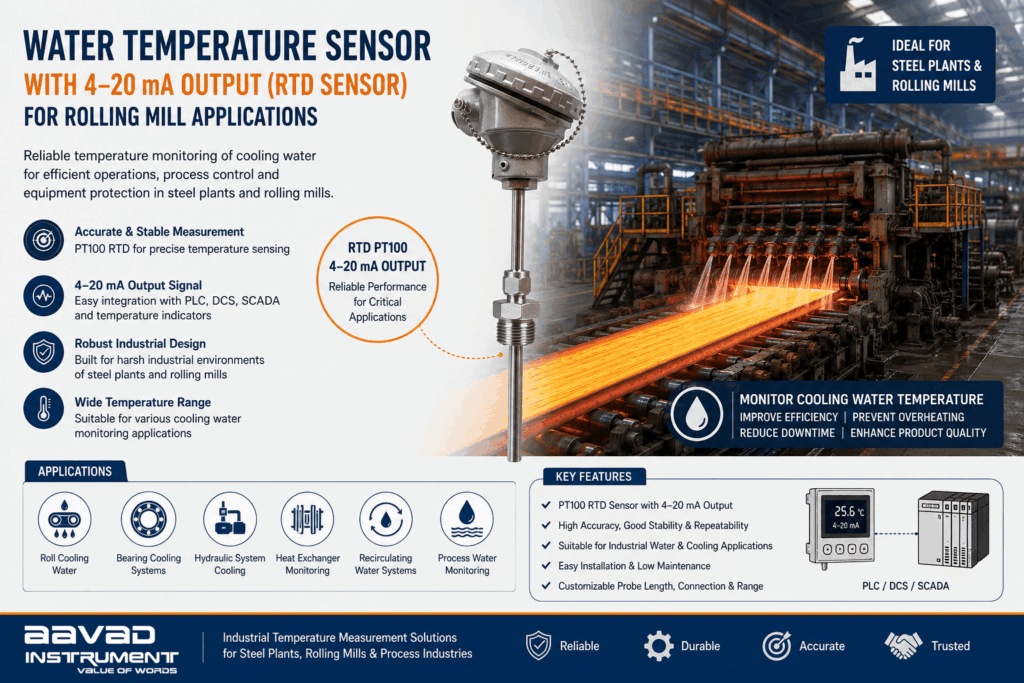
A Water Temperature Sensor with 4–20 mA Output based on RTD technology provides a reliable solution for monitoring cooling-water temperature in rolling mill applications. The sensor can measure process-water temperature and transmit the temperature signal to a PLC, DCS, SCADA system, temperature indicator or other industrial control system.
AAVAD Instrument Pvt. Ltd. has supplied industrial temperature measurement solutions, including RTD temperature sensors with 4–20 mA output, for demanding industrial applications such as rolling mills.
This blog explains the importance of water temperature monitoring in rolling mills, how an RTD sensor works, why 4–20 mA output is preferred in industrial automation, important selection parameters and the benefits of using an industrial RTD temperature sensor.
What Is a Water Temperature Sensor?
A water temperature sensor is an industrial temperature-measuring device designed to detect and monitor the temperature of water or other liquid media.
In a rolling mill, water is frequently used as a cooling medium. The temperature of the cooling water may need to be monitored at the inlet, outlet, circulation line, equipment cooling circuit or other critical points.
An RTD temperature sensor, particularly a PT100 RTD, is commonly used where reliable and accurate temperature measurement is required.
The sensor detects temperature through the change in electrical resistance of the RTD element. The measured temperature can then be converted into a standard industrial signal such as 4–20 mA for transmission to the plant automation system.
Typical measurement chain
Process Water → RTD Sensor → Temperature Transmitter → 4–20 mA Signal → PLC/DCS/SCADA → Operator Monitoring
This arrangement allows operators to continuously monitor water temperature from a control room or local automation system.
Why Is Water Temperature Monitoring Important in Rolling Mills?
Rolling mills operate under demanding mechanical and thermal conditions. Cooling systems help remove heat from equipment and maintain the required operating conditions.
Monitoring cooling-water temperature provides important process information.
1. Maintaining Effective Cooling
-> Cooling water must remain within the required operating temperature range for the particular application. Measuring the water temperature helps operators determine whether the cooling system is performing as expected. If the cooling water becomes excessively hot, its cooling effectiveness may decrease.
2. Equipment Protection
-> Many rolling mill components operate continuously under high mechanical and thermal loads. Proper cooling helps reduce excessive temperature rise in equipment. Continuous temperature monitoring can provide an early indication of abnormal operating conditions.
3. Process Stability
-> Stable cooling conditions can contribute to consistent rolling operations. Temperature information can be integrated into the plant control system for monitoring and process management.
4. Preventive Maintenance
-> A gradual increase in cooling-water temperature can indicate potential issues such as reduced cooling efficiency, heat-exchanger problems, restricted flow or other process abnormalities. Temperature data can therefore support preventive maintenance activities.
5. Automation and Remote Monitoring
-> When the temperature sensor provides a 4–20 mA output, its signal can be easily connected to industrial automation systems. This enables real-time monitoring, alarm generation, data logging and integration with PLC, DCS and SCADA systems.
RTD Temperature Sensor for Rolling Mill Applications
An RTD (Resistance Temperature Detector) measures temperature by using the predictable change in electrical resistance of its sensing element.
One of the most widely used industrial RTDs is the PT100.
A PT100 element has a nominal resistance of 100 ohms at 0°C. As temperature changes, the resistance of the element changes correspondingly. The measuring instrument or transmitter converts this resistance change into a temperature value.
For industrial rolling mill applications, an RTD sensor can be designed according to the process requirements, including:
- Sensor element type
- PT100 configuration
- Accuracy class
- Probe diameter
- Insertion length
- Sheath material
- Process connection
- Cable length
- Temperature range
- Transmitter configuration
- Output signal
- Environmental protection
The correct design depends on the actual installation and process conditions.
What Is a 4–20 mA RTD Temperature Sensor?
A 4–20 mA RTD temperature sensor generally consists of an RTD sensing element and a temperature transmitter that converts the measured temperature into a standardized 4–20 mA electrical signal.
The basic concept is:
RTD measures temperature → Transmitter converts measurement → 4–20 mA signal is sent to control system
The 4–20 mA signal is widely used in industrial instrumentation because it is suitable for transmitting analog process information over industrial wiring.
The control system interprets the current signal according to the configured temperature range.
For example, if a transmitter is configured for a specific temperature range, the lower end of that range corresponds to approximately 4 mA, while the upper end corresponds to approximately 20 mA.
The exact temperature-to-current scaling depends on the transmitter configuration.
Why 4–20 mA Output Is Suitable for Rolling Mills
Rolling mills often have large production areas where sensors may be installed considerable distances away from PLC, DCS or control panels.
A 4–20 mA output provides several practical advantages.
1. Easy PLC and DCS Integration
-> The 4–20 mA output can be connected to compatible analog input modules of PLC and DCS systems. This allows the measured water temperature to be displayed and monitored through the plant automation system.
2. Long-Distance Signal Transmission
-> Industrial plants often require signals to travel from field instruments to control panels. Current-based transmission is widely used for this type of industrial instrumentation.
3. Better Industrial Signal Handling
-> A standardized current signal can provide robust signal transmission in industrial environments when appropriate installation and shielding practices are followed.
4. Easy Alarm Configuration
-> The PLC, DCS or SCADA system can be programmed to generate alarms when water temperature crosses predefined limits.
5. Continuous Monitoring
-> Instead of relying on manual temperature checking, the sensor provides continuous measurement to the automation system.
Rolling Mill Applications of Water Temperature Sensors
A water temperature sensor can be installed at different points depending on the rolling mill’s process design.
- Roll Cooling Water: Rolls can experience significant heat during rolling. Cooling-water temperature can be monitored to help evaluate cooling-system performance.
- Bearing Cooling: Temperature monitoring may also be required in cooling circuits associated with bearings and other rotating equipment.
- Hydraulic System Cooling: Some rolling mill hydraulic systems use cooling arrangements to maintain suitable operating conditions. Water temperature measurement can help monitor the associated cooling circuit where applicable.
- Heat Exchanger Monitoring: Cooling-water temperature at the inlet and outlet of heat exchangers can provide useful information about heat-transfer performance.
- Recirculating Water Systems: Many industrial plants use circulating water systems. Monitoring water temperature at strategic locations helps operators understand the condition of the cooling circuit.
- Process Water Monitoring: Where water is used as part of a rolling process or equipment cooling arrangement, RTD sensors can provide continuous temperature information.
Key Benefits of Using RTD Sensors in Rolling Mills
Selecting a suitable RTD temperature sensor can provide several benefits for industrial temperature measurement.
- High Measurement Reliability: RTDs are widely used for industrial temperature measurement where stable and repeatable temperature measurement is required.
- Continuous Temperature Monitoring: The sensor can provide continuous temperature information instead of requiring periodic manual measurements.
- Automation Compatibility: With a 4–20 mA transmitter output, the sensor can be integrated with PLC, DCS and SCADA systems.
- Improved Process Visibility: Operators can observe cooling-water temperature from the control system and identify changes in operating conditions.
- Equipment Protection: Temperature alarms can be configured to alert operators when the measured temperature exceeds a defined process limit.
- Reduced Manual Monitoring: Continuous electronic measurement can reduce dependence on manual temperature checking.
- Suitable for Industrial Applications: The sensor can be engineered with appropriate construction, materials and protection according to the application’s environmental and process requirements.
Important Parameters for Selecting a Rolling Mill Water Temperature Sensor
Choosing the correct sensor is important for reliable measurement and long service life.
Before selecting an RTD sensor, the following parameters should be considered.
- RTD Element: PT100 is a common choice for industrial temperature measurement. Depending on the application, simplex or duplex RTD configurations may be considered.
- Number of Wires: RTD sensors may use 2-wire, 3-wire or 4-wire configurations. A 3-wire RTD is widely used in industrial applications, while the appropriate configuration depends on the required measurement accuracy and instrumentation system.
- Temperature Range: The required temperature range should be determined according to the actual cooling-water operating conditions and possible temperature excursions. The sensor and transmitter should be selected accordingly.
- Probe Diameter: The probe diameter should be compatible with the installation point, thermowell, connection or piping arrangement.
- Insertion Length: The insertion length must be sufficient to position the sensing element correctly within the water stream. Incorrect insertion depth can affect measurement accuracy.
- Sheath Material: The sheath material should be selected according to the water chemistry, operating temperature, mechanical requirements and environmental conditions.
- Process Connection: Depending on the installation, threaded, flanged or other suitable process connections may be used.
- Cable Length: Cable length should be selected based on the distance between the sensor installation point and the transmitter/control system.
- Output Signal: For automation applications, a 4–20 mA output is a common choice.
- Protection: The sensor assembly should have appropriate environmental protection depending on the installation location, water exposure, dust, vibration and other site conditions.
How Does a Water Temperature RTD Sensor Work?
The working principle is relatively simple.
The RTD sensing element changes its electrical resistance when its temperature changes.
The sensor is installed at the required water measurement point. As water temperature changes, the resistance of the RTD element changes.
The temperature transmitter measures this resistance change and converts it into a standardized 4–20 mA signal.
The signal is then transmitted to the PLC, DCS, SCADA system or temperature monitoring instrument.
Example Signal Flow
Cooling Water -> PT100 RTD Element -> Temperature Transmitter -> 4–20 mA Output -> PLC / DCS / SCADA -> Temperature Display + Alarm + Data Monitoring
This makes the sensor suitable for modern industrial automation systems.
Importance of Correct Sensor Installation
Even a high-quality temperature sensor needs correct installation to achieve reliable measurement.
For rolling mill water-temperature applications, installation should consider:
- Correct insertion depth
- Proper sensor location
- Adequate contact with the flowing water
- Suitable process connection
- Avoiding locations with stagnant water where possible
- Appropriate cable routing
- Proper electrical termination
- Protection against mechanical damage
- Suitable environmental protection
- Correct transmitter configuration
The sensor should be installed at a location representative of the actual process temperature being monitored.
For critical applications, installation should be reviewed according to the plant’s process and instrumentation requirements.
RTD Sensor vs Thermocouple for Water Temperature Measurement
Both RTDs and thermocouples are widely used industrial temperature sensors, but the best choice depends on the application.
For many water-temperature measurement applications, an RTD such as PT100 can be a practical choice because it provides stable and repeatable measurement within its suitable operating range.
Thermocouples are often selected for applications involving higher temperatures and specific process requirements.
For rolling mill cooling-water temperature measurement, an RTD/PT100 sensor with an appropriate transmitter can be a suitable solution where the temperature range and installation conditions are compatible with RTD technology.
The final sensor selection should always be based on actual process conditions.
4–20 mA RTD Sensor Integration with PLC and SCADA
One of the major advantages of using a 4–20 mA temperature transmitter is its compatibility with industrial automation.
The sensor can be connected to an analog input channel of a PLC or DCS.
The automation system can then:
- Display current water temperature
- Record historical temperature data
- Generate high-temperature alarms
- Generate low-temperature alarms
- Monitor trends
- Support preventive maintenance
- Integrate temperature data with other process parameters
When connected to SCADA, temperature trends can be visualized on the operator’s screen.
This provides better visibility of cooling-system performance and helps operators respond quickly to abnormal conditions.
Real Industrial Application: Water Temperature Sensor Supplied for Rolling Mill
AAVAD Instrument Pvt. Ltd. has supplied a Water Temperature Sensor with 4–20 mA Output RTD Sensor for a rolling mill application.
The sensor was supplied for industrial water-temperature monitoring where reliable measurement and integration with the plant’s control system were important requirements.
The application demonstrates how an RTD-based temperature measurement solution can be used in a demanding industrial environment.
For every rolling mill application, sensor construction and specifications should be finalized according to the actual process conditions, installation requirements and customer’s instrumentation system.
Water Temperature Sensor Supplier for Steel Plants Across India
AAVAD Instrument Pvt. Ltd. provides industrial temperature measurement solutions for customers across India.
Our RTD PT100 temperature sensors with 4–20 mA output can be engineered according to application requirements such as temperature range, probe dimensions, insertion length, process connection, cable length, RTD configuration and installation conditions.
For steel plants, rolling mills, metal-processing plants and engineering industries, proper sensor selection is important to achieve reliable temperature measurement and long-term performance.
Whether your plant is located in Gujarat, Maharashtra, Chhattisgarh, Odisha, Jharkhand, West Bengal, Karnataka, Tamil Nadu, Andhra Pradesh, Telangana, Uttar Pradesh, Haryana, Punjab, Rajasthan or Madhya Pradesh, an application-specific RTD temperature measurement solution can be evaluated according to your process requirements.
Why Choose AAVAD Instrument for Industrial RTD Sensors?
AAVAD Instrument Pvt. Ltd. provides industrial temperature measurement solutions for different process industries and applications.
Our temperature-sensor solutions can be customized according to application requirements such as:
- RTD PT100 sensors
- Industrial temperature sensors
- 4–20 mA temperature transmitters
- Cable-type RTD sensors
- Probe-type RTD sensors
- Custom insertion lengths
- Custom process connections
- Industrial sheath materials
- Different wiring configurations
- Application-specific temperature ranges
AAVAD Instrument focuses on application-oriented instrumentation solutions rather than providing only standard catalogue products.
For rolling mills, steel plants, engineering industries and other process industries, the sensor can be selected based on the actual process, installation and automation requirements.
Frequently Asked Questions (FAQ)
What is a water temperature sensor used for in a rolling mill?
-> A water temperature sensor is used to continuously monitor cooling-water temperature in applications such as roll cooling, equipment cooling, bearing cooling circuits, heat exchangers and other industrial water systems.
Which RTD is commonly used for industrial water temperature measurement?
-> PT100 is one of the commonly used RTD elements for industrial temperature measurement. The appropriate sensor configuration depends on the required temperature range, accuracy and installation conditions.
What is the advantage of 4–20 mA output?
-> A 4–20 mA output provides a standardized analog signal that can be integrated with compatible PLC, DCS, SCADA and industrial monitoring systems.
Can an RTD sensor be connected to a PLC?
-> Yes. When the RTD is combined with a suitable temperature transmitter providing 4–20 mA output, the signal can generally be connected to a compatible PLC analog input.
Where can RTD water temperature sensors be used in rolling mills?
-> They can be used for cooling-water monitoring associated with rolls, bearings, hydraulic systems, heat exchangers, circulating-water systems and other suitable process points.
How do I select an RTD sensor for a rolling mill?
-> Important parameters include RTD type, temperature range, accuracy, number of wires, probe diameter, insertion length, sheath material, process connection, cable length, environmental conditions and output signal.
Is PT100 suitable for water temperature measurement?
-> PT100 RTDs are widely used for industrial temperature measurement and can be suitable for water-temperature applications when the sensor construction and temperature range are appropriate for the process.
Can the temperature sensor be customized?
-> Yes. Industrial RTD sensors can be designed according to application-specific requirements such as probe dimensions, cable length, process connection, RTD configuration, sheath material and transmitter output.
Accurate cooling-water temperature measurement plays an important role in maintaining stable and reliable rolling mill operations. A properly selected RTD water temperature sensor with 4–20 mA output can provide continuous temperature information while allowing easy integration with PLC, DCS and SCADA systems.
For rolling mill applications, the right sensor should be selected according to the actual water temperature, installation point, process connection, probe dimensions, environmental conditions and automation requirements.
AAVAD Instrument Pvt. Ltd. provides industrial RTD PT100 temperature sensors and 4–20 mA temperature measurement solutions for process industries and application-specific requirements.
If you are looking for a Water Temperature Sensor for Rolling Mill, PT100 RTD Sensor with 4–20 mA Output, or customized industrial temperature sensor, contact AAVAD Instrument with your application details. Our team can help select a suitable temperature measurement solution based on your process requirements.
Looking for a reliable RTD Water Temperature Sensor for your Rolling Mill?
Share your required temperature range, probe size, insertion length, process connection, cable length and output requirement with AAVAD Instrument Pvt. Ltd.
Contact AAVAD Instrument Pvt. Ltd. for Industrial RTD Temperature Sensors and 4–20 mA Temperature Measurement Solutions.
Website: AAVAD Instrument Pvt. Ltd.
Email: hrg@aavadinstrument.com
Phone: +91 90996 22823