Water-Damaged Electromagnetic Flowmeter Repair | Inspection & Restoration Guide
Electromagnetic flowmeters are widely used in industries for accurate measurement of conductive liquids such as water, wastewater, effluent, chemicals and process fluids. These flowmeters are generally designed for demanding industrial environments, but water ingress, flooding, improper sealing, damaged cable glands and moisture exposure can cause serious damage to the flowmeter electronics and internal components.
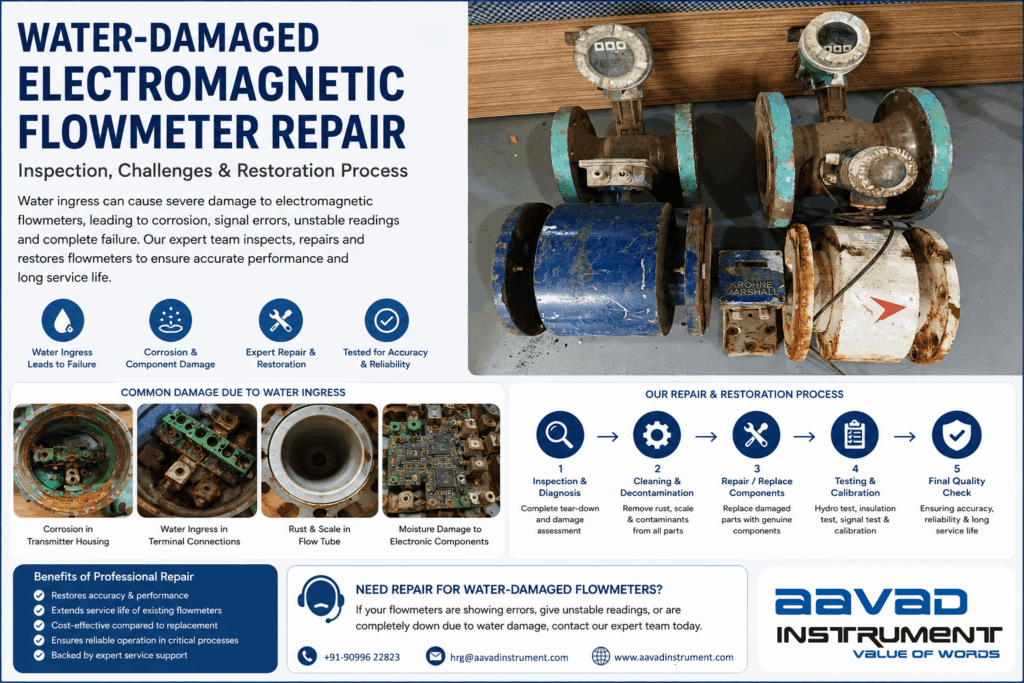
Recently, a set of water-damaged electromagnetic flowmeters was received at our facility for inspection and repair. The flowmeters showed visible signs of prolonged moisture exposure, corrosion, dirt accumulation and deterioration of external components.
This type of condition requires more than simply cleaning the flowmeter. A proper inspection must determine the extent of damage to the transmitter, terminal connections, sensor body, electrodes, coils, cables, connectors, seals and other electrical components.
In this case study, we explain the common causes of electromagnetic flowmeter water damage, inspection procedure, possible failure symptoms, repair challenges and the professional restoration approach followed for industrial flowmeters.
What Is an Electromagnetic Flowmeter?
An electromagnetic flowmeter, also known as a magnetic flowmeter or mag flow meter, is an industrial flow measurement instrument used for measuring the flow rate of electrically conductive liquids.
The operating principle is based on Faraday’s Law of electromagnetic induction.
When a conductive liquid passes through the magnetic field generated inside the flow tube, a small voltage is induced across the electrodes. The flowmeter transmitter processes this signal and converts it into a flow measurement.
Electromagnetic flowmeters are commonly used in:
- Water treatment plants
- Effluent Treatment Plants (ETP)
- Sewage Treatment Plants (STP)
- Chemical industries
- Pharmaceutical industries
- Textile processing plants
- Steel plants
- Power plants
- Paper industries
- Food processing industries
- Mining applications
- Municipal water supply
- Industrial wastewater applications
Because the flowmeter contains both electrical and electronic components, water ingress can significantly affect its performance.
What Causes Water Damage in Electromagnetic Flowmeters?
Water damage can occur due to several reasons. In many industrial installations, the flowmeter may be installed outdoors or in areas exposed to rain, flooding, washdown water, humidity or process leakage.
1. Water Ingress Through Cable Glands
One of the most common causes is improper sealing around cable entries.
If the cable gland is loose, damaged or incorrectly selected, water can enter the transmitter housing through the cable entry.
Once water enters the housing, it can reach:
- Terminal blocks
- PCB
- Electrical connectors
- Signal wiring
- Power supply section
- Communication circuits
This can lead to short circuits, corrosion and electrical failure.
2. Damaged Enclosure Seals
The transmitter housing normally uses seals or gaskets to prevent moisture penetration.
Over time, these seals can become:
- Hard
- Cracked
- Damaged
- Improperly positioned
- Compressed or deformed
A damaged seal can allow moisture to enter the enclosure.
3. Flooding or Heavy Rainfall
Flowmeters installed in low-lying areas can be exposed to flooding or water accumulation.
If water reaches the transmitter housing, the electronics may remain exposed to moisture for an extended period.
4. Improper Installation
Incorrect cable routing, downward-facing cable entries, loose covers or unsuitable cable glands can increase the possibility of water entering the transmitter.
5. High Humidity and Condensation
Even when direct water entry does not occur, high humidity and temperature variations can create condensation inside the transmitter enclosure.
Repeated condensation can gradually cause:
- PCB corrosion
- Terminal oxidation
- Connector deterioration
- Insulation degradation
Water-Damaged Electromagnetic Flowmeter: Inspection Case Study
The flowmeters shown in the supplied case image were received at our facility for inspection and repair after being exposed to water damage.
During visual inspection, several signs indicated significant environmental exposure.
The external condition showed:
- Dirt and deposits on the flowmeter body
- Corrosion around metallic components
- Deterioration of flange areas
- Moisture-related contamination
- Damage or deterioration around transmitter housings
- Corrosion on electrical connection areas
- General aging and environmental exposure
A water-damaged flowmeter should not be immediately powered ON because moisture or conductive contamination inside the electronics can cause additional damage.
Therefore, inspection and electrical safety checks should always be performed before energizing the instrument.
Step-by-Step Inspection of a Water-Damaged Flowmeter
A professional repair process begins with a detailed inspection.
1. Visual Inspection
The first step is to inspect the complete flowmeter externally.
Technicians check:
- Flow tube
- Flanges
- Transmitter housing
- Cable glands
- Cable entries
- Display area
- Junction/terminal box
- Electrical connections
- Mounting hardware
- Sealing surfaces
Visible corrosion or water marks can provide an initial indication of the level of damage.
2. Transmitter Housing Inspection
The transmitter is one of the most critical parts of an electromagnetic flowmeter.
The transmitter contains electronic circuits responsible for:
- Signal processing
- Flow calculation
- Display
- Output generation
- Communication
- Power management
If water enters the transmitter housing, these circuits may be affected.
During inspection, the housing is opened carefully and checked for:
- Moisture
- Water marks
- Rust
- Corrosion
- Oxidation
- Contamination
- Damaged terminals
- PCB deterioration
3. Terminal and Electrical Connection Inspection
Terminal connections are particularly vulnerable to moisture.
Water exposure can result in oxidation and corrosion of electrical terminals.
This may cause:
- Intermittent signals
- Unstable readings
- Loss of output
- Communication failure
- Zero reading
- Incorrect flow indication
- Power supply problems
In severe cases, damaged terminals or connectors may require replacement.
4. PCB and Electronic Circuit Inspection
If water has reached the PCB, a detailed electronic inspection becomes necessary.
The technician checks the board for:
- Corroded tracks
- Damaged components
- Short circuits
- Burn marks
- Oxidation
- Moisture deposits
- Connector damage
Simply drying a PCB does not necessarily mean that it is safe or reliable.
Corrosion can continue to affect electronic components even after visible moisture has disappeared.
Therefore, the PCB should be tested properly before being returned to service.
5. Flow Tube and Electrode Inspection
The flow tube is another important component of an electromagnetic flowmeter.
The internal lining and electrodes should be checked for their condition.
Inspection may include checking for:
- Deposits
- Scaling
- Corrosion
- Mechanical damage
- Lining deterioration
- Electrode contamination
The condition of the flow tube directly affects the measurement performance of the instrument.
6. Coil and Sensor Inspection
The electromagnetic flowmeter sensor generates the magnetic field required for measurement.
The coil and associated wiring should be inspected for:
- Moisture
- Insulation damage
- Electrical continuity
- Short circuits
- Open circuits
- Physical damage
Any abnormality in the coil circuit can affect the flowmeter’s ability to generate and detect the required measurement signal.
Common Symptoms of a Water-Damaged Flowmeter
A water-damaged electromagnetic flowmeter may show one or more of the following symptoms:
Unstable Flow Reading:
-> The displayed flow may fluctuate even when the actual process flow is relatively stable.
No Flow Indication:
-> The display may show zero even though liquid is flowing through the pipeline.
Incorrect Flow Measurement:
-> The flowmeter may provide readings that do not correspond with actual process conditions.
4–20 mA Output Failure:
-> If the transmitter electronics are damaged, the analog output may not function correctly.
Pulse Output Failure:
-> Damage to the output circuit can affect pulse-based flow totalization.
RS-485 / Communication Failure:
-> Moisture-related damage to communication circuits can cause communication problems with PLC, SCADA or other control systems.
Display Failure:
-> The display may become blank, unreadable or intermittent if the transmitter electronics have been affected.
Power Supply Failure:
-> Short circuits or corrosion in the power section can prevent the transmitter from starting.
Electromagnetic Flowmeter Repair and Restoration Process
A proper restoration process depends on the actual condition of the flowmeter.
Step 1: Detailed Inspection
-> The flowmeter is inspected externally and internally to determine the extent of water damage.
Step 2: Disassembly
-> Damaged or contaminated components are carefully dismantled for further inspection.
Step 3: Cleaning and Decontamination
-> Dust, dirt, corrosion products and moisture-related deposits are removed from accessible components.
Step 4: Electrical Testing
-> Electrical circuits are checked for continuity, insulation condition and possible short circuits.
Step 5: Component-Level Assessment
-> Electronic components, terminals, connectors, cables and other parts are evaluated individually.
Step 6: Repair or Replacement
-> Depending on the condition, damaged components may be repaired or replaced. The decision should be based on the actual condition of the component rather than only its external appearance.
Step 7: Reassembly
-> After repair and testing, the flowmeter is carefully reassembled with appropriate attention to sealing and cable entry points.
Step 8: Functional Testing
-> The transmitter and sensor are checked to confirm proper operation.
Step 9: Calibration / Verification
-> Where applicable, flow measurement performance should be verified or calibrated according to the required application and available test facilities.
Step 10: Final Quality Inspection
-> A final inspection is performed before the flowmeter is recommended for field installation.
Why Professional Flowmeter Repair Is Important
Attempting to repair a water-damaged electromagnetic flowmeter without proper inspection can result in repeated failures.
Professional repair helps identify hidden problems that may not be visible from the outside.
Major benefits include:
- Identification of hidden water damage
- Proper electronic inspection
- Corrosion assessment
- Electrical safety verification
- Functional testing
- Reduced risk of repeated failure
- Potential extension of equipment service life
- Better reliability after restoration
In some cases, the cost of professional restoration may be more economical than immediately replacing the complete flowmeter. However, the final repair-versus-replacement decision should always be made after technical inspection.
How to Prevent Water Damage in Electromagnetic Flowmeters
Prevention is always better than repair.
Industries can reduce the risk of water damage by following proper installation and maintenance practices.
Use Proper Cable Glands: Ensure that cable glands are correctly selected, properly tightened and suitable for the installation environment.
Maintain Enclosure Sealing: Check transmitter covers, gaskets and sealing surfaces periodically.
Avoid Water Accumulation: Where possible, install flowmeters away from locations where water can accumulate or flooding can occur.
Proper Cable Routing: Cable entries should be routed in a way that reduces the possibility of water travelling along the cable into the transmitter.
Regular Inspection:
Periodic inspection can identify:
- Loose glands
- Damaged seals
- Corrosion
- Cracked housings
- Cable damage
- Moisture accumulation
before they become major problems.
Water Damage vs Normal Flowmeter Failure
It is important to distinguish between normal electronic failure and water-related failure.
| Parameter | Normal Failure | Water-Damaged Flowmeter |
|---|---|---|
| External condition | Generally normal | May show corrosion/deposits |
| Transmitter | May fail electronically | May contain moisture/corrosion |
| Terminals | Usually intact | May be oxidized/corroded |
| PCB | Component failure possible | Moisture/corrosion may be present |
| Cable glands | Usually functional | May be damaged/loose |
| Flow tube | May remain normal | May show environmental deposits |
| Repair approach | Component troubleshooting | Cleaning + electrical + mechanical inspection |
| Risk of repeated failure | Depends on fault | Higher if water ingress source is not corrected |
When Should You Repair or Replace an Electromagnetic Flowmeter?
Not every water-damaged flowmeter can be economically repaired.
A technical evaluation should consider:
- Age of the flowmeter
- Extent of water damage
- Condition of the transmitter
- Condition of the sensor
- Electrode condition
- Liner condition
- Coil condition
- Availability of replacement components
- Repair cost
- Required measurement accuracy
- Application criticality
If the primary components remain serviceable, restoration may be a practical option.
Importance of Proper Flowmeter Maintenance
Electromagnetic flowmeters are often installed in critical process lines where accurate flow measurement is essential.
A preventive maintenance program can help detect potential problems before complete failure.
Recommended checks may include:
- Visual inspection
- Cable gland inspection
- Terminal inspection
- Housing sealing inspection
- Grounding verification
- Electrical connection inspection
- Flow reading verification
- Output verification
- Periodic calibration/verification as required
Proper maintenance can significantly reduce unexpected downtime.
However, if critical components are extensively damaged, replacement may be technically and economically more suitable.
AAVAD Instrument – Electromagnetic Flowmeter Service & Support
At AAVAD Instrument Pvt. Ltd., we understand that industrial flowmeters can face demanding operating conditions, including moisture, water exposure, corrosion, contamination and electrical issues.
Our technical team can inspect electromagnetic flowmeters to determine the condition of the:
- Flowmeter transmitter
- Sensor body
- Flow tube
- Electrodes
- Coil circuit
- Terminal connections
- Cable and cable glands
- Electronic components
- Mechanical components
Based on inspection findings, the flowmeter can be evaluated for repair, restoration, component replacement, testing or replacement recommendation.
The objective is to provide a technically appropriate solution based on the actual condition of the instrument.
Water damage can seriously affect the performance and reliability of an electromagnetic flowmeter. What may initially appear to be a simple moisture problem can develop into terminal corrosion, PCB damage, electrical failure, unstable readings and complete instrument malfunction.
The water-damaged electromagnetic flowmeters discussed in this case were received for inspection and repair, highlighting the importance of a systematic diagnostic process.
A professional approach should include visual inspection, transmitter examination, electrical testing, sensor assessment, cleaning, component evaluation, repair/replacement, functional testing and final verification.
For industries using electromagnetic flowmeters in water, wastewater, chemical, pharmaceutical, textile, steel, power and other process applications, regular inspection and proper sealing are essential for long-term reliability.
If an electromagnetic flowmeter has been exposed to water, flooding or excessive moisture, do not immediately energize the instrument without inspection. A proper technical assessment can help determine whether the flowmeter can be safely restored or whether replacement is the better option.
Need Repair or Inspection of a Water-Damaged Electromagnetic Flowmeter?
If your electromagnetic flowmeter has been affected by water ingress, flooding, moisture, corrosion, unstable readings, transmitter failure or electrical damage, contact AAVAD Instrument Pvt. Ltd.
Our technical team can inspect the flowmeter and provide a suitable recommendation based on its actual condition.
Send your damaged flowmeter details, photographs, model information and application details to our technical team for evaluation.
AAVAD Instrument Pvt. Ltd. – Industrial Flow Measurement & Instrumentation Solutions