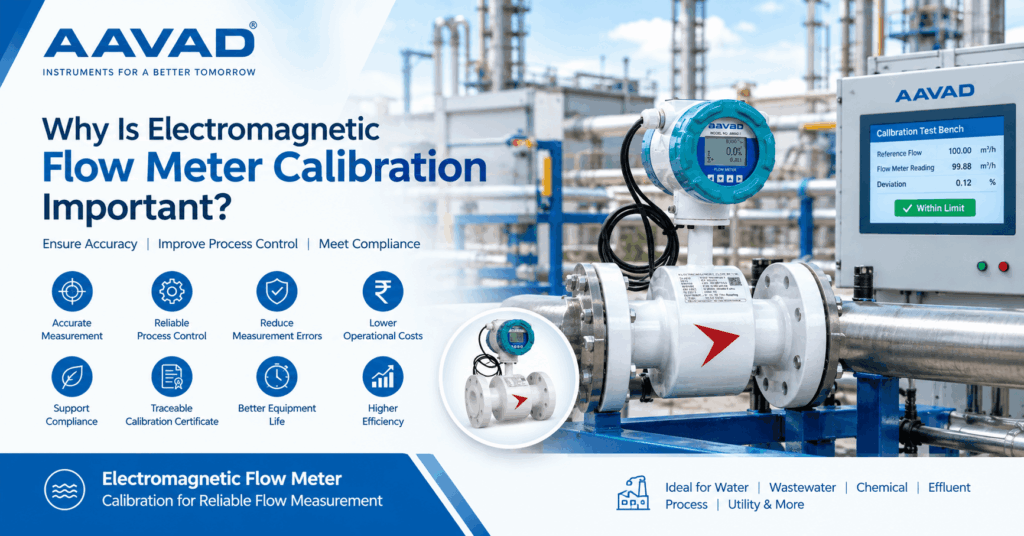
Why Is Electromagnetic Flow Meter Calibration Important? Importance, Process & Benefits
Electromagnetic flow meters (Magnetic Flow Meters) are widely used in industries for accurately measuring the flow of conductive liquids such as water, wastewater, chemicals, effluent, acids, and process fluids. These flow meters are known for having no moving parts and providing reliable flow measurement.
However, even a high-quality electromagnetic flow meter can show measurement deviations over time due to installation conditions, process changes, electrical effects, sensor ageing, or other operating factors. Regular electromagnetic flow meter calibration is therefore essential to maintain measurement accuracy, reliability, and process control.
In this blog, we will understand why electromagnetic flow meter calibration is necessary, how calibration is performed, its benefits, and when a magnetic flow meter should be calibrated.
What Is Electromagnetic Flow Meter Calibration?
Electromagnetic flow meter calibration is the process of checking and verifying the flow meter’s measurement against a known and traceable reference standard.
During calibration, a controlled quantity of liquid is passed through the flow meter and its indicated flow rate is compared with the reference flow rate.
For example:
Reference Flow = 100 m³/h
Flow Meter Indication = 98.5 m³/h
The difference indicates a measurement deviation or error.
Calibration helps determine whether the flow meter is measuring within the required accuracy limits.
Why Is Electromagnetic Flow Meter Calibration Necessary?
1. To Maintain Flow Measurement Accuracy
The primary purpose of calibration is to ensure that the electromagnetic flow meter provides accurate flow readings.
Accurate flow measurement is important when flow data is used for:
- Process control
- Water consumption monitoring
- Chemical dosing
- Effluent monitoring
- Production calculations
- Utility monitoring
- Billing and custody-related measurements
- Environmental compliance
Even a small measurement error can become significant when the flow meter operates continuously.
2. To Detect Measurement Errors
A flow meter may gradually develop measurement deviations due to operating conditions.
Calibration can identify whether the instrument is:
- Reading higher than the actual flow
- Reading lower than the actual flow
- Showing unstable readings
- Developing excessive measurement error
- Operating outside the required accuracy
Early detection allows corrective action before the measurement problem affects the process.
3. To Ensure Reliable Process Control
Many industrial processes depend on accurate flow measurement.
For example, in a chemical plant, incorrect flow measurement can affect the quantity of raw material, chemicals, cooling water, or process water entering a system.
Similarly, in wastewater treatment plants, inaccurate flow measurement can affect monitoring and process calculations.
Regular calibration helps maintain reliable process control.
4. To Reduce Financial Losses
Flow measurement is often directly related to operating costs.
Consider a plant where a flow meter measures thousands of cubic meters of water every month. A small measurement error can result in a significant difference in the calculated consumption.
Accurate calibration helps reduce the risk of:
- Incorrect consumption calculations
- Incorrect production data
- Excessive chemical usage
- Incorrect utility monitoring
- Financial discrepancies
5. To Support Regulatory and Compliance Requirements
In applications where flow measurement data is used for environmental monitoring or regulatory reporting, reliable measurement is particularly important.
Industries involved in:
- Groundwater monitoring
- Effluent monitoring
- Sewage treatment
- Water treatment
- Industrial wastewater management
- Environmental monitoring
may require documented calibration and verification records according to their application or regulatory requirements.
A valid calibration certificate provides documented evidence that the flow meter has been checked against a reference standard.
What Causes Electromagnetic Flow Meter Measurement Errors?
Calibration is important because several factors can influence flow meter performance.
Common causes include:
- Improper installation
- Incorrect grounding
- Air bubbles in the pipeline
- Empty or partially filled pipe
- Electrical interference
- Electrode contamination
- Changes in process conditions
- Sensor ageing
- Incorrect flow profile
- Improper straight pipe length
- Incorrect configuration parameters
- Damaged sensor or cable
- Changes in liner or electrode condition
Not every measurement problem is solved by calibration. If the root cause is installation, grounding, sensor damage, or process conditions, that issue should also be investigated.
How Is an Electromagnetic Flow Meter Calibrated?
The exact calibration procedure depends on the calibration facility and applicable procedure, but a typical flow calibration involves the following steps.
Step 1: Visual Inspection
Before calibration, the flow meter is inspected for:
- Physical damage
- Sensor condition
- Cable condition
- Display condition
- Terminal connections
- Flanges and lining
- Electrode condition
The instrument should be in suitable working condition before calibration.
Step 2: Check Flow Meter Configuration
Important parameters such as:
- Pipe diameter
- Flow range
- Engineering unit
- K-factor or calibration factor
- Output configuration
- Totalizer settings
- Empty pipe detection
- Flow direction
may be checked according to the flow meter design and application.
Step 3: Connect the Flow Meter to a Calibration System
The flow meter is installed in a suitable calibration setup.
A controlled flow of liquid is passed through the sensor while a reference measurement system determines the actual flow.
The reference system should have suitable accuracy and traceability for the intended calibration.
Step 4: Apply Different Flow Rates
The electromagnetic flow meter is tested at selected flow points across its operating range.
For example:
| Test Point | Reference Flow | Flow Meter Reading |
|---|---|---|
| 20% | 20 m³/h | 20.1 m³/h |
| 40% | 40 m³/h | 39.8 m³/h |
| 60% | 60 m³/h | 60.2 m³/h |
| 80% | 80 m³/h | 79.9 m³/h |
| 100% | 100 m³/h | 100.3 m³/h |
The actual test points and acceptance criteria depend on the instrument specification and calibration procedure.
Step 5: Calculate Measurement Error
The difference between the reference value and flow meter indication is evaluated.
A commonly used expression for percentage error is:
Percentage Error = [(Flow Meter Reading − Reference Reading) / Reference Reading] × 100
This helps determine the measurement deviation at each test point.
Step 6: Calibration Certificate
After successful calibration, a calibration certificate can document information such as:
- Instrument identification
- Model
- Serial number
- Flow range
- Calibration date
- Reference standard
- Test points
- Reference readings
- Instrument readings
- Error/deviation
- Calibration result
- Traceability information
The certificate provides a record that can be maintained for quality and audit purposes.
How Often Should an Electromagnetic Flow Meter Be Calibrated?
There is no single calibration interval that is correct for every electromagnetic flow meter.
The recommended calibration frequency depends on:
- Manufacturer recommendations
- Application
- Process fluid
- Operating conditions
- Required measurement accuracy
- Criticality of the measurement
- Previous calibration history
- Regulatory requirements
- Quality management procedures
Some industrial users establish an annual calibration schedule, while other applications may require a different interval based on risk and operating conditions.
For critical measurement applications, calibration or verification should be planned according to the applicable quality and operational requirements.
Calibration vs. Verification: What Is the Difference?
Calibration and verification are related but are not exactly the same.
Calibration
Calibration compares the flow meter measurement with a known reference standard and determines the measurement error or deviation.
Verification
Verification generally checks whether the instrument is operating correctly and whether its performance remains within specified limits.
Depending on the application and manufacturer’s technology, electronic verification or diagnostic methods may also be available.
For critical applications, proper calibration against a suitable reference remains important when traceable measurement accuracy needs to be demonstrated.
Benefits of Regular Electromagnetic Flow Meter Calibration
Regular calibration provides several important benefits:
✔ Improved Measurement Accuracy
Helps maintain reliable flow measurement.
✔ Better Process Control
Accurate flow data supports better control of industrial processes.
✔ Reduced Measurement Errors
Potential deviations can be identified before they become major problems.
✔ Improved Product and Process Quality
Correct flow measurement helps maintain consistent process conditions.
✔ Better Water and Utility Monitoring
Useful for monitoring water consumption, wastewater and process utilities.
✔ Supporting Compliance
Documented calibration records can support quality and regulatory requirements where applicable.
✔ Preventive Maintenance
Calibration can help identify developing measurement problems.
✔ Increased Confidence in Flow Data
Operators and engineers can make decisions based on more reliable measurement data.
Which Industries Need Electromagnetic Flow Meter Calibration?
Electromagnetic flow meters are used across many industries, including:
Water & Wastewater Treatment: Used for raw water, treated water, sewage and effluent flow measurement.
Chemical Industry: Used for conductive chemicals and process liquids.
Pharmaceutical Industry: Used for process water and other compatible conductive liquids.
Food & Beverage Industry: Used for suitable conductive process liquids and CIP-related applications.
Textile Industry: Used for water, process liquids and wastewater measurement.
Steel & Metal Industry: Used for cooling water and process water monitoring.
Power Plants: Used for cooling water, treated water and other conductive liquids.
Paper & Pulp Industry: Used for process liquids and wastewater.
Municipal Water Systems: Used for water distribution and consumption monitoring.
Important Checks Before Calibrating a Magnetic Flow Meter
Calibration alone cannot compensate for an incorrect installation.
Before calibration or troubleshooting, engineers should check:
- Is the pipeline completely filled?
- Is the flow direction correct?
- Is the sensor installed correctly?
- Is proper grounding provided?
- Are the electrodes clean?
- Is the liquid conductivity suitable?
- Are there air bubbles in the pipeline?
- Is the flow profile stable?
- Are there nearby sources of electrical interference?
- Are the transmitter settings correct?
These checks can help identify the actual reason for inaccurate readings.
What Happens If a Flow Meter Is Not Calibrated?
If calibration and appropriate verification are neglected for a long period, measurement uncertainty may go unnoticed.
Possible consequences include:
- Incorrect flow data
- Process control problems
- Incorrect water consumption calculations
- Increased operating costs
- Incorrect production records
- Difficulty during quality audits
- Potential compliance issues where documented measurement accuracy is required
Therefore, calibration should be considered an important part of an industrial flow measurement maintenance program.
Conclusion
Electromagnetic flow meter calibration is important for maintaining accurate, reliable and traceable flow measurement.
Although electromagnetic flow meters have no moving parts and are designed for long-term operation, their measurement performance can still be affected by installation conditions, process changes, electrical factors, sensor condition and other operating variables.
Regular calibration helps identify measurement deviations and provides documented evidence of instrument performance against a suitable reference standard.
For critical industrial applications, a planned calibration and verification program can help improve measurement accuracy, process reliability, operational efficiency and confidence in flow data.
If your electromagnetic flow meter is used for water, wastewater, chemical, effluent, process or utility flow measurement, periodic calibration should be included in your instrument maintenance and quality-control plan.
Frequently Asked Questions (FAQ)
1. Why is electromagnetic flow meter calibration required?
Calibration is required to check the accuracy of the flow meter against a known reference standard and identify any measurement deviation.
2. How often should a magnetic flow meter be calibrated?
The calibration interval depends on the application, manufacturer recommendations, operating conditions, measurement criticality, previous calibration results and applicable requirements. Annual calibration is commonly used in many industrial maintenance programs, but the appropriate interval should be established for the specific application.
3. Can calibration improve flow meter accuracy?
Calibration identifies measurement deviation. If adjustment is supported and appropriate, the instrument may be adjusted according to the manufacturer’s procedure. However, calibration does not correct mechanical, installation, grounding or process-related problems.
4. What is checked during flow meter calibration?
Typically, the indicated flow is compared with a suitable reference at selected flow rates, and the measurement error or deviation is determined.
5. Is calibration important for water flow meters?
Yes. Accurate water flow measurement is important for water treatment, wastewater, utility monitoring, industrial processes and other applications where reliable flow data is required.
6. Does an electromagnetic flow meter require regular maintenance?
Yes. Although electromagnetic flow meters have no moving parts, periodic inspection, verification/calibration and checking of installation and process conditions can help maintain reliable performance.
Need Electromagnetic Flow Meter Calibration or Testing?
Ensure reliable flow measurement with proper inspection, calibration and performance verification.
👉 Contact AAVAD for Flow Meter Calibration & Service → AAVAD Instrument