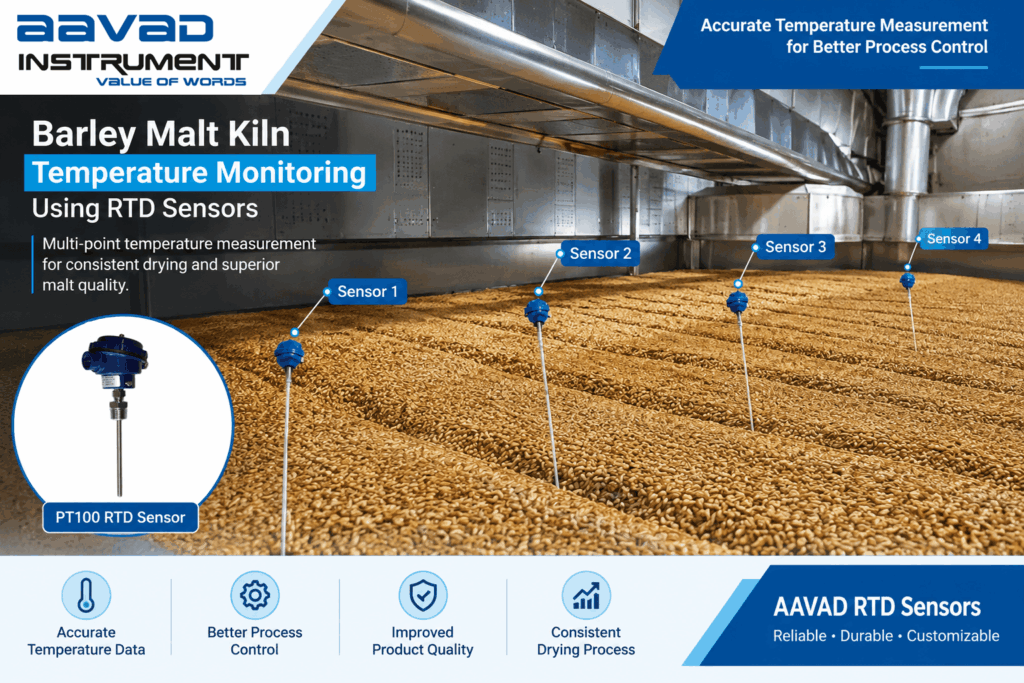
Barley Malt Kiln Machine: Temperature Control, Working Principle & RTD Sensor Applications
Barley malt production is a carefully controlled process in which temperature plays a critical role in achieving consistent malt quality. A Barley Malt Kiln Machine is one of the most important pieces of equipment used during the malting process because it controls the drying and heating of germinated barley grains.
Accurate temperature measurement inside the malt kiln helps manufacturers maintain the required drying conditions, control moisture removal, protect malt quality, and achieve consistent production results. For this reason, reliable RTD sensors and industrial temperature sensors are commonly used for monitoring kiln temperature.
In this article, we will understand the working principle of a barley malt kiln machine, the importance of temperature control, and how RTD temperature sensors can be used for accurate temperature measurement.
What Is a Barley Malt Kiln Machine?
A Barley Malt Kiln Machine is industrial equipment used to dry and thermally process germinated barley after the germination stage of the malting process.
During malting, barley grains are first cleaned and steeped in water. The grains then undergo controlled germination. After sufficient germination, the green malt is transferred to a kiln, where controlled hot air is passed through the malt bed to gradually reduce moisture and develop the desired malt characteristics.
The kiln must maintain controlled temperature and airflow conditions throughout the drying process. Excessive temperature or uneven heating can affect malt quality, colour, flavour, and other important characteristics.
How Does a Barley Malt Kiln Machine Work?
The basic working process of a malt kiln can be divided into several stages:
1. Green Malt Loading
After germination, the moist germinated barley, commonly called green malt, is transferred into the kiln.
The malt is distributed across the kiln floor or drying bed to achieve relatively uniform airflow and drying.
2. Controlled Airflow
Heated air is circulated through the malt bed using fans or an air-handling system.
The airflow removes moisture from the germinated barley while gradually increasing the temperature according to the required drying profile.
3. Temperature Monitoring
Temperature sensors installed at suitable points continuously monitor the air or product temperature.
The measured temperature can be sent to a PLC, temperature controller, DCS, or other automation system for monitoring and control.
4. Moisture Reduction
The drying process gradually reduces the moisture content of the green malt.
Temperature and airflow need to be controlled carefully to achieve uniform drying without unnecessarily exposing the malt to excessive heat.
5. Kilning and Final Malt Development
As the drying process progresses, the temperature profile can be adjusted according to the desired malt characteristics.
The final kilning conditions influence important properties such as colour, aroma, flavour, and enzyme activity.
Why Is Temperature Control Important in Malt Kilning?
Temperature is one of the most important parameters in the malt kiln process.
Accurate temperature monitoring helps operators maintain the required process conditions and avoid unwanted temperature variations.
Key benefits of accurate temperature measurement include:
- Consistent malt drying
- Better process control
- Improved product uniformity
- Reduced risk of overheating
- Better control of malt characteristics
- Improved energy management
- Reliable automated temperature control
- Reduced process variations
- Better batch-to-batch consistency
An inaccurate temperature reading can cause the control system to operate under incorrect conditions. Therefore, selecting a suitable industrial temperature sensor is important for reliable kiln operation.
Role of RTD Sensors in Barley Malt Kiln Machines
An RTD (Resistance Temperature Detector) is a temperature sensor that measures temperature by detecting the change in electrical resistance of its sensing element.
PT100 RTD sensors are widely used for industrial temperature measurement because they provide stable and accurate temperature measurement over a suitable operating range.
In a malt kiln application, an RTD sensor can be installed at appropriate temperature measurement points such as:
- Hot air inlet
- Air circulation system
- Kiln chamber
- Air outlet
- Drying zone
- Different levels of the malt bed
- Heating system
- Ducting or air-handling lines
The exact sensor location depends on the kiln design, process arrangement, and temperature control strategy.
PT100 RTD Sensor for Malt Kiln Temperature Measurement
A PT100 RTD sensor can be considered for applications where accurate and stable temperature measurement is required.
The PT100 sensing element has a nominal resistance of 100 ohms at 0°C. As the temperature changes, its electrical resistance changes, allowing the connected temperature transmitter, indicator, PLC, or controller to determine the temperature.
For malt kiln applications, the sensor construction should be selected according to:
- Required temperature range
- Installation location
- Process environment
- Insertion length
- Sensor diameter
- Number of sensing elements
- Wiring configuration
- Sheath material
- Connection type
- Required response time
- Required accuracy
- Controller or transmitter compatibility
Important Temperature Sensor Selection Parameters
Selecting the correct temperature sensor is essential for reliable malt kiln operation.
1. Temperature Range
The RTD should have a suitable temperature range for the actual kiln operating conditions.
The sensor should not be selected only based on the normal operating temperature. The maximum possible process temperature should also be considered.
2. Sensor Sheath Material
The sheath material should be selected according to the installation environment.
Common industrial RTD sheath materials may include stainless steel grades such as SS304 or SS316, depending on the application requirements.
3. Sensor Length
The insertion length should be suitable for the kiln duct, chamber, air stream, or other measurement point.
Incorrect insertion length can affect measurement quality and installation reliability.
4. Wiring Configuration
RTDs are commonly available in 2-wire, 3-wire, and 4-wire configurations.
For industrial process measurement, 3-wire PT100 RTDs are commonly used where compensation for lead-wire resistance is required.
5. Accuracy
The required accuracy class should be selected according to the process and control requirements.
For applications requiring higher measurement accuracy, an appropriate IEC 60751-compliant RTD configuration can be considered.
6. Response Time
The sensor should respond sufficiently quickly to changes in kiln temperature.
Sensor construction, sheath diameter, installation method, and thermowell or protection arrangement can influence response time.
Where Are Temperature Sensors Used in a Malt Kiln?
Depending on the kiln design, multiple temperature measurement points may be required.
Hot Air Temperature
A temperature sensor can monitor the temperature of hot air entering the kiln.
This measurement can be used by the control system to regulate the heating process.
Kiln Chamber Temperature
Temperature measurement inside the kiln chamber helps operators understand the thermal conditions surrounding the malt.
Air Outlet Temperature
Outlet air temperature can provide useful information about the drying process and heat transfer.
Multi-Point Temperature Monitoring
Large industrial malt kilns may require temperature measurement at multiple locations to identify temperature variations across the drying bed.
Multiple RTD sensors can provide more comprehensive temperature information for process monitoring and automation.
RTD Sensor vs Thermocouple for Malt Kiln Applications
Both RTDs and thermocouples are industrial temperature sensors, but their characteristics differ.
| Parameter | RTD | Thermocouple |
|---|---|---|
| Measurement principle | Resistance change | Thermoelectric voltage |
| Accuracy | Generally high in suitable ranges | Depends on type and application |
| Stability | Generally excellent | Depends on thermocouple type |
| Common industrial element | PT100 | K, J, T, etc. |
| Lead-wire configurations | 2, 3, 4 wire | Typically 2-wire |
| Application | Process and equipment temperature monitoring | Wide range of industrial temperature applications |
| Selection | Based on accuracy, range and environment | Based on temperature range and environment |
The final choice between an RTD and thermocouple should be based on the kiln design, temperature range, required accuracy, response time, installation conditions, and control system.
Common Applications of Barley Malt Kiln Machines
Malt kiln systems are used in industries involved in malt processing and brewing-related raw material production.
Typical applications include:
- Barley malt processing
- Malt manufacturing plants
- Breweries
- Food processing
- Beverage industries
- Grain processing
- Specialty malt production
- Cereal processing
- Agricultural grain processing
Benefits of Using Reliable Temperature Sensors in Malt Kilns
A properly selected temperature sensor can contribute to better process monitoring and automation.
Improved Process Consistency: Accurate temperature measurement helps maintain repeatable kiln operating conditions.
Better Temperature Control: Real-time temperature feedback allows the control system to regulate heaters, dampers, fans, or other process equipment according to the programmed temperature profile.
Reduced Process Variation: Monitoring temperature at critical points can help identify abnormal temperature variations during the drying cycle.
Better Equipment Monitoring: Temperature data can also help operators identify unusual heating conditions or process deviations.
Support for Automation: RTD sensors can be integrated with temperature transmitters, PLCs, SCADA systems, DCS, and industrial controllers for automated monitoring and control.
AAVAD RTD Sensors for Industrial Temperature Measurement
AAVAD Instrument provides industrial temperature measurement solutions including RTD sensors and customized temperature sensors for different industrial applications.
Depending on the process requirements, RTD sensors can be designed with suitable sensing elements, sheath materials, dimensions, wiring configurations, connection arrangements, and mounting options.
For Barley Malt Kiln Machine applications, the appropriate sensor design should be selected according to the kiln temperature range, installation location, required accuracy, response time, and control system requirements.
AAVAD can support industries looking for customized PT100 RTD sensors, industrial temperature sensors, and temperature measurement solutions for process monitoring and automation.
Maintenance and Calibration of Malt Kiln Temperature Sensors
Regular inspection and calibration of temperature sensors are important for maintaining measurement reliability.
The following points should be checked periodically:
- Sensor physical condition
- Cable and terminal connections
- Sensor sheath condition
- Controller or transmitter readings
- Calibration status
- Wiring configuration
- Installation position
- Response to temperature changes
- Signs of mechanical damage or overheating
Calibration intervals should be determined according to the process criticality, operating environment, sensor performance, quality requirements, and plant calibration procedures.
Conclusion
The Barley Malt Kiln Machine plays an important role in the controlled drying and thermal processing of germinated barley. Because temperature directly influences the drying process and final malt characteristics, accurate and reliable temperature measurement is essential.
RTD temperature sensors, particularly PT100 sensors, can provide stable and accurate temperature measurement for suitable malt kiln applications. When correctly selected and installed, they can support temperature control, process automation, monitoring, and consistent production.
For industrial malt kiln applications, selecting the right sensor requires consideration of temperature range, accuracy, sheath material, insertion length, wiring configuration, response time, and installation conditions.
If you are looking for a PT100 RTD Sensor, Industrial Temperature Sensor, or Customized RTD Solution for Barley Malt Kiln Machine applications, AAVAD Instrument can provide application-oriented temperature measurement solutions based on your process requirements.
Frequently Asked Questions (FAQs)
1. What is a Barley Malt Kiln Machine?
-> A Barley Malt Kiln Machine is industrial equipment used to dry and thermally process germinated barley during malt production under controlled temperature and airflow conditions.
2. Why is temperature control important in a malt kiln?
-> Temperature control helps maintain consistent drying conditions and supports the required malt quality, process consistency, and automated kiln operation.
3. Which temperature sensor is suitable for a malt kiln?
-> A suitable RTD or thermocouple can be selected depending on the kiln temperature range, required accuracy, installation location, response time, and control system. PT100 RTDs are commonly considered for applications requiring stable and accurate temperature measurement.
4. Can a PT100 RTD be used in a Barley Malt Kiln Machine?
-> Yes. A suitable PT100 RTD can be used for measuring air or process temperatures in appropriate malt kiln locations, provided its temperature range and construction match the application.
5. Can RTD sensors be connected to a PLC?
-> Yes. An RTD can be connected directly to a compatible PLC input or through a suitable temperature transmitter, depending on the PLC and control system configuration.
6. What information is required to select an RTD for a malt kiln?
-> Important information includes temperature range, measurement point, insertion length, sensor diameter, sheath material, wiring configuration, accuracy requirement, process connection, and controller/transmitter compatibility.
7. Does AAVAD provide customized RTD sensors?
-> Yes. AAVAD Instrument provides industrial RTD and temperature measurement solutions that can be configured according to application and installation requirements.