The ethanol manufacturing industry plays an important role in India’s renewable energy and biofuel sector. Ethanol production requires a significant amount of water for various industrial operations, including feedstock processing, fermentation, distillation, cooling towers, boiler operations and cleaning processes.
Many ethanol plants and distilleries use groundwater extracted through borewells or tube wells to meet their industrial water requirements.
However, groundwater extraction is regulated by the Central Ground Water Authority (CGWA) and the concerned State Ground Water Authorities. Industries extracting groundwater must comply with the applicable groundwater regulations and the conditions specified in their No Objection Certificate (NOC).
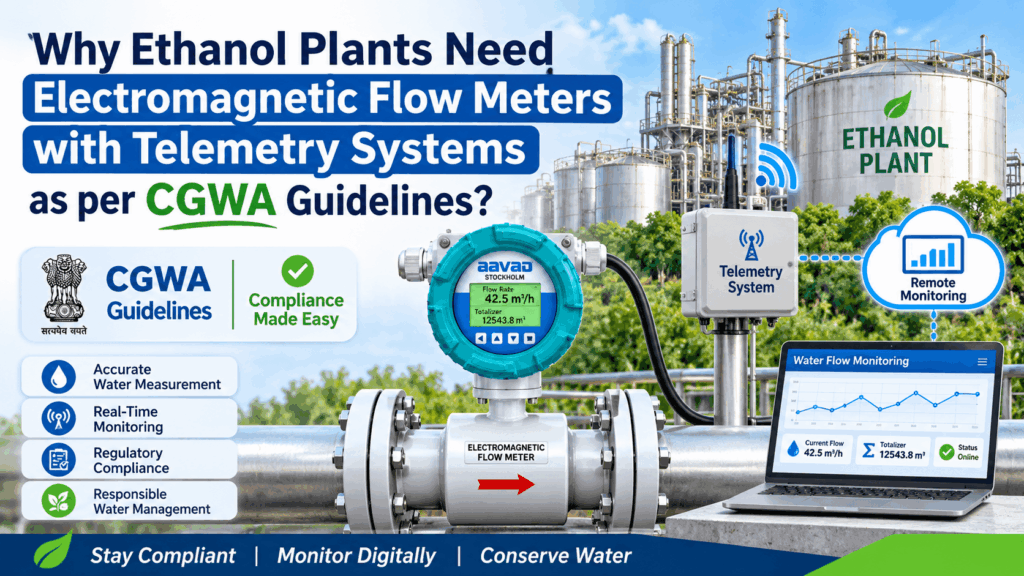
One of the important compliance requirements is installing a Tamper-Proof Digital Water Flow Meter with a Telemetry System to measure and monitor groundwater extraction.
An Electromagnetic Flow Meter integrated with a telemetry system provides a reliable solution for measuring groundwater consumption, recording extraction data and supporting regulatory compliance.
1. Why Is Groundwater Monitoring Important in Ethanol Plants?
Ethanol manufacturing involves multiple processes where water is continuously consumed. Groundwater extraction without proper measurement can make it difficult to maintain accurate water consumption records.
Some major water-consuming applications in ethanol plants include:
-
Feedstock preparation and dilution.
-
Fermentation process.
-
Distillation and dehydration.
-
Cooling towers and heat exchangers.
-
Boiler feed water treatment.
-
Equipment washing and cleaning.
-
Utility and general industrial applications.
Without a proper water monitoring system, industries may face difficulties in tracking daily groundwater extraction and maintaining records for regulatory inspections.
Installing a digital flow meter with telemetry helps industries monitor their actual groundwater consumption and maintain transparent water usage records.
2. What Do CGWA Guidelines Say About Digital Flow Meters with Telemetry?
According to the CGWA groundwater extraction guidelines notified on 24 September 2020, with subsequent amendments, installation of tamper-proof digital water flow meters with telemetry is a mandatory condition for applicable groundwater users seeking a No Objection Certificate.
The relevant requirements include:
-
Installation of tamper-proof digital water flow meters with telemetry on groundwater abstraction structures.
-
Communication of installation details to CGWA within 30 days of NOC grant through the web portal.
-
Annual calibration of water flow meters through an authorised agency.
-
Monitoring of groundwater extraction quantities.
-
Installation of piezometers for groundwater-level monitoring wherever prescribed under applicable conditions.
The 29 March 2023 amendment also provides that when multiple borewells or tube wells are installed within the same premises, meters with telemetry may be installed at common outlet points.
Important: The applicable NOC conditions and current portal requirements should be checked for each ethanol plant before finalising the installation arrangement.
3. Why Is an Electromagnetic Flow Meter Suitable for Ethanol Plants?
An Electromagnetic Flow Meter (EMFM) is designed to measure the flow rate of electrically conductive liquids using Faraday’s law of electromagnetic induction.
It is suitable for many industrial groundwater applications because it has no moving mechanical parts in the measuring tube.
Key advantages
1. Accurate Water Flow Measurement
-> It measures the volume of water passing through the pipeline and provides flow-rate and totalised-volume readings.
2. No Moving Parts
-> Its measuring tube has no rotating turbine or mechanical impeller, reducing mechanical wear in normal operating conditions.
3. Digital Measurement
-> The transmitter can display instantaneous flow rate and cumulative water consumption.
4. Industrial Construction
-> Depending on the selected model, suitable liner, electrodes and body materials can be selected for groundwater and industrial water applications.
5. Integration with Telemetry
-> The flow meter can provide digital or communication outputs for integration with a compatible telemetry/data-logging system.
6. Long-Term Monitoring
-> Digital readings help maintain daily, monthly and cumulative groundwater extraction records.
Technical note: Electromagnetic flow meters require electrically conductive liquids and a properly filled measuring pipe. Actual suitability depends on water conductivity, pipe size, flow range, installation conditions and the required compliance specifications.
4. What Is a Telemetry System and How Does It Work?
A telemetry system automatically collects flow meter data and transmits it to a remote monitoring platform through an available communication network such as GSM/GPRS, 4G or other supported connectivity.
It allows authorised users to monitor groundwater extraction without physically visiting the borewell every time.
Working process
-
Groundwater is extracted through the borewell using a pump.
-
The Electromagnetic Flow Meter measures the water flow.
-
The transmitter records instantaneous flow and total water consumption.
-
The telemetry device collects the meter readings.
-
Data is transmitted to a cloud-based monitoring platform.
-
Users can access the available readings and reports remotely.
-> This system supports transparent groundwater monitoring and helps industries maintain the required extraction records.
5. What Are the Benefits of Installing a Telemetry-Based Flow Meter in an Ethanol Plant?
Installing an electromagnetic flow meter with telemetry offers several operational and compliance-related benefits.
| Benefits | Importance for ethanol plants |
|---|---|
| Real-time monitoring | Monitor groundwater flow remotely |
| Daily consumption tracking | Record daily water extraction |
| Monthly reports | Maintain monthly consumption records |
| Totaliser readings | Track cumulative groundwater usage |
| Remote accessibility | Access readings without visiting the borewell |
| Data transparency | Maintain reliable extraction records |
| Water management | Identify unnecessary water consumption |
| Compliance support | Maintain records for regulatory inspections |
Why is tamper-proof technology important?
A tamper-proof arrangement helps protect the flow measurement system against unauthorised interference.
For groundwater monitoring applications, the complete arrangement should consider:
-
Mechanical and electronic sealing.
-
Protection against unauthorised access.
-
Power failure detection, wherever required.
-
Data storage during communication interruptions.
-
Reliable data transmission.
-
Secure monitoring and data records.
The exact technical specifications should match the applicable authority’s requirements and the plant’s NOC conditions.
6. What Happens If an Ethanol Plant Does Not Install a Digital Flow Meter with Telemetry?
Failure to comply with applicable CGWA NOC conditions can create regulatory and financial risks for an ethanol manufacturing unit.
According to the consolidated CGWA guidelines:
-
Non-installation or faulty digital water flow meter with telemetry is listed under the NOC non-compliance penalty provisions.
-
Non-maintenance of daily groundwater withdrawal records can also attract penalties.
-
Non-compliance can affect NOC renewal.
-
Authorities can conduct inspections and take enforcement action.
-
Unauthorised groundwater extraction without the required permission can attract environmental compensation.
The consolidated guidelines list a penalty of ₹2,00,000 for non-installation/faulty digital water flow meter with telemetry under the specified non-compliance provision. The applicable amount and enforcement should be verified against the current notification and the relevant NOC.
7. Why Choose an Integrated Electromagnetic Flow Meter and Telemetry Solution?
For ethanol plants, installing only a conventional water meter may not provide the complete remote monitoring facility required under applicable NOC conditions.
An integrated digital flow measurement and telemetry solution combines:
-
Electromagnetic flow measurement.
-
Digital flow transmitter.
-
Instantaneous flow-rate measurement.
-
Cumulative water totalisation.
-
Telemetry/data logger.
-
GSM/4G or other suitable communication.
-
Cloud-based monitoring dashboard.
-
Data storage and reporting facilities.
-
Tamper detection and protection arrangements.
->The system should be selected and configured according to borewell discharge, pipeline diameter, water conductivity, electrical supply, communication availability and applicable compliance requirements.
8. Why Is Annual Calibration Important?
Annual calibration is an important requirement under the applicable CGWA general NOC compliance conditions.
The consolidated guidelines specify that water flow meters must be calibrated once a year through an authorised agency.
Calibration helps:
-
Verify flow measurement accuracy.
-
Identify measurement deviations.
-
Maintain reliable totaliser readings.
-
Support groundwater consumption records.
-
Provide calibration documentation during inspections.
Ethanol plants should maintain their calibration certificates and installation records for compliance documentation.
9. Complete Groundwater Monitoring Solution for Ethanol Plants
An ethanol manufacturing facility should consider its complete groundwater monitoring requirements rather than focusing only on the flow meter.
The monitoring arrangement may include:
1. Electromagnetic Flow Meter
– Measures groundwater flow rate and cumulative water extraction.
2. Telemetry System
– Collects flow meter readings and transmits data to a remote monitoring platform.
3. Piezometer with Digital Water Level Recorder
– Monitors groundwater level wherever required under applicable CGWA conditions.
4. Cloud Monitoring Dashboard
– Provides access to recorded flow and water-level data, according to the connected system.
Note: A flow meter measures the quantity of groundwater extracted, whereas a piezometer monitors groundwater levels. Both serve different purposes and should not be considered interchangeable.
10. Why Choose AAVAD Instrument for Ethanol Plant Groundwater Monitoring?
AAVAD Instrument Pvt. Ltd. is an Indian manufacturer and supplier of industrial instrumentation and automation solutions since 2009.
For ethanol plants, distilleries and other groundwater-dependent industries, AAVAD offers solutions for digital groundwater flow measurement and telemetry-based monitoring.
Our product and service capabilities
-
Electromagnetic Flow Meters for industrial water applications.
-
Digital water flow measurement solutions.
-
Telemetry and remote monitoring systems.
-
Groundwater monitoring solutions.
-
Piezometer and water-level monitoring solutions.
-
NABL-accredited calibration coordination/services, subject to the applicable arrangement.
-
Pan-India product supply.
-
Technical support for installation and commissioning.
Our objective is to help industries monitor groundwater extraction accurately and maintain the necessary measurement and compliance records.
Groundwater is an important resource for ethanol manufacturing industries. Proper measurement and monitoring of groundwater extraction are essential for responsible water management and compliance with applicable regulatory requirements.
An Electromagnetic Flow Meter with a Telemetry System provides an effective solution for measuring borewell water consumption, recording extraction data and remotely monitoring groundwater usage.
Ethanol plants should review their CGWA NOC conditions and install a suitable tamper-proof digital water flow meter with telemetry to meet the applicable requirements.
Official references
For regulatory accuracy and credibility, include these external references:
Need a CGWA-compliant groundwater monitoring solution for your ethanol plant?
Contact AAVAD Instrument Pvt. Ltd. for Electromagnetic Flow Meters with Telemetry Systems, industrial water measurement and groundwater monitoring solutions.
Website: www.aavadinstrument.com
Regulatory note: Before publishing, have the final technical claims checked against the plant’s specific NOC and the latest applicable CGWA/State Authority requirements.