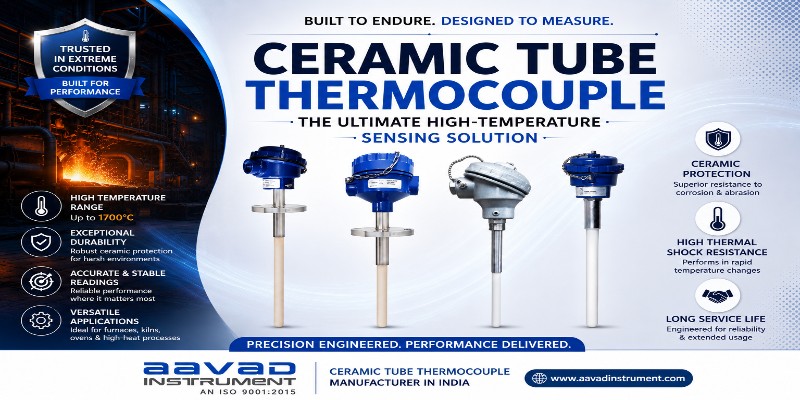
Ceramic Tube Thermocouple: The Ultimate High-Temperature Sensing Solution
By Aavad Instrument Pvt. Ltd. | Ceramic Tube Thermocouple Manufacturer in Ahmedabad, Gujarat, India
Temperature Measurement | High Temperature Thermocouples | Furnace Instrumentation
Introduction
When temperatures exceed the limits of conventional sensors, standard thermocouples often fail due to oxidation, thermal shock, corrosion, and extreme process conditions. Industries operating furnaces, kilns, heat treatment plants, glass melting units, and steel foundries require specialized temperature sensors capable of surviving temperatures above 1000°C for extended periods.
This is where Ceramic Tube Thermocouples become essential.
Designed specifically for extreme-temperature environments, ceramic tube thermocouples provide reliable, accurate, and long-lasting temperature measurement in some of the harshest industrial conditions. Their ceramic protection tubes shield the sensing element from direct flame, molten materials, abrasive particles, corrosive gases, and thermal stress.
Whether you’re operating a steel furnace, ceramic kiln, heat treatment oven, or glass manufacturing plant, selecting the right high temperature thermocouple can significantly improve process control, product quality, and equipment reliability.
Why Extreme Temperature Applications Need Ceramic Protection
Standard metal-sheathed thermocouples perform well in moderate industrial temperatures. However, in applications exceeding 1000°C, metal sheaths often experience:
- Oxidation
- Scaling
- Thermal deformation
- Chemical attack
- Reduced sensor lifespan
Ceramic protection tubes solve these challenges by providing:
✔ Superior heat resistance
✔ Excellent electrical insulation
✔ Protection against corrosive atmospheres
✔ Resistance to thermal shock
✔ Longer thermocouple life
✔ Improved measurement reliability
This makes ceramic tube thermocouples the preferred choice for high-temperature industrial processes.
What is a Ceramic Tube Thermocouple?
A Ceramic Tube Thermocouple is a temperature sensor assembly consisting of:
Thermocouple Element
Commonly:
- Type K
- Type N
- Type R
- Type S
- Type B
Ceramic Protection Tube
Protects the thermocouple from harsh environments.
Terminal Head Assembly
Provides electrical connection and sensor protection.
Mounting Arrangement
Threaded, flanged, or custom installation design.
The ceramic tube acts as a barrier between the thermocouple junction and the process environment.
Types of Ceramic Protection Tubes
The choice of ceramic material significantly affects performance and lifespan.
Mullite Ceramic Tubes
Mullite is one of the most commonly used ceramic materials.
Advantages
✔ Good thermal shock resistance
✔ Cost-effective
✔ Suitable for medium-high temperatures
Typical Temperature Range
Up to 1400°C
Applications
- Ceramic kilns
- Industrial ovens
- Heat treatment furnaces
Alumina Ceramic Tubes (99.7%)
High-purity alumina is widely used in critical industrial applications.
Advantages
✔ Excellent mechanical strength
✔ Outstanding oxidation resistance
✔ Superior electrical insulation
✔ Long service life
Temperature Range
Up to 1700°C
Applications
- Steel industries
- Glass manufacturing
- High-temperature furnaces
Steatite Ceramic Tubes
Steatite offers excellent insulation properties.
Advantages
✔ Good dielectric strength
✔ Economical
✔ Suitable for moderate temperatures
Applications
- Industrial heating systems
- General-purpose thermocouple assemblies
Silicon Carbide (SiC) Protection Tubes
Used for extremely aggressive environments.
Advantages
✔ Exceptional thermal conductivity
✔ Excellent wear resistance
✔ High mechanical strength
Applications
- Molten metal applications
- Steel foundries
- Glass furnaces
Temperature Ranges and Material Selection Guide
Selecting the correct protection tube depends on operating temperature and process conditions.
| Ceramic Material | Maximum Temperature |
|---|---|
| Steatite | 1200°C |
| Mullite | 1400°C |
| Alumina 99.7% | 1700°C |
| Silicon Carbide | 1600°C+ |
General Selection Guidelines
- Up to 1200°C → Steatite
- Up to 1400°C → Mullite
- Up to 1700°C → Alumina
- Abrasive environments → Silicon Carbide
Industries That Rely on Ceramic Tube Thermocouples
High-temperature industries depend heavily on ceramic tube thermocouples.
Glass Manufacturing Industry
Glass furnaces operate continuously at extremely high temperatures.
Applications include:
- Glass melting furnaces
- Forehearth systems
- Annealing operations
Benefits:
✔ Accurate furnace temperature control
✔ Improved glass quality
✔ Reduced energy consumption
Ceramic Industry
Ceramic production requires precise kiln temperature monitoring.
Applications:
- Tunnel kilns
- Shuttle kilns
- Sintering furnaces
Benefits:
✔ Uniform firing
✔ Reduced rejects
✔ Consistent product quality
Steel Foundries
Steel manufacturing involves some of the most demanding temperature environments.
Applications:
- Reheating furnaces
- Billet heating
- Continuous casting systems
Benefits:
✔ Reliable high-temperature monitoring
✔ Improved process efficiency
✔ Enhanced product consistency
Heat Treatment Industry
Heat treatment processes rely heavily on accurate temperature control.
Applications:
- Annealing furnaces
- Hardening furnaces
- Tempering ovens
Benefits:
✔ Consistent metallurgical properties
✔ Improved product quality
✔ Reduced scrap rates
Cement Industry
Applications include:
- Rotary kilns
- Clinker coolers
- Preheater systems
Ceramic tube thermocouples provide reliable operation under harsh process conditions.
Aavad Instrument Ceramic Tube Thermocouple Specifications
Aavad manufactures custom ceramic tube thermocouples designed for demanding industrial environments.
Available Thermocouple Types
✔ Type K
✔ Type N
✔ Type R
✔ Type S
✔ Type B
Protection Tube Materials
✔ Mullite
✔ Alumina 99.7%
✔ Steatite
✔ Silicon Carbide
Construction Options
✔ Single Element
✔ Duplex Element
✔ Threaded Mounting
✔ Flanged Mounting
✔ Custom Designs
Temperature Range
From ambient conditions up to 1700°C depending on sensor type and protection material.
Installation Best Practices in High-Temperature Environments
Proper installation significantly impacts thermocouple life and performance.
Ensure Correct Immersion Length
The sensing junction must be positioned within the actual process zone.
Avoid Mechanical Shock
Ceramic tubes are durable but can crack if subjected to impact.
Use Proper Support
Long thermocouple assemblies may require additional support.
Protect Against Thermal Shock
Rapid temperature changes can shorten ceramic life.
Allow gradual heating where possible.
Verify Process Compatibility
Select protection materials suitable for:
- Temperature
- Gas composition
- Abrasive particles
- Chemical exposure
Common Failure Modes and How to Prevent Them
Understanding common failures helps improve reliability.
Thermal Shock Cracking
Cause:
Rapid temperature changes.
Prevention:
Use gradual heating and cooling cycles.
Mechanical Breakage
Cause:
Improper handling.
Prevention:
Use correct mounting and support systems.
Chemical Corrosion
Cause:
Aggressive process gases.
Prevention:
Select appropriate ceramic materials.
Sensor Drift
Cause:
Long-term exposure to extreme temperatures.
Prevention:
Regular calibration and inspection.
Ceramic Tube Thermocouple vs Metal Sheathed Thermocouple
| Feature | Ceramic Tube | Metal Sheathed |
|---|---|---|
| Maximum Temperature | Up to 1700°C | Typically up to 1200°C |
| Corrosion Resistance | Excellent | Moderate |
| Thermal Shock Resistance | High | Moderate |
| Cost | Higher | Lower |
| Lifespan in Furnaces | Longer | Shorter |
For extreme-temperature applications, ceramic tube thermocouples provide significantly better long-term performance.
Custom Ceramic Thermocouple Manufacturing
Every furnace and kiln application is different.
AAVAD offers customized solutions based on:
Process Temperature
Furnace Design
Mounting Method
Protection Material
Insertion Length
Thermocouple Type
Connection Head Type
Custom manufacturing ensures optimal sensor performance and lifespan.
Why Choose Aavad Instrument Pvt. Ltd.?
Aavad Instrument Pvt. Ltd. manufactures high-performance ceramic tube thermocouples for industries across India.
Key Advantages
✔ Custom Engineering
✔ High-Temperature Expertise
✔ Quality Manufacturing
✔ Fast Delivery
✔ Technical Support
✔ PAN India Supply
Frequently Asked Questions
What is a ceramic tube thermocouple?
A ceramic tube thermocouple is a high-temperature temperature sensor protected by a ceramic sheath designed for furnaces, kilns, and heat treatment systems.
What temperature can ceramic thermocouples handle?
Depending on the ceramic material and thermocouple type, they can operate up to 1700°C or higher.
What type of thermocouple is used in kilns and furnaces?
Type K, Type N, Type R, Type S, and Type B thermocouples are commonly used in kiln and furnace applications.
What is a refractory thermocouple?
A refractory thermocouple uses ceramic or refractory protection materials to withstand extreme temperatures and harsh environments.
How long does a ceramic protection tube last?
Service life depends on temperature, thermal cycling, and process conditions, but properly selected ceramic tubes can operate reliably for years.
Get a Custom Quote
Looking for a reliable Ceramic Tube Thermocouple Manufacturer in India?
Aavad Instrument Pvt. Ltd. provides customized high-temperature thermocouples for furnaces, kilns, heat treatment plants, steel foundries, glass manufacturing facilities, and industrial heating systems.
📞 +91 90996 22823
Aavad Instrument Pvt. Ltd.
Precision Temperature Measurement for Extreme Industrial Environments