Discharge Water Control: Complete Guide to Flow Measurement, Monitoring & Compliance
Introduction
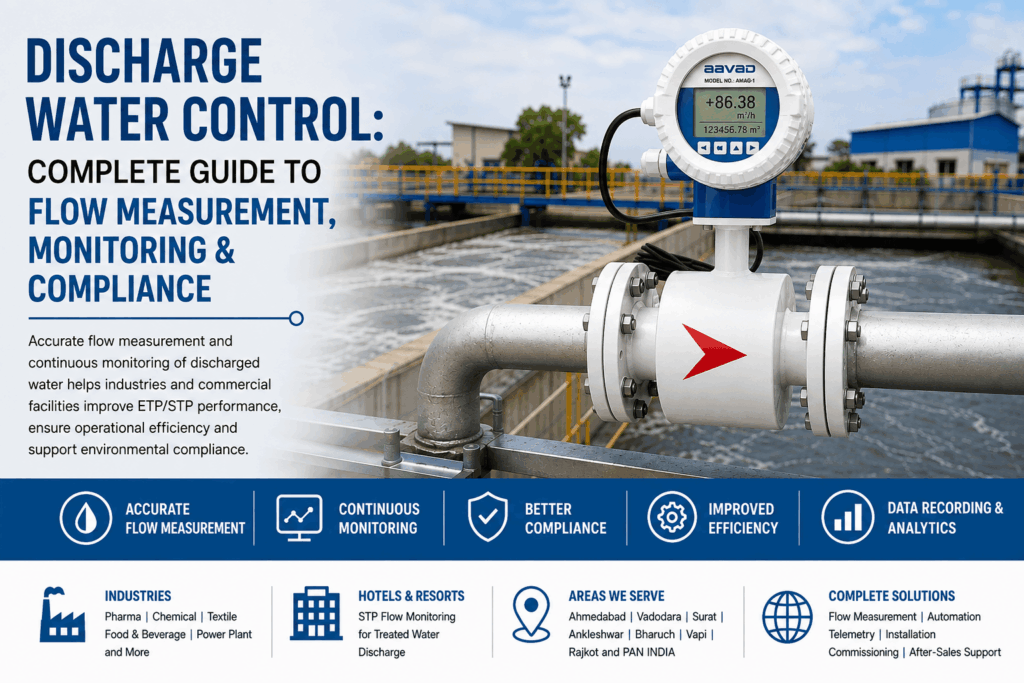
Discharge water management has become an important requirement for industries, hotels, resorts, hospitals, commercial facilities and other organizations operating wastewater treatment systems. Proper measurement and monitoring of discharged water helps organizations understand their wastewater flow, improve treatment-system performance, maintain operational control and support environmental compliance requirements.
A reliable Discharge Water Control System generally combines accurate flow measurement, continuous monitoring, data recording and appropriate control mechanisms. Among these, an accurate Discharge Water Flow Meter plays a critical role because it provides reliable information about the quantity of treated or effluent water being discharged.
Industries with ETPs, STPs and wastewater treatment facilities need dependable flow measurement at inlet, outlet and discharge points. This is particularly important for facilities where wastewater generation varies throughout the day.
AAVAD Instrument Pvt. Ltd. provides industrial instrumentation and flow measurement solutions for wastewater, effluent and treated-water applications across Gujarat and Pan India.
What Is Discharge Water Control?
Discharge water control refers to the process of measuring, monitoring and managing the quantity of wastewater or treated water discharged from an industrial, commercial or institutional facility.
The objective is not simply to measure water flow. A properly designed discharge water monitoring system can help organizations:
- Measure the actual quantity of discharged water
- Monitor variations in wastewater flow
- Track ETP/STP performance
- Identify abnormal discharge conditions
- Maintain operational records
- Improve wastewater management
- Support environmental monitoring requirements
- Integrate flow measurement with automation and telemetry systems
For industrial facilities, accurate discharge flow measurement can become an important part of an overall wastewater management strategy.
Why Is Discharge Water Flow Measurement Important?
Without reliable flow measurement, an organization may have limited visibility into how much wastewater is entering or leaving its treatment system.
A Discharge Water Flow Meter can provide continuous flow information and help operators make better decisions.
Key benefits include:
1. Accurate Flow Measurement
-> An industrial flow meter measures the volume or flow rate of water passing through the pipeline. This helps operators understand actual wastewater discharge.
2. ETP Performance Monitoring
-> Flow measurement at the ETP outlet can help operators compare wastewater flow with the treatment plant’s operating capacity.
3. Better Wastewater Management
-> Continuous flow information allows organizations to identify peak-flow periods and manage treatment capacity more effectively.
4. Operational Control
-> Flow data can be integrated with PLC, SCADA, automation panels or telemetry systems for centralized monitoring.
5. Data Recording
-> Digital flow measurement systems can provide accumulated flow information, which can be useful for operational analysis and reporting.
6. Early Detection of Abnormal Conditions
-> Sudden changes in flow may indicate leakage, process changes, pump problems, valve issues or unusual wastewater generation.
Where Is Discharge Water Control Used?
Discharge water monitoring is applicable across a wide range of industries and commercial facilities.
1. Pharmaceutical Industry
-> Pharmaceutical manufacturing facilities can generate different types of wastewater depending on production processes.
Flow meters can be installed at:
- ETP inlet
- ETP outlet
- Treated water discharge
- Process wastewater lines
- Reuse-water lines
Reliable flow measurement helps operators monitor wastewater movement through the treatment system.
Industrial Areas: Ahmedabad, Changodar, Sanand, Vadodara, Ankleshwar, Bharuch, Vapi, Dahej, Hyderabad, Pune and other pharmaceutical manufacturing zones.
2. Chemical Industry
-> Chemical manufacturing facilities often operate sophisticated ETP systems because wastewater characteristics and flow can vary considerably.
A suitable Effluent Flow Meter can help monitor:
- Process effluent
- ETP inlet flow
- Treated effluent
- Discharge pipelines
- Recycled wastewater
Industrial locations such as Vatva, Ankleshwar, Bharuch, Dahej, Vapi and Vadodara have numerous chemical and process industries where wastewater flow monitoring can be an important instrumentation requirement.
3. Textile and Dyeing Industry
-> Textile processing and dyeing plants can generate significant quantities of wastewater.
Flow measurement can be used for:
- Dyeing wastewater
- ETP inlet
- ETP outlet
- Treated water
- Reuse water
- Final discharge
Accurate flow data can help textile plants understand wastewater generation and treatment-system loading.
Important textile locations include: Surat, Ahmedabad, Jetpur, Vapi, Bharuch, Tirupur, Coimbatore and other textile manufacturing clusters across India.
4. Food & Beverage Industry
-> Food processing plants, dairy facilities, beverage manufacturers and packaged-food factories generate wastewater from production and cleaning operations.
Flow meters can be installed on wastewater pipelines to monitor:
- Process wastewater
- CIP wastewater
- ETP inlet
- Treated water
- Final discharge
Discharge Water Control for Hotels & Resorts
-> Large hotels and resorts can generate substantial quantities of wastewater from guest rooms, restaurants, kitchens, laundry facilities, swimming pools and other operations.
For these facilities, an STP Flow Meter or wastewater flow meter can be used to monitor treated-water flow.
Typical measurement points include:
- STP inlet
- STP outlet
- Treated sewage discharge
- Recycled water
- Flushing-water systems
- Gardening/reuse water
- Final discharge
Large hotels and resorts can benefit from continuous monitoring because wastewater generation can change significantly depending on occupancy, events, restaurants, banquets and seasonal demand.
Hotel & Resort Applications
Discharge water monitoring can be considered for:
- Luxury hotels
- Business hotels
- Large resorts
- Convention hotels
- Integrated hospitality complexes
- Hotel chains
- Theme resorts
- Golf resorts
- Large commercial hospitality properties
For hospitality facilities in Ahmedabad, Gandhinagar, Udaipur, Jaipur, Mumbai, Pune, Goa, Bengaluru, Hyderabad, Delhi NCR and other major tourism and business destinations, reliable wastewater flow measurement can support better STP and water-management operations.
How Does a Discharge Water Flow Meter Work?
The working principle depends on the type of flow meter selected.
For conductive wastewater and effluent applications, an Electromagnetic Flow Meter is commonly considered because it has no moving parts inside the measuring section and can be suitable for many water and wastewater applications.
An electromagnetic flow meter works using Faraday’s law of electromagnetic induction.
When conductive liquid passes through the magnetic field generated inside the meter, a voltage is induced. The meter’s electronics process this signal and convert it into a flow measurement.
The result can be displayed as:
- Instantaneous flow rate
- Totalized flow
- Flow percentage
- Other configurable parameters depending on the transmitter
Why Electromagnetic Flow Meter for Discharge Water?
For many wastewater and effluent applications, electromagnetic flow meters offer several practical advantages.
Major advantages:
- No moving mechanical parts
- Suitable for conductive liquids
- Low pressure loss
- Suitable for wastewater applications
- Digital flow indication
- Flow totalization
- 4–20 mA output options
- Pulse output options
- RS-485/communication options depending on model
- Suitable for automation integration
- Available in different line sizes
The correct flow meter should always be selected according to the actual application, pipe size, conductivity, flow range, pressure, temperature, lining and installation conditions.
Discharge Water Flow Meter Installation Points
-> Correct installation is essential for obtaining reliable measurements.
Common installation locations include:
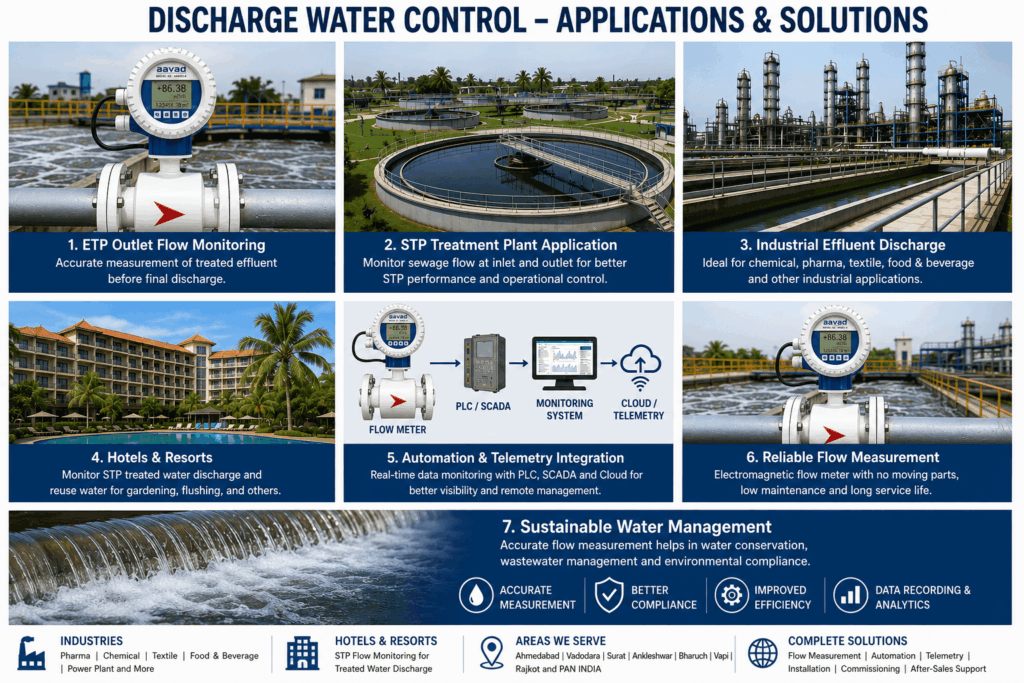
ETP Inlet: Measures wastewater entering the treatment plant.
ETP Outlet: Measures treated water leaving the treatment system.
Final Discharge Line: Measures water being discharged from the facility.
STP Outlet: Used to monitor treated sewage flow from the STP.
Reuse Water Line: Can be used to measure treated water supplied for reuse applications.
For best performance, the installation should consider appropriate straight pipe length, pipe filling conditions, grounding, flow direction and meter orientation according to the manufacturer’s installation requirements.
Industries That Require Discharge Water Monitoring
Discharge water flow measurement can be useful across multiple sectors, including:
- Pharmaceutical industries
- Chemical industries
- Textile industries
- Dyeing plants
- Food processing plants
- Dairy plants
- Beverage industries
- Paper industries
- Pulp industries
- Sugar industries
- Tyre and rubber industries
- Engineering industries
- Automotive industries
- Metal processing industries
- Ceramic industries
- Glass industries
- Power plants
- Hospitals
- Large commercial buildings
- Hotels
- Resorts
- Educational campuses
- Industrial estates
Discharge Water Control in Gujarat
Gujarat is one of India’s major industrial states, with extensive manufacturing activity across pharmaceutical, chemical, textile, engineering, food processing and other sectors.
Therefore, demand for reliable wastewater and effluent flow measurement is relevant across major industrial clusters.
Important Gujarat Locations
Ahmedabad: Vatva, Odhav, Naroda, Changodar, Sanand
Vadodara: Makarpura, Nandesari and surrounding industrial areas
Bharuch: Ankleshwar, Dahej and surrounding industrial zones
Surat: Textile and dyeing industries
Vapi: Chemical, pharmaceutical and manufacturing industries
Rajkot: Engineering and manufacturing industries
Morbi: Ceramic and manufacturing industries
Industrial organizations in these regions can use appropriate flow measurement solutions for ETP, STP and wastewater discharge applications.
Pan-India Discharge Water Flow Measurement
Discharge water monitoring is not limited to Gujarat. Industries and commercial facilities across India require reliable wastewater flow measurement.
AAVAD Instrument Pvt. Ltd. can support industrial instrumentation requirements across major Indian locations including:
Ahmedabad | Vadodara | Surat | Rajkot | Ankleshwar | Bharuch | Vapi | Mumbai | Pune | Nashik | Hyderabad | Bengaluru | Chennai | Delhi NCR | Noida | Gurugram | Jaipur | Indore | Bhopal | Udaipur | Goa | Coimbatore | Tirupur | Kolkata | Visakhapatnam | Pan India
This makes discharge water flow measurement relevant for both regional industries and large multi-location organizations.
How to Select the Right Discharge Water Flow Meter?
Before selecting a flow meter, several parameters should be evaluated.
1. Pipe Size: Confirm the actual pipeline diameter.
2. Flow Range: Determine minimum, normal and maximum flow rates.
3. Liquid Conductivity: For electromagnetic flow meters, the liquid must have adequate electrical conductivity.
4. Fluid Temperature: Check the operating temperature of the wastewater.
5. Pressure: Consider the maximum operating pressure of the pipeline.
6. Pipe Material: The pipeline material should be considered during installation and grounding planning.
7. Lining Material: For aggressive or chemically loaded wastewater, appropriate lining selection is important.
8. Electrode Material: Electrode material should be selected based on the wastewater composition.
9. Output & Communication:
Depending on the application, requirements may include:
- 4–20 mA
- Pulse output
- RS-485
- Modbus
- Relay
- Data logging
- Telemetry
10. Installation Environment: Outdoor, underground, wet-area and hazardous-area installations may require different protection or construction options.
Discharge Water Monitoring with Automation & Telemetry
Modern wastewater management can go beyond local flow indication.
A flow meter can be integrated with automation systems for centralized monitoring.
Depending on the system architecture, flow data can be connected to:
- PLC
- SCADA
- HMI
- Industrial automation systems
- Data logging systems
- Remote monitoring
- Cloud-based telemetry
This can allow authorized users to monitor wastewater flow data from a centralized location.
For organizations managing multiple plants or facilities, remote monitoring can also help provide greater visibility into water-management operations.
Common Problems Without Proper Discharge Water Monitoring
Without reliable flow measurement, organizations may face difficulties such as:
- Lack of accurate discharge data
- Difficulty identifying flow variations
- Poor visibility of ETP loading
- Manual recording errors
- Difficulty comparing water consumption and discharge
- Delayed detection of abnormal flow
- Limited centralized monitoring
- Difficulty analyzing long-term wastewater trends
Installing a suitable flow measurement system can improve operational visibility.
Discharge Water Control: Best Practices
For better wastewater flow management, organizations should consider the following practices:
- Select the flow meter according to the actual wastewater characteristics.
- Measure flow at important ETP/STP locations.
- Maintain proper installation conditions.
- Monitor instantaneous and totalized flow.
- Integrate the meter with automation where required.
- Maintain regular calibration and inspection schedules.
- Keep proper flow measurement records.
- Investigate unusual flow variations.
- Evaluate sensor and lining materials for the actual wastewater.
- Use remote monitoring where centralized visibility is required.
Why Choose AAVAD Instrument for Discharge Water Flow Measurement?
AAVAD Instrument Pvt. Ltd. is an Indian instrumentation manufacturer and supplier providing industrial measurement and automation solutions.
Our product and service portfolio includes solutions for:
- Electromagnetic Flow Meters
- Industrial Flow Measurement
- ETP Flow Measurement
- STP Flow Measurement
- Wastewater Flow Monitoring
- Temperature Sensors
- RTD Sensors
- Thermocouples
- Pressure & Temperature Instruments
- Industrial Automation
- Telemetry Systems
- Calibration Services
- Installation & Commissioning
Our solutions can be considered for industrial plants, ETP/STP systems, commercial facilities, hotels, resorts, hospitals and other wastewater-management applications.
Effective Discharge Water Control requires more than simply measuring wastewater flow. Accurate flow measurement, continuous monitoring, proper installation, data recording and automation integration can together create a more effective wastewater management system.
For industrial plants, pharmaceutical companies, chemical industries, textile units, food-processing facilities, hotels, resorts, hospitals and commercial establishments, a properly selected Discharge Water Flow Meter can provide valuable information about wastewater movement and treatment-system performance.
An electromagnetic flow meter can be an effective solution for many conductive wastewater and effluent applications, provided that the meter is correctly selected according to the liquid characteristics and installation conditions.
If you are planning a new ETP/STP flow measurement system, upgrading an existing discharge monitoring system or looking for an industrial wastewater flow meter, selecting the right instrumentation partner is an important first step.
Need a Discharge Water Flow Measurement Solution?
Contact AAVAD Instrument Pvt. Ltd. for your industrial wastewater, ETP, STP and discharge water flow measurement requirements.
📞 Contact us for technical consultation, product selection, quotation and application support.
🌐 Website: www.aavadinstrument.com
AAVAD Instrument Pvt. Ltd. – Industrial Instrumentation & Flow Measurement Solutions for India and Pan-India Applications.