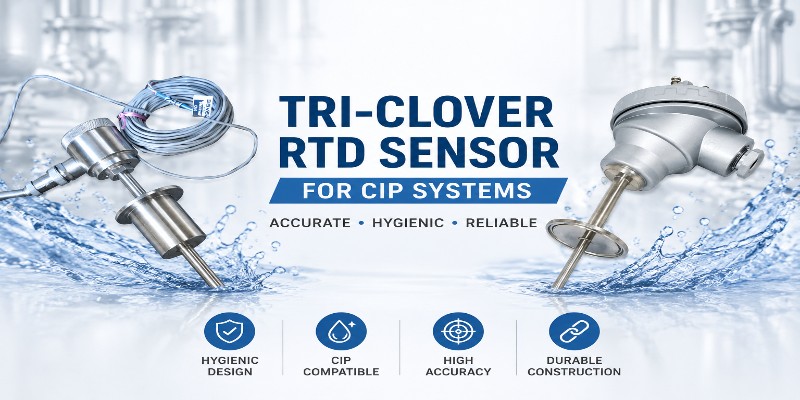
How to Select a Tri-Clover RTD Sensor for CIP (Clean-in-Place) Sanitization Systems
CIP (Clean-in-Place) systems are the backbone of hygiene compliance in food, dairy, beverage, and pharmaceutical manufacturing. But a CIP cycle is only as good as the temperature data confirming it worked — too cool, and the cleaning or sanitization cycle may not achieve the kill-step temperature required; too aggressive, and you waste energy and cleaning time. This is exactly why Tri-Clover RTD sensors are the standard choice for temperature monitoring in CIP/SIP sanitary process lines.
This guide walks through how to select the right Tri-Clover RTD sensor for your CIP system, with specifications relevant to food & beverage processing, dairy, and pharmaceutical cleanroom environments.
Why CIP Systems Need a Sanitary-Specific RTD
Standard industrial RTDs — even good ones — aren’t necessarily built for direct installation in a hygienic process line. CIP and SIP (Sterilize-in-Place) systems demand sensors that:
- Mount via hygienic, crevice-free connections that don’t trap residue or bacteria
- Withstand repeated CIP/SIP cleaning cycles without degrading
- Provide accurate, repeatable readings to confirm cleaning cycle temperatures were actually reached
- Resist corrosion from cleaning chemicals (caustic, acid, sanitizing solutions) used in CIP cycles
A Tri-Clover (Tri-Clamp) connection addresses the mounting half of this requirement directly — it’s a quick-connect, smooth, crevice-free fitting standard across hygienic process industries.
What Is a Tri-Clover RTD Sensor?
A Tri-Clover RTD sensor combines a PT100 (or PT1000) sensing element with a Tri-Clover (Tri-Clamp) process connection and a hygienic, smooth sensor body designed to avoid bacteria-trapping crevices — making it suitable for direct installation in sanitary pipelines, tanks, and CIP/SIP systems without compromising cleanability.
Key Selection Criteria for a CIP-Suitable Tri-Clover RTD
1. Hygienic, Crevice-Free Design
Confirm the sensor body and Tri-Clover fitting are designed for CIP/SIP cleaning — a smooth, crevice-free profile is essential to prevent bacterial harborage points that could compromise your cleaning validation.
2. Accuracy Class
RTD accuracy is defined under IEC 60751 as Class A or Class B. Class B (±0.3 + 0.005|t| °C) is common for general CIP monitoring, while Class A (±0.15 + 0.002|t| °C) is recommended where tighter validation of cleaning cycle temperature is required — confirm which class your specific quality/validation protocol calls for.
3. Temperature Range
CIP and SIP cycles typically run from ambient cleaning temperatures up to sterilization temperatures around 121°C–135°C. Confirm your sensor’s rated range comfortably covers your highest cleaning/sterilization setpoint with margin.
4. Material of Construction
SS 316 is the standard material for sanitary RTD sensors, offering the corrosion resistance needed to withstand repeated exposure to caustic and acid-based CIP cleaning chemicals.
5. Wiring Configuration
3-wire configurations are common for industrial sanitary RTDs, compensating for lead-wire resistance while keeping installation straightforward. Confirm your control system’s input requirements before specifying.
6. Protection Head Type
Sanitary RTDs are typically supplied with a compact, miniature stainless steel head rather than a bulky die-cast aluminum enclosure — keeping the sensor’s footprint appropriate for tight sanitary piping layouts.
7. Calibration Traceability
NABL-traceable calibration certificates support your facility’s quality documentation, audit readiness, and validation requirements — particularly important in pharmaceutical cleanroom and dairy HACCP environments.
Tri-Clover RTD Applications by Industry
| Industry | CIP/Sanitary Application |
|---|---|
| Food & Beverage Processing | Sanitary pipeline and tank temperature monitoring during CIP cycles |
| Dairy | Pasteurizer and CIP cleaning cycle verification in milk and dairy processing lines |
| Pharmaceutical Cleanrooms | WFI/CIP system monitoring supporting GMP-validated cleaning cycles |
| Brewing & Beverage | Beer brewing and biodiesel-adjacent applications requiring liquid-tight, hygienic seals |
| Bioprocessing | Bioreactor and buffer line CIP/SIP cycle temperature verification |
Step-by-Step: How to Specify Your Tri-Clover RTD
- Confirm your Tri-Clover fitting size (e.g., 1″, 1.5″, 2″) to match your existing sanitary piping standard.
- Determine your required accuracy class (Class A or Class B) based on your validation/quality protocol.
- Confirm your CIP/SIP cycle’s maximum temperature and select a sensor rated comfortably above it.
- Specify SS 316 construction for chemical resistance to CIP cleaning agents.
- Choose your wiring configuration (commonly 3-wire) to match your transmitter/controller.
- Request NABL-traceable calibration certification if your facility requires documented validation.
- Confirm insertion length matches your pipeline or vessel’s specific installation point for accurate, representative temperature sensing.
Aavad Instrument’s Tri-Clover RTD Sensor Specifications
Aavad Instrument Pvt. Ltd., based in Ahmedabad, Gujarat, manufactures the Triclover RTD Sensor (Model APSS), purpose-built for hygienic CIP/SIP applications:
- Type: PT-100
- Configuration: Simplex, 3-wire
- Accuracy: Class B
- Temperature range: -50°C to 400°C
- Material of construction: SS 316
- Insulation: Compacted MgO
- Process connection: Tri-Clover
- Protection head: Miniature SS head
- Terminal block: Nickel-plated ceramic
- Standard dimensions: 6 mm OD, 100 mm length below Tri-Clover fitting
Key features include a hygienic Tri-Clover connection ideal for sanitary environments, head-type termination for secure wiring and easy maintenance, a smooth, crevice-free design suitable for CIP/SIP cleaning, and durable construction for demanding food and pharma applications. Available in 2-wire, 3-wire, and 4-wire configurations.
Manufactured under an ISO 9001:2015 quality system with calibration support from Aavad’s in-house NABL-accredited laboratory, this sensor is part of the broader Head Type RTD Sensor Manufacturer range, with deployments across food, dairy, and pharmaceutical clients including Torrent Pharma, Piramal Glass, and Pepsico.
Frequently Asked Questions
Q1. What is a Tri-Clover (Tri-Clamp) connection, and why is it used for CIP systems? A Tri-Clover connection is a quick-connect, smooth-sealing fitting standard across sanitary process industries. Its crevice-free design prevents residue buildup and bacterial harborage, making it ideal for CIP/SIP-cleaned pipelines and vessels.
Q2. Should I choose Class A or Class B accuracy for CIP temperature monitoring? This depends on your facility’s specific validation requirements. Class B is commonly used for general CIP monitoring, while Class A’s tighter tolerance may be specified where stricter validation of cleaning cycle temperature is required — confirm with your quality team.
Q3. Can a Tri-Clover RTD withstand repeated CIP/SIP cleaning cycles? Yes, when constructed with SS 316 and a hygienic, crevice-free design as standard for sanitary sensors — these are specifically built to withstand repeated exposure to CIP cleaning chemicals and SIP sterilization cycles.
Q4. What wiring configuration is best for a CIP-monitoring RTD? 3-wire is the most common industrial configuration, compensating for lead-wire resistance while remaining straightforward to install. 4-wire configurations are available where maximum accuracy is required.
Q5. How do I know what Tri-Clover fitting size I need? Match the sensor’s Tri-Clover connection size to your existing sanitary piping or vessel fitting standard (commonly 1″, 1.5″, or 2″) — confirm your exact piping specification with your facility’s engineering documentation before ordering.
Specify a CIP-Ready Tri-Clover RTD for Your Facility
Aavad Instrument’s engineering team can help you confirm the right Tri-Clover RTD configuration — fitting size, accuracy class, and wiring — for your food, dairy, or pharmaceutical CIP system. Request a quote or view the Triclover RTD Sensor product page for complete specifications.