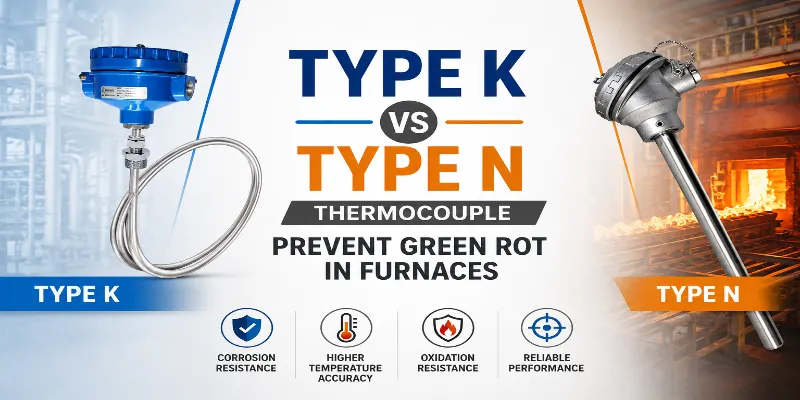
Type K vs Type N Thermocouple: Preventing Green Rot and Degradation in High-Temperature Industrial Furnaces
If a Type K thermocouple that read perfectly fine for months suddenly starts drifting, giving erratic readings, or fails outright — usually right when a production batch is on the line — the most common cause is a well-known but under-discussed failure mode called green rot.
Green rot is a form of internal oxidation that attacks the Chromel (Nickel-Chromium) leg of a Type K thermocouple. It develops silently — the sensor keeps producing a plausible-looking reading while that reading quietly drifts away from reality — which makes it one of the more dangerous failure modes in furnace instrumentation precisely because it doesn’t announce itself the way an open-circuit failure does. This guide explains exactly what causes it, why Type K is specifically vulnerable, why Type N was engineered to resist it, and how to decide which type is right for your furnace, kiln, or heat-treatment line.
What Is “Green Rot” in Thermocouples?
Green rot is a form of internal oxidation that affects the Chromel (Nickel-Chromium) positive leg of a Type K Thermocouple. It typically occurs when the thermocouple operates in the 800°C to 1050°C range, inside a sheath, under marginally oxidizing or low-oxygen (slightly reducing) atmospheres — a very common condition inside sealed furnace tubes, sheathed probes, and protection wells where oxygen is limited but not completely absent.
Here’s what happens at the metallurgical level:
- In a properly oxidizing atmosphere, chromium in the Chromel wire forms a stable, protective chromium oxide layer on the wire’s surface.
- In a low-oxygen environment (common inside long, sealed, or poorly vented thermowells), the chromium instead oxidizes internally, beneath the surface, rather than forming that protective layer.
- This internal oxidation depletes chromium from the alloy matrix, changes the wire’s composition, and physically turns the affected section a green or olive color — hence the name.
Why Green Rot Is a Problem for Your Process
Green rot isn’t just cosmetic. It directly damages thermocouple performance:
- Calibration drift – As chromium is depleted, the thermocouple’s voltage output no longer matches standard Type K reference tables, causing readings to drift, often by tens of degrees.
- Embrittlement and wire failure – The affected zone becomes brittle and prone to cracking or snapping, especially under vibration or thermal cycling.
- Unpredictable failure timing – Unlike a clean burnout, green rot develops gradually and unevenly, making it hard to predict when a sensor will fail.
- Process and safety risk – In furnaces, kilns, and heat-treatment lines, a silently drifting sensor can lead to under- or over-processing, scrapped batches, or unsafe operating conditions before anyone notices the reading is wrong.
Type K Thermocouple: Strengths and Limitations
The K Type Thermocouple (Chromel/Alumel) remains the most widely used thermocouple worldwide, and for good reason:
- Wide operating range from approximately -200°C to 1,372°C
- Low cost and wide availability
- Fast response time
- Reliable performance in clean, well-oxidized atmospheres above 540°C
However, its Achilles’ heel is exactly the marginally oxidizing, oxygen-deficient environment found inside many industrial furnace sheaths and thermowells — precisely the condition that triggers green rot. For continuous, long-duration furnace operations where the sensor is sealed inside a protection tube, this vulnerability can significantly shorten service life.
Aavad’s NABL Certified K Type Thermocouple, built with Chromel/Alumel elements to ANSI/IEC standards, is engineered with this risk in mind — but no Type K design can fully escape the underlying metallurgical limitation of the Chromel alloy itself.
Type N Thermocouple: The Engineered Solution to Green Rot
The Type N Thermocouple (Nicrosil/Nisil) was developed specifically to solve the green rot problem that plagues Type K sensors. Here’s how it differs:
| Parameter | Type K (Chromel/Alumel) | Type N (Nicrosil/Nisil) |
|---|---|---|
| Positive leg | Chromel (Ni-Cr) | Nicrosil (Ni-Cr-Si) |
| Negative leg | Alumel (Ni-Al) | Nisil (Ni-Si) |
| Temperature range | -200°C to 1,372°C | -270°C to 1,300°C |
| Sensitivity | ~41 µV/°C | ~39 µV/°C |
| Green rot resistance | Vulnerable in 800–1050°C low-oxygen zones | Significantly more resistant |
| Long-term stability | Good | Better — up to 3x more stable over time |
| Cost | Lower | Slightly higher |
The higher silicon content in both the Nicrosil and Nisil alloys promotes the formation of a stable, adherent silicon oxide layer on the wire surface, even in marginally oxidizing atmospheres. This protective layer prevents the internal oxidation process that causes green rot in Type K wires — giving Type N thermocouples substantially better long-term stability and drift resistance in the same demanding furnace conditions.
When Should You Choose Type N Over Type K?
Based on field experience across Indian steel, ceramic, glass, and heat-treatment industries, we recommend considering a Type N Thermocouple when:
- The sensor will be sealed inside a long thermowell or protection tube with limited oxygen circulation
- Operating temperatures regularly fall in the 800°C–1050°C “danger zone” for green rot
- The furnace runs continuously or for extended duration cycles, increasing cumulative exposure time
- You need longer calibration intervals and reduced sensor replacement frequency
- Process consistency and batch quality depend on stable, drift-free temperature readings
For shorter cycles, lower-temperature applications, or where occasional replacement is acceptable, the cost-effective Type K Thermocouple remains a perfectly suitable choice.
Aavad Instrument: NABL Certified Type K and Type N Thermocouples
As a leading thermocouple manufacturer and exporter based in Ahmedabad, Gujarat, Aavad Instrument supplies both:
- K Type Thermocouple – NABL certified, Chromel/Alumel construction, ANSI/IEC 60584 compliant, available in head-type, ceramic tube, and wire configurations.
- Type N Thermocouple – Nicrosil/Nisil construction offering superior oxidation resistance and long-term stability for continuous high-temperature furnace duty.
Every sensor we manufacture comes with NABL Calibration Certification and is built under ISO 9001:2015 quality systems, with 15+ years of experience serving BHEL, ONGC, Indian Oil, Aditya Birla, and 2,900+ industrial clients across India and 12+ countries.
Frequently Asked Questions (FAQs)
1. What causes green rot in Type K thermocouples? Green rot is caused by internal oxidation of the chromium in the Chromel wire when it operates in marginally oxidizing or low-oxygen atmospheres, typically between 800°C and 1050°C. Instead of forming a protective surface oxide layer, the chromium oxidizes internally, depleting the alloy and turning the wire green.
2. How do I know if my thermocouple has green rot? Common signs include unexplained calibration drift, inconsistent or fluctuating readings, and reduced output accuracy over time. On inspection (if the sheath is opened), the affected wire section often shows a visible green or olive discoloration and becomes brittle.
3. Is Type N thermocouple a direct replacement for Type K? In most applications, yes. Type N thermocouples have a similar temperature range and can typically be installed using the same thermowells, heads, and instrumentation as Type K, with only minor calibration table differences in your controller or indicator settings.
4. Why is Type N more resistant to green rot than Type K? Type N’s Nicrosil and Nisil alloys contain higher silicon content, which forms a stable, adherent silicon oxide layer on the wire surface even in low-oxygen atmospheres. This prevents the internal oxidation process responsible for green rot in Type K’s Chromel alloy.
5. Does Type N thermocouple cost more than Type K? Yes, Type N thermocouples are typically priced slightly higher than Type K due to the specialized alloy composition. However, the extended service life and reduced replacement frequency often make Type N more cost-effective over the long run in continuous high-temperature operations.
6. What temperature range is Type N thermocouple suitable for? Type N thermocouples are suitable for use from approximately -270°C to 1,300°C, making them ideal for industrial furnaces, kilns, and heat-treatment processes operating in the mid-to-high temperature range.
7. Can Aavad Instrument provide a custom thermocouple for my furnace application? Yes. Aavad Instrument offers fully customized Type K and Type N thermocouples, including sheath material, length, configuration, and protection class, tailored to your specific furnace and process conditions. Contact our technical team for a free consultation.
8. Does Aavad Instrument provide NABL calibration for these thermocouples? Yes. Every Type K and Type N thermocouple supplied by Aavad Instrument is backed by an NABL Calibration Certificate, ensuring traceable accuracy and compliance with ANSI/IEC 60584 standards.
Conclusion
Green rot is one of the most common — and most preventable — causes of premature thermocouple failure in Indian furnaces, kilns, and heat-treatment plants. While the Type K Thermocouple remains a dependable, economical workhorse for general-purpose use, the Type N Thermocouple is the better engineered choice wherever long-term stability inside sealed, high-temperature thermowells matters most.
Not sure which type fits your specific furnace conditions? Our engineering team can recommend the right thermocouple type, sheath material, and configuration for your exact process.
Talk to Aavad Instrument’s technical team today: call +91 90996 22823 or WhatsApp us for a free consultation and quote.