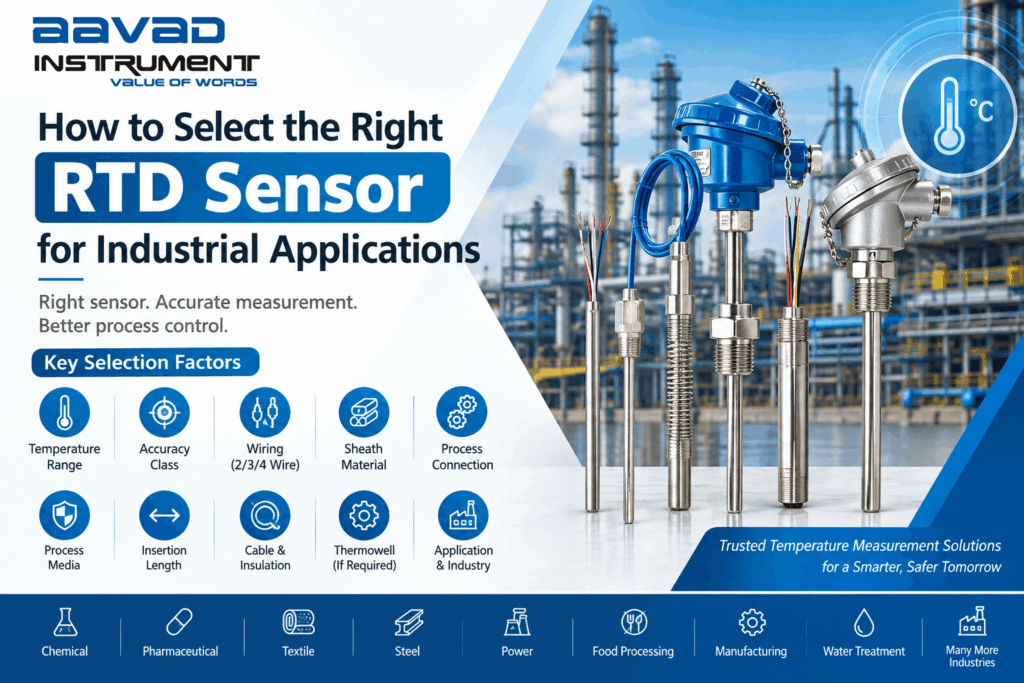
How to Select the Right RTD Sensor for Industrial Applications
Introduction
Accurate temperature measurement is essential for maintaining process safety, product quality, energy efficiency, and equipment reliability in industrial plants. From chemical processing and pharmaceuticals to steel, power, textile, food processing, and manufacturing industries, the right temperature sensor can significantly improve process control.
Among the various temperature measurement technologies available, RTD sensors (Resistance Temperature Detectors) are widely used because of their excellent accuracy, repeatability, stability, and long-term performance.
However, selecting the right RTD sensor is not simply a matter of choosing a PT100 element. The sensor must be selected according to the temperature range, process conditions, accuracy requirement, installation location, wiring configuration, sheath material, process connection, response time, vibration, pressure, and environmental conditions.
This guide explains how to select the right RTD sensor for industrial applications and what technical parameters should be considered before placing an order.
What Is an RTD Sensor?
An RTD (Resistance Temperature Detector) is a temperature sensor that measures temperature based on the predictable change in electrical resistance of a sensing element.
As temperature changes, the resistance of the RTD element changes. An instrumentation system, temperature transmitter, PLC, DCS, or temperature indicator converts this resistance change into a temperature reading.
The most commonly used industrial RTD is the PT100 RTD.
What Does PT100 Mean?
PT100 means:
- PT = Platinum
- 100 = Resistance of 100 ohms at 0°C
Platinum is widely preferred for industrial RTDs because it provides excellent stability, corrosion resistance, repeatability, and predictable resistance characteristics.
Common industrial RTD types include:
- PT100
- PT500
- PT1000
- PT200
- Duplex RTD
- Triplex RTD
For many industrial temperature measurement applications, PT100 remains one of the most commonly selected RTD elements.
Why Is Selecting the Correct RTD Sensor Important?
An incorrectly selected RTD can result in:
- Inaccurate temperature measurement
- Slow temperature response
- Frequent sensor failure
- Reduced process efficiency
- Incorrect control-system operation
- Increased maintenance costs
- Unnecessary production downtime
- Premature sensor replacement
For example, an RTD designed for a low-temperature application may not be suitable for a high-temperature furnace. Similarly, an RTD with an unsuitable sheath material can fail prematurely in corrosive chemical service.
Therefore, RTD sensor selection should always be application-specific.
10 Important Factors for Selecting the Right RTD Sensor
1. Determine the Required Temperature Range
The first and most important parameter is the actual process temperature range.
Before selecting an RTD, determine:
- Minimum operating temperature
- Normal operating temperature
- Maximum operating temperature
- Possible temperature fluctuations
- Temperature during startup and shutdown
Different RTD constructions and insulation materials are suitable for different temperature ranges.
Typical Application-Based Temperature Considerations
| Temperature Range | Typical Applications |
|---|---|
| -50°C to 100°C | HVAC, water, environmental systems |
| 0°C to 200°C | Chemical, pharmaceutical, textile processes |
| 0°C to 400°C | Industrial machinery, dryers, process equipment |
| 0°C to 600°C | Furnaces, ovens, heat-treatment equipment |
| Higher temperatures | Specialized high-temperature sensor designs |
The actual usable range depends on the RTD element, insulation, sheath, cable, terminal arrangement, and sensor construction.
Important Tip
Do not select a sensor only according to the maximum temperature. Always consider the complete assembly, including:
Sensing element + insulation + sheath + cable + connector + process connection.
2. Select the Correct RTD Element
The sensing element determines the basic electrical characteristics of the sensor.
PT100
PT100 is the most widely used industrial RTD configuration.
Advantages include:
- Good accuracy
- Excellent repeatability
- Long-term stability
- Good corrosion resistance
- Wide industrial application
- Compatibility with many temperature transmitters and controllers
PT1000
PT1000 has a nominal resistance of 1000 ohms at 0°C.
It can be useful where higher resistance provides advantages in the measurement circuit, particularly for longer cable runs or specific instrumentation designs.
PT500
PT500 provides 500 ohms resistance at 0°C and is also used in selected industrial and instrumentation applications.
PT200
PT200 RTDs are used in applications where the instrumentation system is specifically designed for this resistance characteristic.
Always verify compatibility between the RTD element and the connected temperature instrument.
3. Choose the Correct RTD Accuracy Class
Accuracy is another critical consideration.
RTDs are available in different accuracy classes depending on the applicable standard and sensor construction.
Common RTD accuracy classifications include:
- Class A
- Class B
- Higher-accuracy configurations depending on specification
Class A RTD
Class A is commonly selected when better temperature measurement accuracy is required.
It is suitable for applications such as:
- Pharmaceutical processes
- Laboratory equipment
- Precision process control
- Chemical processing
- Critical industrial temperature monitoring
Class B RTD
Class B is commonly used for general industrial temperature measurement where standard accuracy is acceptable.
How to Choose?
If temperature accuracy is critical to your process, consider:
Class A RTD
For general-purpose industrial monitoring:
Class B RTD
The final choice should be based on the required measurement tolerance and applicable standard.
4. Select the Correct Wiring Configuration
RTD wiring configuration has a significant effect on measurement accuracy because the resistance of the connecting wires can influence the measured resistance.
The most common configurations are:
2-Wire RTD
A 2-wire RTD uses two wires for connection.
It is generally suitable for:
- Short cable distances
- Less critical measurements
- Simple temperature monitoring
However, lead-wire resistance can introduce measurement error.
3-Wire RTD
The 3-wire RTD is one of the most commonly used industrial configurations.
It provides compensation for lead-wire resistance when used with compatible instrumentation.
Applications include:
- Process plants
- Chemical industries
- Textile plants
- Pharmaceutical industries
- Power plants
- General industrial automation
4-Wire RTD
A 4-wire RTD offers higher measurement accuracy because it can compensate for lead-wire resistance more effectively.
It is commonly selected for:
- Precision measurement
- Calibration systems
- Laboratory applications
- High-accuracy process monitoring
Quick Selection
| Wiring | Typical Use |
|---|---|
| 2-Wire | Basic/short-distance measurement |
| 3-Wire | General industrial applications |
| 4-Wire | High-accuracy measurement |
For most industrial applications, 3-wire PT100 RTD is a practical and widely used configuration.
5. Select the Right Sensor Sheath Material
The sheath protects the RTD sensing element from the surrounding environment.
Common sheath materials include:
- Stainless Steel 304
- Stainless Steel 316
- Stainless Steel 316L
- Inconel and other high-temperature alloys for specialized applications
- PTFE/Teflon protection for selected chemical applications
Stainless Steel 304
Suitable for many general industrial applications.
Stainless Steel 316 / 316L
Often preferred for applications involving:
- Chemical environments
- Pharmaceutical equipment
- Moisture
- Corrosive process conditions
- Food and hygienic applications
PTFE/Teflon Protection
PTFE protection can be useful in selected applications where chemical resistance is more important than high-temperature capability.
The material should always be selected according to the process media, chemical compatibility, pressure, temperature, and mechanical conditions.
6. Consider the Process Media
The process material surrounding the sensor is extremely important.
An RTD installed in clean water may require a completely different construction from one installed in an aggressive chemical process.
Before selecting the sensor, identify:
- Liquid
- Gas
- Steam
- Slurry
- Chemical solution
- Oil
- Water
- Air
- Exhaust gas
- High-temperature process media
Also consider:
- Corrosiveness
- Moisture
- Abrasion
- Pressure
- Flow velocity
- Chemical compatibility
For corrosive environments, selecting the wrong sheath material can significantly reduce sensor life.
7. Select the Correct Sensor Length and Diameter
RTD dimensions directly affect installation and temperature measurement performance.
Important dimensions include:
- Sensor insertion length
- Probe diameter
- Tip length
- Overall length
- Extension length
- Cable length
Why Is Insertion Length Important?
The sensing element should be positioned properly within the process to obtain a representative temperature measurement.
If the sensor is too short, it may not reach the correct measurement zone.
If it is excessively long, it may create:
- Mechanical stress
- Installation problems
- Vibration
- Unnecessary material cost
Therefore, the sensor insertion length should be selected according to the equipment and process connection.
8. Select the Appropriate Process Connection
The RTD must be securely installed in the process.
Common mounting arrangements include:
- Threaded connection
- Flanged connection
- Compression fitting
- Adjustable gland
- Spring-loaded mounting
- Thermowell-mounted RTD
- Direct insertion probe
Common industrial thread types may include:
- BSP
- NPT
- Metric threads
The process connection should match the equipment nozzle or mounting arrangement.
Spring-Loaded RTD
Spring-loaded RTDs can maintain contact between the sensing tip and the measurement point, which can help improve thermal contact in suitable installations.
They are frequently used in:
- Motors
- Gearboxes
- Machinery
- Bearing housings
- Industrial equipment
9. Decide Whether a Thermowell Is Required
A thermowell provides a protective barrier between the RTD and the process.
Thermowells are particularly useful when the sensor needs protection from:
- High pressure
- High velocity
- Corrosive media
- Mechanical damage
- Frequent sensor replacement
A thermowell also allows the RTD to be removed for maintenance without necessarily opening the process connection, depending on the installation design.
However, thermowell selection must consider:
- Process pressure
- Process temperature
- Flow velocity
- Material compatibility
- Insertion length
- Wake frequency/vibration considerations
For critical applications, proper thermowell design and verification are important.
10. Select the Correct Cable and Insulation
The cable is often overlooked during RTD selection, but it can significantly affect sensor reliability.
Cable selection should consider:
- Temperature
- Moisture
- Chemical exposure
- Flexibility
- Mechanical movement
- Electrical noise
- Cable length
Common insulation materials include:
- PVC
- PTFE/Teflon
- Fiberglass
- Silicone
- Other application-specific insulation
PTFE Cable
PTFE-insulated cable is often selected for applications requiring good chemical resistance and higher temperature capability than standard PVC cabling.
For high-temperature applications, the cable insulation should be selected carefully according to the actual temperature at the cable transition point.
RTD Sensor Selection Based on Industrial Application
Different industries require different RTD constructions.
Chemical Industry
Chemical plants may require RTDs with:
- PT100 element
- SS316/316L sheath
- Suitable chemical-resistant construction
- Thermowell protection
- Appropriate process connection
- 3-wire or 4-wire configuration
The exact construction depends on the chemical, concentration, temperature, and pressure.
Pharmaceutical Industry
Pharmaceutical applications generally require:
- High measurement accuracy
- Stable temperature measurement
- Hygienic construction where applicable
- Suitable SS material
- Easy cleaning
- Reliable calibration
RTD sensors are commonly used in:
- Reactors
- Storage tanks
- Autoclaves
- Sterilization systems
- Water systems
- Process skids
Textile Industry
Textile processing applications may require RTDs for:
- Dyeing machines
- Chemical processing
- Dryers
- Hot-water systems
- Steam systems
- Process tanks
Depending on the application, PT100 sensors with suitable cable insulation and protective sheath construction can provide reliable temperature measurement.
Steel and Metal Industry
Steel plants involve demanding temperature conditions.
RTDs may be used in:
- Cooling water systems
- Hydraulic systems
- Lubrication systems
- Rolling mills
- Bearing temperature measurement
- Gearboxes
- Process equipment
For very high-temperature applications, thermocouples may be more appropriate than standard RTDs. The choice should be based on the actual temperature and installation conditions.
Power Plants
RTD sensors are widely used for temperature monitoring in:
- Turbine bearing systems
- Pumps
- Motors
- Cooling-water systems
- Lubrication systems
- Condensate systems
- Heat exchangers
For rotating machinery, sensor construction, vibration resistance, insertion dimensions, and mounting arrangement become especially important.
RTD vs Thermocouple: Which One Should You Choose?
RTDs and thermocouples are both widely used industrial temperature sensors, but they have different characteristics.
| Parameter | RTD | Thermocouple |
|---|---|---|
| Accuracy | Generally high | Application dependent |
| Stability | Excellent | Good |
| Repeatability | Excellent | Good |
| Temperature Range | Moderate to high depending on construction | Very wide |
| Response Time | Generally slower | Generally faster |
| Long-Term Stability | Excellent | Depends on type/environment |
| Typical Application | Precision process measurement | High-temperature measurement |
Choose an RTD when:
- Accuracy is important
- Excellent stability is required
- The temperature is within the suitable RTD range
- Repeatability is important
- Long-term reliable measurement is required
Choose a Thermocouple when:
- Very high temperature is involved
- Fast response is important
- The application is mechanically demanding
- A wide temperature range is required
The best sensor depends on the complete process requirement.
Common RTD Sensor Configurations
Industrial RTDs can be manufactured in various configurations, including:
Simplex RTD
– Contains one sensing circuit.
– Suitable for standard temperature measurement.
Duplex RTD
– Contains two independent sensing elements.
– Advantages include:
- Redundancy
- Two measurement systems
- Monitoring and control from separate instruments
– Duplex RTDs can be useful in critical process applications.
Triplex RTD
– Contains three sensing elements and can be used where multiple temperature signals are required from one installation point.
RTD Sensor Selection Checklist
Before ordering an RTD sensor, collect the following information:
Temperature
- Minimum temperature
- Normal temperature
- Maximum temperature
Sensor
- RTD type
- PT100/PT500/PT1000
- Accuracy class
- Simplex/Duplex/Triplex
Wiring
- 2-wire
- 3-wire
- 4-wire
Mechanical
- Probe diameter
- Insertion length
- Overall length
- Thread/process connection
Material
- SS304
- SS316
- SS316L
- PTFE/Teflon
- Special alloy
Installation
- Direct insertion
- Thermowell
- Spring-loaded
- Flanged
- Threaded
- Compression fitting
Cable
- Cable length
- Cable insulation
- Temperature rating
- Shielding requirement
Process
- Process media
- Pressure
- Flow velocity
- Corrosion
- Vibration
- Moisture
Providing these details to the RTD manufacturer helps ensure the sensor is correctly designed for the application.
How to Avoid Common RTD Selection Mistakes
Mistake 1: Selecting Only by Temperature Range
Temperature range is important, but it is not the only factor.
Solution: Consider temperature, pressure, media, sheath, cable, mounting, and accuracy together.
Mistake 2: Ignoring Lead-Wire Resistance
Long cables can affect RTD measurement.
Solution: Consider 3-wire or 4-wire configuration where appropriate.
Mistake 3: Using the Wrong Sheath Material
An unsuitable sheath can corrode or fail.
Solution: Check chemical compatibility before selecting the material.
Mistake 4: Incorrect Insertion Length
An improperly positioned sensing element may not measure the actual process temperature.
Solution: Determine the correct measurement point and insertion depth.
Mistake 5: Ignoring Instrument Compatibility
A PT100 cannot simply be connected to an instrument configured for another sensor type.
Solution: Confirm the input specification of the PLC, DCS, temperature transmitter, indicator, or controller.
Why Customized RTD Sensors Are Often Better for Industrial Applications
Standard RTDs may not always match the exact installation requirements of industrial equipment.
A customized RTD can be designed according to:
- Process temperature
- Sensor diameter
- Insertion length
- Cable length
- Process connection
- Sheath material
- Accuracy class
- Wiring configuration
- Connector type
- Thermowell dimensions
- Environmental conditions
This can improve installation compatibility, measurement reliability, and sensor service life.
AAVAD Instrument – Industrial RTD Sensor Solutions
AAVAD Instrument Pvt. Ltd. manufactures and supplies industrial temperature measurement solutions, including RTD PT100 sensors, thermocouples, thermowells, and customized temperature sensors for a wide range of industrial applications.
RTD sensors can be configured according to specific application requirements such as:
- PT100 sensing element
- 2-wire, 3-wire, or 4-wire configuration
- Simplex, Duplex, or Triplex construction
- SS304 / SS316 / SS316L construction
- PTFE/Teflon protection where applicable
- Customized insertion length
- Customized probe diameter
- Cable and connector options
- Threaded or other process connections
- Spring-loaded construction
- Thermowell-mounted configuration
AAVAD Instrument provides temperature measurement solutions for industries such as:
Chemical | Pharmaceutical | Textile | Steel | Power | Food Processing | Manufacturing | Water Treatment | Machinery | Process Industries
Selecting the right RTD sensor requires more than simply choosing a PT100 element. The sensor must be matched to the temperature range, accuracy requirement, process media, pressure, sheath material, wiring configuration, insertion length, process connection, cable construction, and installation environment.
For general industrial applications, a 3-wire PT100 RTD is often a practical choice. For higher-accuracy measurement, a 4-wire RTD may be preferred. In corrosive environments, appropriate sheath or protection material should be selected, while high-pressure or high-velocity applications may require a properly engineered thermowell.
The right RTD sensor can help industries achieve better temperature accuracy, improved process control, reduced maintenance, and longer sensor life.
If you are unsure which RTD sensor is suitable for your process, provide your temperature range, process media, sensor length, diameter, connection, cable length, and application details to an experienced RTD manufacturer for proper selection.
Need the Right RTD Sensor for Your Application?
AAVAD Instrument can provide customized industrial RTD temperature sensors based on your process and installation requirements.
Contact AAVAD Instrument Pvt. Ltd.
📞 Mobile: +91 90996 22823
📧 Email: hrg@aavadinstrument.com
🌐 Website: www.aavadinstrument.com