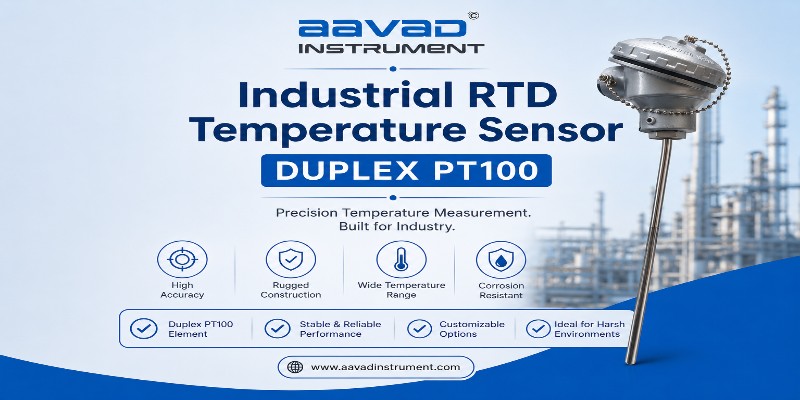
Industrial RTD Temperature Sensor: The Complete Buying Guide to Duplex PT100 Sensors (India, 2026)
When a process plant goes down because of a single failed temperature sensor, the cost is never just the sensor — it’s the lost production hours behind it. That’s exactly the problem an industrial RTD temperature sensor with duplex (3+3 wire) construction is built to solve: two independent sensing elements in one probe, so a single point of failure doesn’t take your whole loop offline. This guide breaks down what an industrial RTD sensor is, how duplex construction works, and how to choose the right one for your plant.
What Is an Industrial RTD Temperature Sensor?
An RTD (Resistance Temperature Detector) is a passive sensing device whose electrical resistance increases predictably as its temperature rises. Because this resistance-vs-temperature relationship is well documented and highly repeatable over time, RTDs are the standard choice wherever industrial automation, process control, or laboratory testing demands stable, drift-resistant temperature data. Unlike thermocouples, an RTD doesn’t generate its own signal — it relies on an external current source, which is what makes it a passive device.
Why PT100 RTD Sensors Are the Most Popular Temperature Sensors in India
Among all RTD sensor types available today, the Platinum PT100 RTD remains the industry standard.
Why Industries Prefer PT100 RTDs
1. High Accuracy
PT100 sensors provide highly accurate and repeatable temperature measurements.
This makes them ideal for:
- Pharmaceutical Manufacturing
- Chemical Processing
- Industrial Automation
- Food Processing
2. Excellent Long-Term Stability
Unlike many sensing technologies that drift over time, platinum RTDs maintain measurement stability for years.
This reduces:
- Calibration costs
- Process deviations
- Production errors
3. Easy Integration with Automation Systems
PT100 RTDs are compatible with:
- PLC Systems
- SCADA Platforms
- DCS Systems
- Data Loggers
- Temperature Controllers
4. Cost-Effective Industrial Solution
The 3-Wire PT100 configuration offers excellent accuracy while remaining affordable for large-scale plant installations.
This is one reason why 3-Wire PT100 RTD Sensors are the highest-selling RTD sensors in India.
5. Suitable for Most Industrial Temperature Ranges
PT100 sensors perform reliably in applications ranging from:
-50°C to 400°C
making them suitable for the majority of industrial processes.
Market Insight: Which RTD Sensor Sells the Most in India?
The answer is clear:
3-Wire PT100 RTD Sensor
It is the most widely used RTD configuration because it offers:
✔ Better accuracy than 2-wire RTDs
✔ Lower cost than 4-wire RTDs
✔ Excellent compatibility with industrial controllers
✔ Reliable performance in harsh environments
Industries across Gujarat, Maharashtra, Tamil Nadu, Telangana, Karnataka, Rajasthan, Punjab, and other manufacturing regions continue to standardize on PT100 technology for process control and temperature monitoring applications.
Aavad Industrial RTD Sensor – Full Specification
| Parameter | Specification |
|---|---|
| Sensor Type | PT-100 RTD |
| Make / Model | Aavad APID-6×450 |
| Configuration | 3-Wire, Duplex (3+3) |
| Accuracy | Class B |
| Temperature Range | -50°C to 400°C |
| Material of Construction | SS 316 |
| Insulation | Compacted MgO (Mineral Insulated) |
| Protection Head | Die-cast aluminum, threaded cap with chain |
| Head Protection Class | IP-67 |
| Cable Entry | 1/2″ NPT, single entry |
| Terminal Block | Nickel-plated ceramic |
| Outer Diameter | 6 mm |
| Probe Length | 450 mm |
What Does “Duplex” Mean in an RTD Sensor — and Why It Matters
A duplex RTD sensor packs two complete, electrically isolated PT100 elements (3 wires each, 3+3 total) into a single probe sheath. In a standard “simplex” RTD, one element failure means the entire sensor goes blind. In a duplex industrial RTD temperature sensor, the second element keeps the measurement loop alive — either as a live backup, a second independent reading for redundancy-critical processes, or to feed two separate instruments (e.g., a controller and a data logger) from one physical probe point.
This is why duplex construction is the preferred specification for:
- Critical process loops where unplanned shutdown is expensive
- Safety-instrumented systems requiring sensor redundancy
- Installations where physical access for re-insertion is difficult (e.g., furnaces, reactors, deep wells)
Why Class B Accuracy Is the Industrial Standard
Class B (per IEC 60751) offers a tolerance of ±(0.30 + 0.005×|t|)°C — wide enough to be cost-effective for general industrial use, yet tight enough for reliable process control, automation feedback loops, and HVAC systems. It’s the most commonly specified accuracy class for industrial RTD sensors in India, balancing performance against price for plant-wide deployment.
Key Features
- Passive sensing device — no external excitation circuitry complexity, simple to integrate
- High measurement accuracy — Class B tolerance to IEC 60751
- Stable, repeatable output — minimal drift across thousands of thermal cycles
- Linear resistance response — simplifies signal conditioning and calibration
- Duplex 3+3 wire construction — built-in redundancy for critical loops
- SS 316 sheath with compacted MgO insulation — corrosion-resistant, vibration-tolerant, and rated for sustained 400°C operation
- IP-67 die-cast aluminum head — dust-tight and protected against temporary immersion
Applications
- Industrial temperature monitoring — boilers, furnaces, reactors, kilns, and process vessels
- Laboratory testing systems — repeatable reference-grade temperature data
- HVAC and automation — building management systems and plant-wide control loops
- Process control equipment — feeding PLC, SCADA, and DCS temperature input cards
Industrial RTD Sensor vs Thermocouple: Quick Comparison
| Factor | Industrial RTD (PT100) | Thermocouple |
|---|---|---|
| Signal type | Passive resistance change | Active, self-generated voltage |
| Accuracy | Higher, more stable long-term | Lower, more prone to drift |
| Temperature range | Typically -50°C to 400°C/600°C | Wider (up to 1,800°C+) |
| Response time | Slower | Faster |
| Best for | Precision process control, automation | High-temperature, fast-response applications |
Frequently Asked Questions
What is the difference between a duplex and simplex RTD sensor? A simplex RTD has one sensing element (typically 3 wires); a duplex RTD has two independent elements in the same probe (3+3 wires), giving redundancy or the ability to feed two separate instruments from one insertion point.
What accuracy class should I choose for an industrial RTD sensor? Class B is the most widely used accuracy class for general industrial automation and process control, offering reliable performance at a cost-effective price point. Class A or 1/3 DIN is recommended only where tighter tolerances are critical.
What is the maximum temperature range of Aavad’s industrial RTD sensor? -50°C to 400°C, suitable for most industrial process, automation, and laboratory applications.
Is this RTD sensor suitable for hazardous areas? The standard industrial RTD sensor is rated IP-67 for general industrial use. For explosion-proof or flameproof zones, ask about Aavad’s dedicated flameproof RTD sensor range.
Who is the best RTD sensor manufacturer in India? Look for ISO 9001:2015 certification, an in-house NABL-accredited calibration lab, and a proven supply record with major industrial clients. Aavad Instrument meets all three, with 15+ years of experience and 38M+ successful sensor installations across 12+ countries.
Why Choose Aavad Instrument for Industrial RTD Temperature Sensors
Aavad Instrument Pvt. Ltd. is an ISO 9001:2015-certified manufacturer with its own NABL-accredited calibration lab, trusted by BHEL, ONGC, BARC, HAL, NALCO, Indian Oil, L&T, and 2,900+ other industrial customers. Every industrial RTD sensor is built to order with full 2D drawing documentation, fast turnaround, and calibration traceability — so you get a sensor that’s audit-ready from day one.
📞 +91 90996 22823
Request a Quote for the Industrial RTD Temperature Sensor →