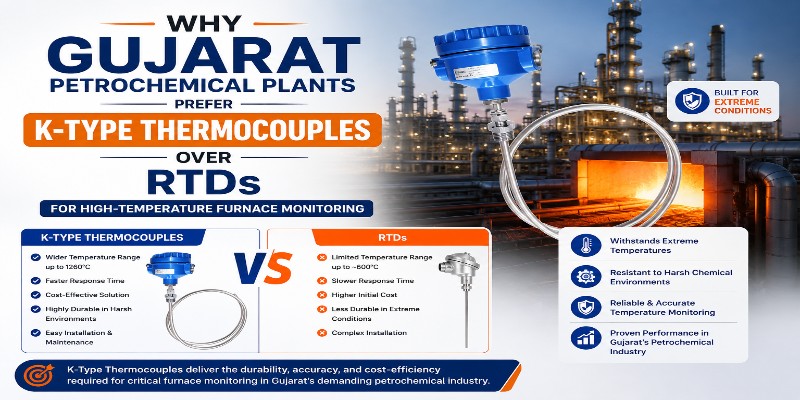
Why Gujarat Petrochemical Plants Choose K-Type Thermocouples Over RTDs for High-Temperature Furnace Monitoring — Complete Buyer’s Guide
Furnace temperature control is one of the most demanding measurement applications in any petrochemical plant. Cracking furnaces, reformers, heat-treatment ovens, and thermal oxidizers routinely operate in the 600°C–1,200°C range, and a sensor failure or a few degrees of drift can mean coking, tube damage, off-spec product, or a costly unplanned shutdown.
Across Gujarat’s petrochemical and process industry clusters — Dahej, Vapi, Ankleshwar, Jamnagar’s ancillary belt, and Vadodara — field engineers consistently report leaning toward K-Type thermocouples over RTDs for these high-temperature furnace zones. This guide breaks down exactly why, with a full side-by-side technical comparison to help you choose correctly.
Quick Comparison: K-Type Thermocouple vs PT100 RTD
| Parameter | K-Type Thermocouple | PT100 RTD |
|---|---|---|
| Typical temperature range | -270°C to 1,372°C | -200°C to ~600°C (most industrial RTDs rated up to 400°C-850°C) |
| Response time | Fast | Comparatively slower |
| Accuracy at moderate temp | Good | Excellent (Class A: ±0.15°C) |
| Accuracy at high temp (>600°C) | Stable and reliable | Accuracy and lifespan degrade |
| Output signal | Self-generated millivolt | Resistance change (needs excitation current) |
| Cost per measurement point | Lower | Higher |
| Vibration/mechanical resistance | Generally more robust | More sensitive to shock |
| Best suited for | Furnaces, kilns, exhaust, high-temp reactors | Precision control in low-to-moderate temp loops |
Why K-Type Wins for Furnace Duty Specifically
1. It Simply Goes Hotter
Furnace zones in petrochemical processing — cracking units, reformer tubes, regeneration furnaces — regularly exceed the practical operating ceiling of standard RTDs. K-Type thermocouples (Chromel/Alumel) are rated across an exceptionally wide span, from -270°C up to 1,372°C, making them well suited to high-temperature combustion zones and oxidizing atmospheres where furnace sensors typically operate above 540°C. For applications approaching the 1,200°C mark, plants generally specify a thermocouple sheath/sleeve rated for that duty (e.g., higher-grade alloy or ceramic protection tubes) rather than relying on an RTD, since RTDs are not designed for this temperature class.
2. Faster Response in Fluctuating Combustion Zones
Furnace temperatures can swing quickly during start-up, fuel changes, or burner trim adjustments. A thermocouple’s direct millivolt generation at the junction means it reacts faster to these swings than an RTD’s resistance-based measurement, giving the combustion control system a quicker, more current reading.
3. Lower Installed Cost Across Many Points
A typical furnace has multiple skin-point, flue gas, and zone thermocouples. Because thermocouples cost less to manufacture and install per point — and don’t require the more delicate platinum element — they are the more economical choice when many measurement points are needed across a furnace structure.
4. Mechanical Robustness
Furnaces vibrate, expand, and contract through thermal cycling. Thermocouple junctions, especially in mineral-insulated (MI) construction with compacted MgO insulation and an SS 316 (or higher-grade alloy) sheath, tolerate this mechanical stress better than the more fragile platinum resistance elements inside an RTD.
5. Field-Proven in Oxidizing Atmospheres
K-Type thermocouples are specifically noted for performing well in oxidizing atmospheres — the typical environment inside a fired furnace or kiln — which is one reason they have become a default specification for this duty across Gujarat’s process plants.
Where RTDs Still Make More Sense
It’s worth being clear: RTDs are not inferior sensors — they are simply optimized for a different job. For furnace jacket water, lube oil, combustion air pre-heat (moderate range), or any loop where tight process control below ~400°C is required, a PT100 RTD’s superior accuracy and stability make it the better choice. Many petrochemical furnace skids use a hybrid approach: K-Type thermocouples on the high-temperature furnace/flue side, and PT100 RTDs on the lower-temperature utility and control loops.
Buyer’s Checklist: Specifying a Furnace-Grade K-Type Thermocouple
- Confirm the actual peak process temperature — including upset/excursion conditions, not just normal operating temperature.
- Select the correct sheath material — SS 316 for general chemical service; higher nickel-alloy or ceramic-protected sheaths for sustained service near or above 1,000°C.
- Specify compacted MgO insulation — this keeps insulation resistance stable at elevated temperatures and extends sensor life.
- Choose the right process connection — BSP/NPT thread with thermowell mounting allows the sensor to be replaced without a furnace shutdown.
- Verify the connection head rating — a die-cast aluminum, flameproof, IP-67 head is standard for hazardous-area furnace installations.
- Ask for NABL-traceable calibration — essential for plants operating under ISO 9001 or process safety management systems.
- Check response time and insertion length — these should match your specific furnace geometry and the flue/zone being measured.
Aavad Instrument’s K-Type Thermocouple Range
Aavad Instrument Pvt. Ltd., an ISO 9001:2015 certified manufacturer based in Ahmedabad, Gujarat, supplies furnace-duty K-Type thermocouples including the K Type Thermocouple (Model AKFS-10), built with:
- SS 316 sheath construction
- Compacted MgO insulation for high-temperature stability
- Die-cast aluminum flameproof connection head, IP-67 rated
- BSP process connection, adjustable for thermowell mounting
- Nickel-plated ceramic terminal block for reliable, low-noise connections
For furnace applications approaching or exceeding 1,000°C, Aavad also offers custom-engineered sheath materials and protection tube configurations through its Build Your Products service. Explore the complete Head Type Thermocouple Manufacturer category for additional configurations.
Frequently Asked Questions
Q1. Can a K-Type thermocouple really handle furnace temperatures up to 1,200°C? K-Type thermocouples have a rated measurement span of -270°C to 1,372°C. For sustained operation at the higher end of this range, plants typically select a heavier-gauge or higher-grade sheath/protection tube to maximize sensor lifespan — your supplier should confirm the exact sheath specification for your specific furnace temperature and atmosphere.
Q2. Why don’t RTDs work well in furnaces? RTDs use a platinum resistance element that becomes less accurate and less durable as temperatures climb beyond their rated range — most industrial PT100 RTDs are designed for service up to roughly 400°C–600°C, well below typical furnace operating zones.
Q3. Is a K-Type thermocouple accurate enough for process control? Yes, K-Type thermocouples offer good accuracy for furnace and high-temperature process control, though RTDs remain more accurate at moderate temperatures. Many plants use thermocouples for the high-temperature zone and RTDs for tighter-tolerance, lower-temperature loops.
Q4. What sheath material should I choose for a furnace thermocouple? SS 316 is suitable for most general chemical and moderate-temperature furnace duty. For sustained high-temperature or aggressive atmospheres, ask your manufacturer about higher-grade alloy or ceramic-protected sheath options.
Q5. How do I select between flameproof and weatherproof connection heads? If the furnace is located in a classified hazardous (Ex) area, a flameproof, IP-67-rated die-cast aluminum head is mandatory. For non-hazardous outdoor furnace locations, a weatherproof head may be sufficient — confirm your plant’s area classification before specifying.
Get the Right Furnace Sensor for Your Plant
Talk to Aavad Instrument’s application engineers to match the correct K-Type thermocouple specification to your furnace’s temperature profile, atmosphere, and hazardous area classification. Request a quote or view the K Type Thermocouple product page for full datasheets.