Mineral Insulated Cable: Complete Guide to Temperature Range, Construction, Benefits, Types & Industrial Applications
Introduction
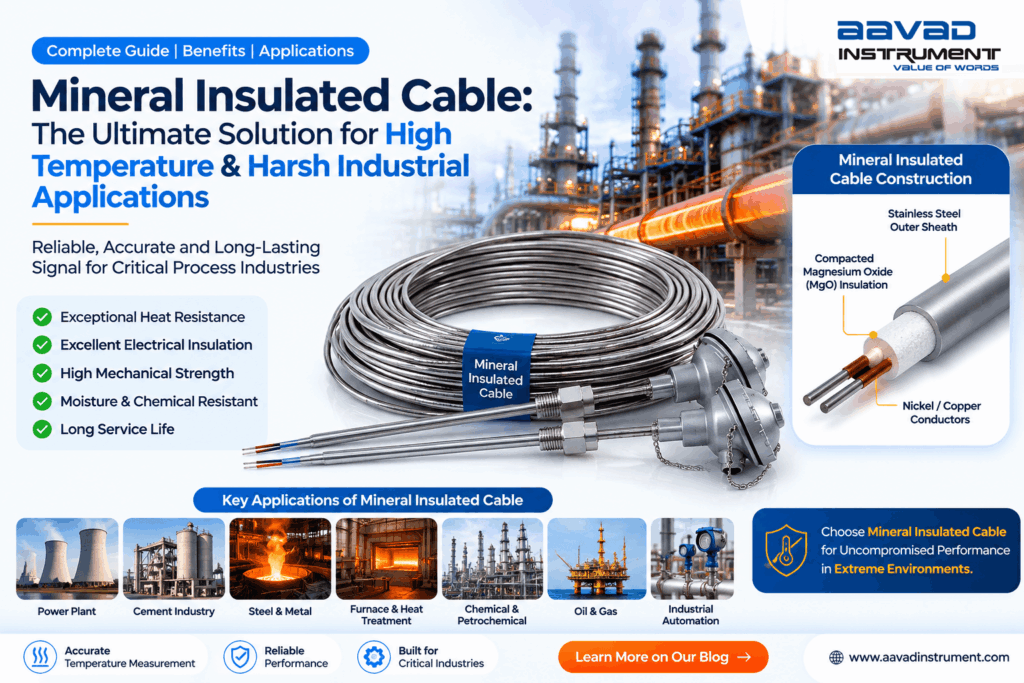
Mineral Insulated Cable (MI Cable) is a high-performance cable designed for reliable operation in high-temperature, harsh and demanding industrial environments. Unlike conventional cables that use polymer-based insulation, Mineral Insulated Cable uses compacted Magnesium Oxide (MgO) insulation between the internal conductors and a metallic outer sheath.
This unique construction provides excellent high-temperature resistance, electrical insulation, mechanical strength, vibration resistance, compact size and long service life.
Mineral Insulated Cable is widely used for manufacturing RTD PT100 sensors, thermocouples, mineral insulated thermocouples, high-temperature temperature probes and industrial temperature measurement assemblies.
Depending on the cable diameter, sheath material, conductor material, insulation quality and sensor construction, MI cables can be designed for applications ranging from moderate industrial temperatures to 1000°C and above in specialized high-temperature constructions.
For industries such as steel, cement, chemical, pharmaceutical, power generation, oil & gas, petrochemical, glass, textile and heat-treatment, selecting the correct MI cable is important for achieving reliable temperature measurement and long-term performance.
What Is a Mineral Insulated Cable?
A Mineral Insulated Cable is a specially constructed cable in which one or more electrical conductors are surrounded by highly compacted mineral insulation, normally Magnesium Oxide (MgO), and enclosed within a metallic outer sheath.
The basic construction consists of three main components:
- Metallic Outer Sheath
- Compacted Magnesium Oxide (MgO) Insulation
- Internal Electrical Conductors
The metallic sheath provides mechanical and environmental protection, while MgO provides electrical insulation and excellent thermal performance.
This compact construction makes MI cable particularly suitable for applications where conventional PVC, rubber or other polymer-insulated cables may not be suitable because of temperature or environmental limitations.
Mineral Insulated Cable Construction
1. Metallic Outer Sheath
The outer metallic sheath protects the internal conductors and mineral insulation from the surrounding environment.
Common sheath materials include:
- Stainless Steel 304
- Stainless Steel 316
- Stainless Steel 316L
- Inconel
- Nickel-based alloys
- Other high-temperature alloys
Stainless Steel 304
SS 304 is commonly used for general industrial applications where good mechanical strength and corrosion resistance are required.
Stainless Steel 316 / 316L
SS 316 and 316L can be selected for applications where better corrosion resistance is required, particularly in chemical and process environments.
Inconel and Nickel Alloys
Nickel-based alloys such as Inconel can be considered for specialized high-temperature applications where higher temperature and oxidation resistance are required.
The correct sheath material should always be selected according to the temperature, process atmosphere, chemical exposure and mechanical conditions.
2. Magnesium Oxide (MgO) Insulation
The internal conductors are surrounded by compacted Magnesium Oxide (MgO).
MgO is an important part of MI cable construction because it provides:
- Excellent electrical insulation
- High dielectric strength
- High-temperature resistance
- Good thermal conductivity
- Compact construction
- Long-term stability
- Reliable insulation between conductors and sheath
The quality and compaction of MgO are extremely important. Proper manufacturing and sealing are required to prevent moisture ingress and maintain insulation resistance.
3. Internal Conductors
Mineral Insulated Cable can be manufactured with different conductor configurations according to the application.
Common configurations include:
- Single-core
- Duplex
- Triplex
- Multi-core
Conductor material can vary depending on whether the cable is being used for electrical transmission, RTD temperature measurement or thermocouple measurement.
For example:
RTD PT100:
2-wire, 3-wire or 4-wire configuration
Thermocouple:
Single or duplex thermocouple conductors depending on the application.
Mineral Insulated Cable Temperature Range
One of the biggest advantages of Mineral Insulated Cable is its ability to operate in high-temperature environments.
However, there is no single maximum temperature applicable to every MI cable.
The actual operating temperature depends on:
- Sheath material
- Conductor material
- Cable diameter
- MgO insulation
- Sensor element
- Thermocouple type
- Process atmosphere
- Exposure duration
- Termination
- Installation conditions
Typical MI Cable Temperature Application Guide
| Operating Temperature | Typical Application Suitability |
|---|---|
| Up to 200°C | General industrial RTD and temperature applications |
| 200°C – 400°C | Industrial process, heating and chemical applications |
| 400°C – 600°C | Furnaces, ovens, heat-treatment and industrial processes |
| 600°C – 800°C | High-temperature thermocouple applications |
| 800°C – 1000°C | Specialized high-temperature MI thermocouple construction |
| Above 1000°C | Specialized thermocouple, sheath and high-temperature alloy construction |
Important: These are indicative application ranges. The actual maximum operating temperature should always be confirmed for the complete MI cable or sensor assembly.
Which Mineral Insulated Cable Is Suitable for Different Temperatures?
MI Cable for Applications Up to 200°C
For temperatures up to approximately 200°C, MI cable can be used in many general industrial temperature measurement applications.
Typical applications include:
- Process temperature measurement
- Industrial machinery
- Pumps
- Skids
- Heating systems
- General automation
- RTD PT100 sensors
SS 304 or SS 316 construction may be suitable depending on the process environment.
MI Cable for 200°C to 400°C
This range is commonly found in industrial process applications.
Typical applications include:
- Chemical processing
- Textile processing
- Dryers
- Industrial ovens
- Oil processing
- Heating systems
- Process pipelines
MI RTD and thermocouple assemblies can provide reliable temperature measurement when correctly designed.
MI Cable for 400°C to 600°C
At temperatures above 400°C, proper material selection becomes increasingly important.
Applications can include:
- Heat-treatment systems
- Industrial furnaces
- Steel processing
- Foundries
- High-temperature ovens
- Cement process equipment
The appropriate sheath and sensing element should be selected according to the process conditions.
MI Cable for 600°C to 800°C
For temperatures in this range, MI thermocouple construction is generally more suitable than standard RTD construction.
Typical applications include:
- Steel plants
- Heat-treatment furnaces
- Metal processing
- Industrial heating systems
- Kilns
- High-temperature process equipment
The thermocouple type, sheath material and process atmosphere should be evaluated before selection.
MI Cable for 800°C to 1000°C and Above
Specialized Mineral Insulated Thermocouples can be designed for very high-temperature applications.
These can be used in:
- High-temperature furnaces
- Steel and metal industries
- Glass manufacturing
- Ceramic processing
- Heat-treatment plants
- Specialized industrial heating systems
At these temperatures, the selection of thermocouple type, sheath alloy, conductor diameter, insulation and process atmosphere becomes particularly important.
Mineral Insulated Cable for RTD PT100 Sensors
One of the most important applications of MI cable is the manufacturing of RTD PT100 sensors.
A typical MI RTD assembly may consist of:
PT100 Element → Mineral Insulated Cable → Process Sheath → Terminal Head / Connector
MI RTD sensors are suitable for applications where the sensor requires:
- Compact diameter
- High mechanical strength
- Good vibration resistance
- Fast thermal response
- Reliable temperature measurement
- High-temperature capability
PT100 sensors are generally selected when accuracy, stability and repeatability are important.
Depending on the complete sensor construction, specialized PT100 assemblies can be used at elevated temperatures. However, the actual upper temperature limit must be checked against the specific PT100 element, sheath, insulation and sensor design.
For very high-temperature applications, a thermocouple is often a more suitable choice.
Mineral Insulated Cable for Thermocouples
MI cable is widely used in the manufacturing of Mineral Insulated Thermocouples.
Common thermocouple types include:
- Type K
- Type J
- Type T
- Type N
- Type R
- Type S
- Type B
Each thermocouple type has a different temperature capability and application suitability.
Approximate Thermocouple Temperature Reference
| Thermocouple Type | Broad Reference Range* |
|---|---|
| Type T | Up to approximately 350°C |
| Type J | Up to approximately 750°C |
| Type K | Up to approximately 1200°C |
| Type N | Up to approximately 1200°C |
| Type R | Up to approximately 1600°C |
| Type S | Up to approximately 1600°C |
| Type B | Up to approximately 1700°C |
*These are broad reference values. Actual continuous-use temperature limits depend on wire diameter, sheath, insulation, accuracy requirements, process atmosphere and manufacturer construction.
For many industrial high-temperature applications, Type K MI Thermocouple is a popular choice. For specialized very-high-temperature applications, Type R, Type S or Type B may be considered.
Types of Mineral Insulated Cable
Single-Core MI Cable
-> Single-core MI cable contains one conductor and is used for specific electrical or sensor applications.
Duplex MI Cable
-> Duplex MI cable contains two conductor sets and is commonly used for:
- Duplex RTD
- Dual temperature measurement
- Redundant sensing
- Dual thermocouple applications
Triplex MI Cable
-> Triplex construction is used where three conductor sets are required for specialized measurement applications.
Multi-Core MI Cable
-> Multi-core MI cables are used where multiple electrical or measurement signals need to be carried through a compact cable.
Mineral Insulated Cable Diameter
MI cables are manufactured in different diameters depending on the application.
Common industrial diameters may include:
- 1.0 mm
- 1.5 mm
- 2.0 mm
- 3.0 mm
- 3.2 mm
- 4.5 mm
- 6.0 mm
- 8.0 mm
Availability depends on the manufacturer, construction and application.
Why Does MI Cable Diameter Matter?
A smaller diameter can provide:
- Faster response
- Better flexibility
- Easy installation in restricted spaces
- Better access to small measurement points
A larger diameter can provide:
- Higher mechanical strength
- Better durability
- Greater resistance to physical damage
Therefore, the smallest diameter is not always the best option. Cable diameter should be selected according to the temperature, mechanical stress, installation space and required response time.
Key Advantages of Mineral Insulated Cable
1. High Temperature Resistance
-> MI cable is specifically designed for applications where high-temperature performance is required.
2. Excellent Electrical Insulation
-> Compacted MgO provides excellent electrical insulation between the conductors and outer sheath.
3. High Mechanical Strength
-> The metallic sheath provides protection against:
- Vibration
- Abrasion
- Mechanical impact
- Compression
- Industrial handling
4. Compact Construction
-> MI cable can achieve a small outside diameter while maintaining good mechanical and electrical performance.
5. Fast Thermal Response
-> The compact construction and thermal conductivity of MgO can help provide fast response in temperature-sensing applications.
6. Long Service Life
-> When correctly selected, manufactured and installed, MI cable can provide long-term industrial performance.
7. Good Flexibility
-> MI cable can be carefully formed and routed to suit various industrial installations.
8. Suitable for Harsh Environments
-> With the correct sheath and termination, MI cables can be used in environments involving:
- High temperature
- Vibration
- Moisture
- Chemicals
- Dust
- Mechanical stress
Mineral Insulated Cable Applications
Power Plant
MI cables are used for temperature measurement of:
- Turbine bearings
- Pumps
- Boilers
- Pipes
- Motors
- Process equipment
Steel Industry
Applications include:
- Reheating furnaces
- Heat-treatment furnaces
- Rolling mills
- Metal processing
- Furnace temperature monitoring
Cement Industry
MI temperature sensors can be used in:
- Kilns
- Preheaters
- Gearboxes
- Bearings
- Process equipment
Chemical Industry
MI cable-based sensors can be used for temperature monitoring of:
- Reactors
- Vessels
- Heat exchangers
- Process pipelines
- Process heaters
Pharmaceutical Industry
Applications may include:
- Process equipment
- Sterilization systems
- Heating systems
- Temperature monitoring systems
Glass Industry
MI thermocouples can be used for:
- Glass melting furnaces
- Heating systems
- High-temperature process monitoring
Oil & Gas and Petrochemical
Applications include:
- Refineries
- Process heaters
- Pipelines
- Petrochemical plants
- Process equipment
Textile Industry
MI temperature sensors can be used in:
- Dyeing machines
- Dryers
- Heating systems
- Process temperature monitoring
Furnace & Heat Treatment
MI thermocouples are particularly suitable for:
- Industrial furnaces
- Heat-treatment systems
- Ovens
- Kilns
- High-temperature heating equipment
Mineral Insulated Cable vs Conventional Cable
| Feature | Mineral Insulated Cable | Conventional Cable |
|---|---|---|
| High Temperature Resistance | Excellent | Generally limited by insulation material |
| Mechanical Strength | Very High | Depends on construction |
| Compact Diameter | Excellent | Application dependent |
| Electrical Insulation | Excellent | Good |
| Vibration Resistance | Excellent | Depends on design |
| Harsh Environment | Excellent with suitable sheath | Depends on cable insulation |
| RTD Application | Excellent | Limited in high-temperature areas |
| Thermocouple Application | Excellent | Depends on cable type |
| Service Life | Long when correctly selected | Application dependent |
How to Select the Right Mineral Insulated Cable?
Selecting the correct MI cable requires more than simply checking the temperature rating.
1. Operating Temperature
Determine:
- Normal operating temperature
- Maximum continuous temperature
- Peak temperature
- Duration of exposure
2. Sheath Material
Consider:
- Temperature
- Corrosion
- Chemicals
- Process atmosphere
- Mechanical conditions
3. Cable Diameter
Select based on:
- Installation space
- Mechanical strength
- Response time
- Bending requirements
4. Number of Conductors
Select:
- Simplex
- Duplex
- Triplex
- Multi-core
according to the application.
5. RTD or Thermocouple
For applications where accuracy and stability are important within the sensor’s operating range, RTD PT100 can be suitable.
For higher-temperature applications, thermocouples are generally preferred.
6. Process Environment
Consider exposure to:
- Water
- Steam
- Chemicals
- Corrosive gases
- Dust
- Vibration
- Pressure
- High temperature
Moisture Protection of Mineral Insulated Cable
MgO is hygroscopic and can absorb moisture if exposed to the atmosphere.
Therefore, proper termination and sealing are critical.
Moisture ingress can reduce insulation resistance and affect the performance of the cable or sensor.
Proper protection is especially important during:
- Storage
- Transportation
- Installation
- Sensor assembly
Bending and Installation of MI Cable
Mineral Insulated Cable is flexible, but it should always be bent within the recommended bending radius provided by the manufacturer.
Excessive bending may cause:
- Sheath damage
- Mechanical stress
- Insulation degradation
- Reduced insulation resistance
During installation, sharp bends and unnecessary mechanical stress should be avoided.
Mineral Insulated Cable Testing
Quality MI cable and finished sensor assemblies may undergo different tests depending on the application.
Insulation Resistance Test
-> Checks the insulation between conductors and metallic sheath.
Continuity Test
-> Confirms electrical continuity of the internal conductors.
Dimensional Inspection
Verifies:
- Cable diameter
- Sheath dimensions
- Length
- Construction
High-Temperature Testing
-> Specialized cables may be evaluated at elevated temperatures according to the required application.
RTD Resistance Verification
-> For PT100 assemblies, resistance can be checked against the expected temperature-resistance relationship.
Thermocouple Calibration
-> Thermocouple assemblies can be calibrated against suitable reference standards to verify measurement performance.
Mineral Insulated Cable Selection Example
Suppose a steel plant furnace operates at approximately 800°C and continuous temperature measurement is required.
A possible configuration may be:
Application: Furnace
Operating Temperature: 800°C
Sensor: Thermocouple
Cable: Mineral Insulated Thermocouple Cable
Insulation: Compacted MgO
Sheath: Suitable stainless steel or high-temperature alloy
Thermocouple: Type K or another suitable high-temperature type
For a furnace operating around 1200°C, the selection needs to be reviewed again. Thermocouple type, sheath alloy, wire diameter, process atmosphere and continuous operating limit become increasingly important.
This is why MI cable should always be selected according to the complete application requirement, rather than temperature alone.
Quality Factors in Mineral Insulated Cable Manufacturing
The quality of MI cable has a direct impact on the performance of the final temperature sensor.
Important manufacturing factors include:
- Raw material quality
- Sheath quality
- Conductor quality
- MgO quality
- MgO compaction
- Cable diameter control
- Insulation resistance
- Moisture protection
- Annealing
- Termination quality
- Final inspection
For critical industrial applications, choosing a reliable Mineral Insulated Cable Manufacturer in India can help reduce sensor failures and maintenance requirements.
Why Choose Mineral Insulated Cable for Industrial Temperature Measurement?
MI cable provides an excellent combination of:
High Temperature Resistance + Compact Construction + Mechanical Strength + Electrical Insulation + Reliable Performance
This makes it particularly suitable for industrial temperature measurement applications where conventional cable construction may not provide sufficient temperature or mechanical performance.
Whether the requirement is for a PT100 RTD sensor, Type K thermocouple, high-temperature furnace sensor or specialized industrial temperature probe, the MI cable construction can be customized according to the application.
Frequently Asked Questions
What temperature can Mineral Insulated Cable withstand?
-> The maximum temperature depends on the complete cable construction. Suitable MI cables can be used from moderate industrial temperatures up to 1000°C and beyond in specialized high-temperature applications.
Is Mineral Insulated Cable suitable for 500°C?
-> Yes. A correctly selected MI cable can be suitable for approximately 500°C, provided the sheath, insulation, conductor and complete sensor construction are rated for the application.
Is MI cable suitable for 800°C?
-> Yes. Suitable MI thermocouple constructions can be used around 800°C, subject to the thermocouple type, sheath material and process environment.
Can Mineral Insulated Cable be used at 1000°C?
-> Yes. Specialized MI thermocouple constructions can be designed for approximately 1000°C or higher, depending on the complete material and sensor construction.
Is MI cable suitable for PT100?
-> Yes. MI cable is widely used in PT100 RTD sensors. However, the temperature limit must be checked against the complete RTD element and sensor assembly.
Which is better for high temperature: RTD or Thermocouple?
-> For very high-temperature applications, thermocouples are generally preferred. RTDs are commonly selected where accuracy and stability are important within the practical temperature range of the RTD assembly.
Is Mineral Insulated Cable waterproof?
-> The MgO insulation itself should not be considered waterproof. Proper sealing and termination are required to prevent moisture ingress and maintain insulation resistance.
Where is Mineral Insulated Cable used?
-> MI cable is widely used in power plants, steel plants, cement plants, chemical plants, pharmaceutical industries, oil & gas, petrochemical plants, glass industries, textile industries, furnaces, heat-treatment systems and industrial automation.
Mineral Insulated Cable is a reliable and high-performance solution for temperature measurement and other critical industrial applications where conventional cable insulation may not be suitable.
Its unique construction of metallic sheath, compacted Magnesium Oxide insulation and internal conductors provides excellent high-temperature performance, mechanical protection, electrical insulation and long service life.
Depending on the complete construction, MI cable can be used for applications around 200°C, 400°C, 600°C, 800°C, 1000°C and specialized higher-temperature applications.
For RTD PT100 applications, the sensor element and complete assembly should determine the practical temperature limit. For high-temperature applications, an appropriate Mineral Insulated Thermocouple and suitable sheath material should be selected.
The right combination of sheath material, cable diameter, conductor configuration, MgO insulation, sensor type and termination is essential for achieving reliable and long-lasting performance.
Looking for Reliable Mineral Insulated Cable for Your Industrial Application?
Need Mineral Insulated Cable, MI RTD, MI Thermocouple or High-Temperature Temperature Sensors for your process?
Choose the right cable construction, sheath material, conductor configuration and temperature rating for reliable long-term performance.
AAVAD Instrument Pvt. Ltd. provides industrial temperature measurement solutions for demanding applications across India.
Get in Touch Today!
📞 Call: +91 90996 22823
📧 Email: hrg@aavadinstrument.com
👉 Contact AAVAD Instrument Pvt. Ltd. for the right Mineral Insulated Cable solution for your application.