Description
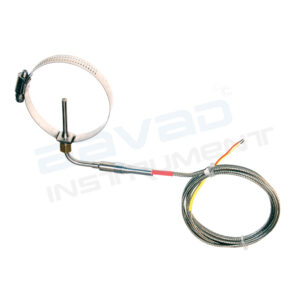
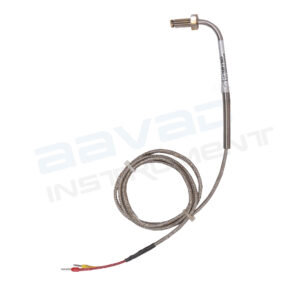
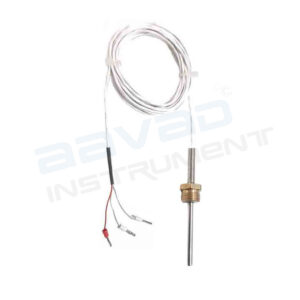
The S-Type Exposed Junction Thermocouple is designed for high-accuracy, fast-response temperature measurement in demanding industrial, laboratory, pharmaceutical, and high-temperature process applications. Unlike conventional grounded or ungrounded thermocouples, this design features an exposed measuring junction, where the platinum and platinum-rhodium conductors are welded together and left directly exposed to the process medium. This construction minimizes thermal resistance, enabling significantly faster response to temperature changes compared with enclosed junction designs.
Manufactured with a Type S (Platinum / Platinum-10% Rhodium) thermocouple element and a Ker-710 ceramic insulator, the sensor provides exceptional measurement stability, repeatability, and resistance to high-temperature environments. The standard model is rated for continuous operation up to 1000°C, while the S-Type sensing element is capable of much higher temperatures under suitable operating conditions. Its excellent long-term stability makes it particularly suitable for applications where calibration accuracy and measurement consistency are critical.
The S-Type Exposed Junction Thermocouple is widely used in pharmaceutical manufacturing, biotechnology, laboratories, calibration furnaces, glass processing, ceramics, heat treatment, research facilities, and clean high-temperature processes where rapid response is more important than mechanical protection. Since the measuring junction is directly exposed, this design is best suited for clean, controlled environments with minimal mechanical stress or corrosive contamination.
Key Features
-
Exposed Sensing Junction Design Direct exposure of the measuring tip provides near-instantaneous thermal response, far exceeding the speed of grounded or ungrounded enclosed probes.
-
Platinum Noble Metal Type S Calibration ($text{Pt / Pt-Rh10%}$) Exceptional long-term calibration stability, repeatable accuracy, and high resistance to oxidation at temperatures up to 1000°C continuous.
-
Ker-710 High-Purity Ceramic Sheath ($5.5text{mm}times 300text{mm}$) Premium dense alumina insulation offers superior dielectric strength and thermal shock resistance without contaminating pure process gases.
-
Ultra-Low Drift for Calibration-Critical Standards Type S platinum alloy minimizes thermal degradation over extended operational cycles, making it suitable for laboratory reference standards.
-
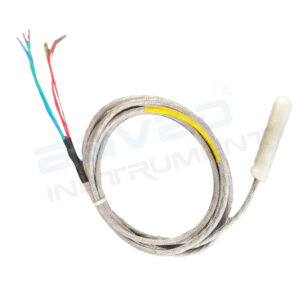
Armored Lead Wire Connection (1-Meter FG/FG/SS) High-temperature fiberglass insulation shielded by an outer stainless steel wire braid protects copper/compensating leads against mechanical fraying.
-
Ideal for Clean & Inert Environments Bare junction design excels in non-reducing, clean-gas atmospheres, vacuum furnaces, and sterile pharmaceutical chambers.
Datasheet
FAQs
1. What is an S-Type Exposed Junction Thermocouple?
An S-Type Exposed Junction Thermocouple is a high-temperature sensor that uses Platinum and Platinum-10% Rhodium conductors with an exposed measuring junction to provide extremely fast and accurate temperature response in demanding industrial and laboratory applications.
2. What is an Exposed Junction Thermocouple?
An Exposed Junction Thermocouple has its sensing junction directly exposed to the process medium instead of being enclosed within a protective sheath. This design provides faster response to temperature changes but offers less mechanical protection than grounded or ungrounded thermocouple designs.
3. Why is an Exposed Junction used?
An exposed junction minimizes thermal resistance between the process medium and the sensing element, allowing the thermocouple to detect temperature changes more quickly than grounded or ungrounded designs. It is ideal for applications requiring rapid temperature response.
4. Why choose an S-Type Thermocouple instead of a K-Type?
S-Type Thermocouples provide superior long-term stability, higher measurement accuracy, and excellent performance at elevated temperatures compared to K-Type Thermocouples. They are widely used in calibration laboratories, heat treatment, glass manufacturing, ceramic processing, and other critical high-temperature industrial applications.