Description
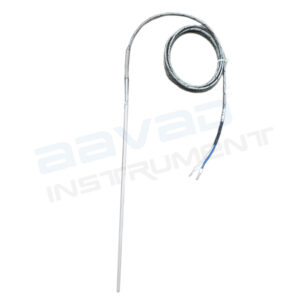
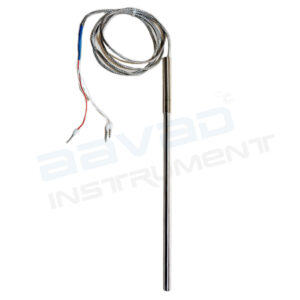
Sharp Point Autoclave PT100 RTD Probe (Model APES) is designed for core temperature measurement inside products during sterilization and validation processes. Unlike standard chamber-mounted RTD sensors that measure ambient autoclave temperature, this handheld insertion probe measures the coldest point within the load, helping verify that sterilization conditions have been achieved throughout the product.
The sensor features a sharp-point SS316 probe with a 5 mm diameter and 110 mm insertion length, allowing easy penetration into semi-solid products, packaged goods, laboratory samples, and food materials. The PT100 sensing element provides accurate temperature measurement from -50°C to +400°C, while the ergonomic plastic handle enables comfortable manual positioning during validation studies.
A 5-meter silicone rubber cable is designed to withstand repeated autoclave heat cycles while allowing connection to external data loggers, temperature indicators, or validation equipment. Available in 2-wire, 3-wire, and 4-wire configurations, the probe can also be customized for probe length, cable length, and handle design to meet specific validation requirements.
Key Features
-
Sharp Needle-Point Penetration Tip Engineeered for smooth, direct insertion into semi-solid goods, packaged foods, media bags, and dense pharmaceutical samples.
-
Cold-Spot Load Validation Accurately tracks internal core thermal profiles rather than relying solely on ambient autoclave chamber temperature.
-
Ergonomic Plastic Handle Allows safe manual positioning and firm control when inserting the needle tip into dense test media before sealing the sterilizer.
-
Autoclave-Grade Silicone Rubber Cable (5m) Steam-resistant, highly flexible insulation withstands repeated pressure and heat cycles without cracking or moisture ingress.
-
High-Precision PT100 Sensing Element Platinum resistance element ($100,Omega$ at $0^circtext{C}$) ensures linear accuracy and dependable repeatability across -50°C to 400°C.
-
Versatile Terminal Wiring Compatible with 2-wire, 3-wire, or 4-wire process monitoring, data logging, and validation instruments.
Applications
-
Autoclave & Sterilizer Load Mapping Measuring internal cold-spot temperature profiles in pharmaceutical, medical, and laboratory autoclaves.
-
Food Processing & Canning Retorts Core temperature verification during retort pouch processing, canning, and food preservation cycles.
-
Pharmaceutical & Microbiological Media Preparation In-situ monitoring of agar culture media, bottled liquids, and biological waste loads.
-
Laboratory & Research Sample Penetration Spot-checking semi-solid agar gels, biological gels, and dense organic samples.
-
Sterilization Quality Control Verification Direct empirical data collection for $F_0$ value calculation and regulatory compliance audits.
Datasheet
FAQs
1. What is a Sharp Point Autoclave PT100 RTD Probe?
A Sharp Point Autoclave PT100 RTD Probe is a PT100 Resistance Temperature Detector (RTD) designed for insertion into products during autoclave sterilization, validation, and temperature mapping. The sharp-point probe enables accurate measurement of the product’s internal temperature, helping verify that sterilization requirements are achieved throughout the load.
2. Why is a Sharp-Point Probe used for Autoclave Validation?
The sharp-point probe is designed to penetrate semi-solid products, pharmaceutical containers, food products, and packaged materials, allowing temperature to be measured at the product’s cold spot rather than only inside the sterilizer chamber. This provides more accurate validation of the actual sterilization process.
3. What is the difference between Load Temperature and Chamber Temperature?
During an autoclave cycle, the sterilizer chamber may reach the target temperature before the center of the load. Measuring the load’s core temperature ensures that the required sterilization conditions have been achieved throughout the product, making it an essential part of autoclave validation, performance qualification (PQ), and temperature mapping studies.