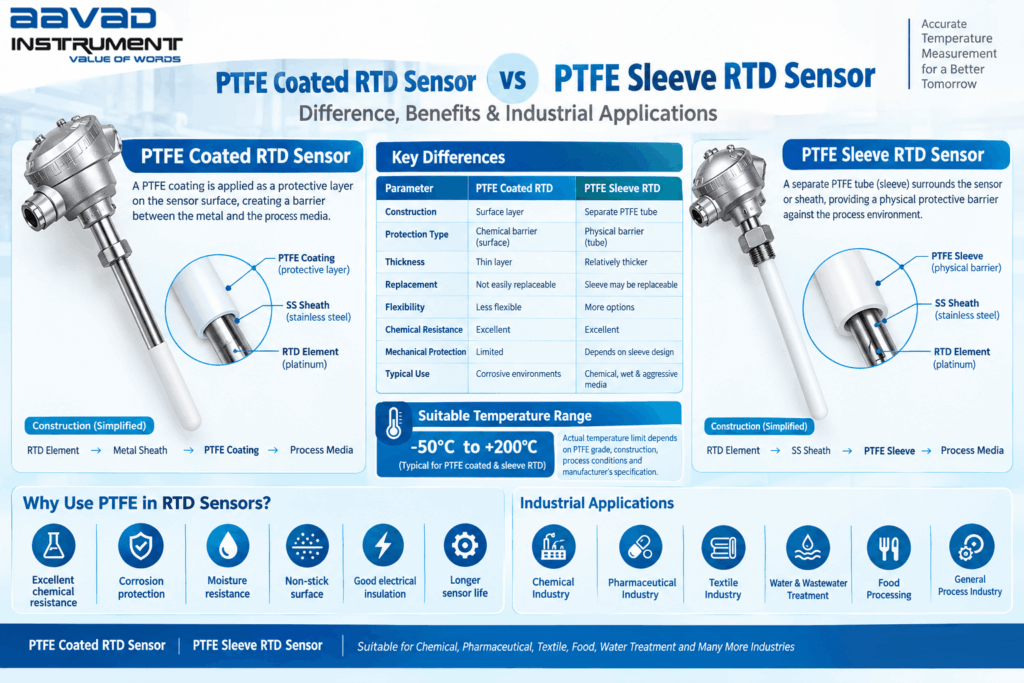
PTFE Coated RTD Sensor vs PTFE Sleeve RTD Sensor: Difference, Benefits & Industrial Applications
In modern industrial processes, accurate temperature measurement is essential for maintaining product quality, process efficiency, safety, and equipment reliability. RTD sensors (Resistance Temperature Detectors) are widely used for precise and stable temperature measurement across industries such as chemical processing, pharmaceuticals, food processing, textiles, plastics, water treatment, and general manufacturing.
However, when an RTD sensor is installed in a corrosive, chemically aggressive, wet, or contamination-prone environment, standard metal sensor construction may not always provide sufficient protection. This is where PTFE coating and PTFE sleeves become useful.
PTFE, or Polytetrafluoroethylene, is a fluoropolymer known for its excellent chemical resistance, low friction, non-stick properties, and resistance to moisture. Depending on the application, an RTD sensor can be supplied with a PTFE coating or protected using a PTFE sleeve.
Although both solutions provide chemical protection, they are not exactly the same. Understanding the difference between a PTFE coated RTD sensor and a PTFE sleeve RTD sensor helps engineers select the right temperature sensor for their process.
What Is an RTD Sensor?
An RTD sensor is a temperature measuring device that determines temperature by measuring the change in electrical resistance of a sensing element.
The most commonly used RTD is the Pt100 RTD, which has a nominal resistance of 100 ohms at 0°C. As temperature changes, the resistance of the platinum element changes in a predictable manner.
Common RTD configurations include:
-
Pt100 RTD sensor
-
Pt500 RTD sensor
-
Pt1000 RTD sensor
-
2-wire RTD
-
3-wire RTD
-
4-wire RTD
-
Simplex RTD
-
Duplex RTD
-
Mineral insulated RTD
-
Surface RTD
-
Sanitary RTD
-
Custom industrial RTD sensors
RTD sensors can be manufactured with different sheath materials such as stainless steel, depending on the process environment.
What Is PTFE?
PTFE stands for Polytetrafluoroethylene, a high-performance fluoropolymer widely used where chemical resistance is important.
PTFE offers excellent resistance against many acids, alkalis, solvents, moisture, and other aggressive chemicals. It also has a very low coefficient of friction and a non-stick surface.
Because of these properties, PTFE is commonly used as a protective material in industrial temperature sensors.
Key Properties of PTFE
Some important properties of PTFE include:
-
Excellent chemical resistance
-
High corrosion resistance
-
Excellent moisture resistance
-
Non-stick surface
-
Low friction
-
Good electrical insulation
-
Good weather resistance
-
Resistance to many industrial chemicals
-
Suitable for many demanding process environments
The actual suitability of PTFE should always be checked against the specific chemical, concentration, temperature, pressure, and exposure conditions of the application.
What Is a PTFE Coated RTD Sensor?
A PTFE coated RTD sensor is an RTD sensor in which the required external surface is protected with a layer of PTFE.
The coating creates a protective barrier between the sensor’s metallic surface and the surrounding process environment.
A simplified construction can be represented as:
RTD Element → Metal Sheath → PTFE Protective Coating → Process Media
The PTFE coating is particularly useful when the sensor is exposed to corrosive chemicals or aggressive process fluids.
Benefits of PTFE Coated RTD Sensors
A PTFE coated RTD can provide several advantages:
1. Chemical Protection
-> The PTFE layer helps protect the underlying sensor construction from contact with many corrosive chemicals.
2. Corrosion Resistance
-> When the process environment is aggressive, PTFE can provide an additional protective barrier against corrosion.
3. Moisture Protection
-> PTFE has excellent resistance to moisture, making it useful in wet industrial environments.
4. Non-Stick Surface
-> The low-stick nature of PTFE can help reduce material accumulation on the sensor surface in suitable applications.
5. Longer Sensor Life
-> Properly selected PTFE protection can help reduce chemical attack on the sensor sheath and potentially increase service life.
What Is a PTFE Sleeve RTD Sensor?
A PTFE sleeve RTD sensor uses a separate PTFE tube or sleeve around the sensor or sensor sheath.
Unlike a coating, the PTFE sleeve is a physical component that surrounds the sensor.
A simplified construction can be represented as:
RTD Element → Sensor Sheath → PTFE Sleeve → Process Media
Depending on the design, the sleeve can provide an additional layer of chemical and moisture protection.
PTFE sleeves can be particularly useful when the application requires a physical PTFE barrier around the sensor.
PTFE Coating vs PTFE Sleeve: What Is the Difference?
The major difference is in their construction.
A PTFE coating is a protective layer applied to the sensor surface, whereas a PTFE sleeve is a separate PTFE tube fitted around the sensor.
| Parameter | PTFE Coated RTD | PTFE Sleeve RTD |
|---|---|---|
| Construction | PTFE protective layer | Separate PTFE tube/sleeve |
| Protection | Surface-level chemical barrier | Physical protective barrier |
| Design | Integrated with sensor surface | Additional sleeve component |
| Replacement | Coating is generally not field-replaceable | Sleeve may be replaceable depending on construction |
| Chemical Resistance | Excellent when properly selected | Excellent when properly selected |
| Mechanical Protection | Depends on coating thickness | Depends on sleeve construction |
| Application | Corrosive and chemical environments | Chemical, wet and aggressive environments |
| Maintenance | Generally low | Sleeve condition should be inspected |
| Customization | Depends on coating process | Sleeve dimensions can be selected for application |
The correct option depends on the process conditions and sensor construction.
Suitable Temperature Range for PTFE RTD Sensors
Temperature range is one of the most important factors when selecting a PTFE-protected RTD sensor. PTFE provides excellent chemical resistance, but its temperature capability is lower than that of many unprotected metallic RTD constructions.
For many industrial PTFE applications, a typical working temperature range of approximately -50°C to +200°C can be considered as a practical reference, depending on the PTFE material, sensor construction, installation method, and process conditions.
However, the exact operating temperature should always be confirmed from the PTFE material specification and complete RTD assembly design.
Typical Temperature Consideration
| Parameter | Typical Reference |
|---|---|
| Lower operating temperature | Approximately -50°C |
| Common upper operating temperature | Approximately +200°C |
| Higher-temperature applications | Special construction required |
| Exact maximum temperature | Depends on PTFE grade and sensor design |
Why Temperature Range Matters
When an RTD sensor operates close to or above the recommended PTFE temperature limit, the protective material can lose its required mechanical properties. This can affect the sensor’s protection and long-term reliability.
Therefore, before selecting a PTFE coated or PTFE sleeve RTD, consider:
-
Continuous operating temperature
-
Maximum process temperature
-
Minimum process temperature
-
Chemical concentration
-
Process pressure
-
Exposure duration
-
Flow velocity
-
Mechanical conditions
-
PTFE grade and construction
For applications above approximately 200°C, a conventional PTFE-protected RTD may not be the most appropriate choice. In such cases, an alternative sensor construction or a specially engineered high-temperature solution should be evaluated.
Important: The temperature range mentioned above is a general engineering reference and should not be treated as a universal rating for every PTFE coated or PTFE sleeve RTD. The final allowable temperature must be determined from the specific PTFE material, coating/sleeve construction, RTD design, process conditions, and manufacturer’s technical specification.
| RTD Construction | Typical Temperature Suitability* | Main Advantage |
|---|---|---|
| Standard SS RTD | Application-dependent; often suitable for higher temperatures | Mechanical strength |
| PTFE Coated RTD | Approx. -50°C to +200°C | Chemical protection |
| PTFE Sleeve RTD | Approx. -50°C to +200°C | Chemical barrier |
| Mineral Insulated RTD | Can be designed for high-temperature applications | Fast response & durability |
Why Is PTFE Used in RTD Sensors?
The primary reason for using PTFE in RTD sensors is protection against aggressive process environments.
For example, an RTD installed directly in a corrosive chemical may experience deterioration of its outer metallic surface over time. A suitable PTFE barrier can reduce direct contact between the process media and the underlying metal.
This can be particularly useful in applications involving:
-
Chemical solutions
-
Corrosive liquids
-
Pharmaceutical processes
-
Textile processing chemicals
-
Water treatment chemicals
-
Industrial cleaning solutions
-
Certain acids and alkalis
-
Moist and humid environments
However, PTFE is not a universal solution for every chemical or temperature condition. Material compatibility must be verified before final selection.
Industrial Applications of PTFE RTD Sensors
PTFE-protected RTD sensors can be used in a wide range of industries.
1. Chemical Industry
Chemical processing plants frequently deal with corrosive chemicals and aggressive process fluids. PTFE-protected RTDs can be considered where chemical resistance is required.
Typical applications include:
-
Chemical tanks
-
Process vessels
-
Storage tanks
-
Chemical reactors
-
Dosing systems
-
Process pipelines
2. Pharmaceutical Industry
Temperature control is critical in pharmaceutical manufacturing.
PTFE-protected sensor designs can be useful in selected chemical or cleaning applications where resistance to the process environment is important.
Applications may include:
-
Process tanks
-
Chemical preparation systems
-
Cleaning systems
-
Utility systems
-
Controlled temperature processes
For hygienic applications, the complete sensor construction and required sanitary standards should also be considered.
3. Textile Industry
Textile processing can involve dyes, chemicals, washing solutions, and other aggressive media.
RTD sensors with appropriate PTFE protection can be used for temperature measurement in:
-
Dyeing machines
-
Chemical processing tanks
-
Washing systems
-
Treatment tanks
-
Process pipelines
4. Water and Wastewater Treatment
Temperature measurement can be required in water treatment and chemical dosing processes.
PTFE-protected RTDs may be suitable for selected applications where chemical exposure and moisture are concerns.
5. Food Processing
Food processing plants use temperature sensors throughout heating, cooling, cleaning, and processing operations.
Where PTFE is being considered for a food-related application, the specific process requirements, temperature range, hygiene requirements, and applicable material compliance should be verified before selection.
PTFE RTD Sensor Selection: Important Factors
Selecting the correct PTFE RTD is not only about choosing PTFE protection. Several technical parameters should be evaluated.
1. Temperature Range
Always check the actual operating temperature of the process.
PTFE has temperature limitations, so the sensor should be selected according to the actual continuous and intermittent process temperature.
Do not select a PTFE-protected RTD simply because the process is chemically corrosive.
2. Chemical Compatibility
The chemical compatibility of PTFE depends on the specific process media and operating conditions.
Consider:
-
Chemical type
-
Concentration
-
Temperature
-
Exposure time
-
Pressure
-
Mixture composition
A chemical compatibility check should be performed before finalizing the sensor.
3. Sensor Accuracy
The required RTD accuracy class should be selected according to the application.
Common options include:
-
Class A
-
Class B
-
Other application-specific accuracy requirements
4. Wiring Configuration
The RTD can be supplied in:
-
2-wire
-
3-wire
-
4-wire
For many industrial installations, 3-wire Pt100 RTDs are commonly used because they offer a practical balance between accuracy and wiring requirements.
5. Sheath Material
The underlying sheath material is also important.
Depending on the application, materials such as SS304 or SS316 may be considered before adding PTFE protection.
6. Sensor Length and Diameter
The insertion length and sensor diameter should match the installation point.
Incorrect dimensions can result in poor temperature measurement or installation problems.
7. Process Connection
Depending on the application, different process connections may be required, such as:
-
Threaded connection
-
Flanged connection
-
Tri-Clamp connection
-
Compression fitting
-
Custom mounting arrangement
8. Response Time
Additional protective layers can affect heat transfer and response time.
If the process requires fast temperature measurement, the sensor construction should be evaluated carefully.
Advantages of PTFE-Protected RTD Sensors
Some of the major advantages include:
-
Excellent chemical resistance
-
Protection against corrosive environments
-
Good moisture resistance
-
Non-stick surface
-
Suitable for selected aggressive process applications
-
Reduced direct exposure of the underlying sheath
-
Available in customized RTD configurations
-
Useful across multiple industrial sectors
Limitations and Considerations
Although PTFE provides excellent chemical resistance, it is important to understand its limitations.
Temperature Limitation
PTFE should not be selected for applications beyond its specified operating temperature.
Mechanical Protection
PTFE is chemically resistant but should not automatically be considered a substitute for heavy mechanical protection.
If the sensor is exposed to impact, abrasion, high flow velocity, or mechanical damage, additional protection may be required.
Chemical Compatibility
PTFE is highly chemically resistant, but no material should be assumed compatible with every chemical under every condition.
Response Time
A thicker protective layer can influence sensor response time. Applications requiring rapid temperature response should consider the complete sensor construction.
How to Choose Between PTFE Coating and PTFE Sleeve?
The selection depends on the application.
Choose a PTFE coated RTD when:
-
A protective PTFE surface is required.
-
The sensor needs a compact protective construction.
-
The process involves chemical exposure.
-
A coated external surface is suitable for the installation.
Consider a PTFE sleeve RTD when:
-
A separate PTFE barrier is preferred.
-
The application requires a physical PTFE sleeve around the sensor.
-
Sleeve dimensions need to be customized.
-
The sensor design allows sleeve installation and maintenance.
For demanding applications, the complete assembly should be reviewed rather than selecting PTFE protection alone.
PTFE coated RTD sensors and PTFE sleeve RTD sensors are useful solutions for temperature measurement in many chemical, pharmaceutical, textile, water treatment, and industrial process applications.
The main difference is simple: a PTFE coating is a protective layer applied to the sensor surface, while a PTFE sleeve is a separate PTFE tube fitted around the sensor or sheath.
PTFE can provide excellent chemical resistance and protection against many aggressive environments. However, correct sensor selection requires consideration of temperature, chemical compatibility, pressure, sensor accuracy, sheath material, insertion length, process connection, response time, and mechanical conditions.
Choosing the right construction can help improve sensor reliability and service life while maintaining accurate temperature measurement.
For customized industrial temperature measurement requirements, an RTD sensor should always be designed according to the actual process conditions rather than using a one-size-fits-all configuration.
Frequently Asked Questions (FAQ)
What is the difference between a PTFE coated RTD sensor and a PTFE sleeve RTD sensor?
A PTFE coated RTD sensor has a PTFE protective layer applied directly to the sensor surface, forming a chemical barrier. The coating is integrated with the sensor, ensuring uniform protection during operation. In contrast, a sleeve provides a barrier without altering the sensor’s core structure.
A PTFE sleeve RTD sensor uses a separate PTFE tube or sleeve around the sensor, providing a physical barrier. The sleeve remains an add-on that surrounds the device, while the coating is built into the sensor itself. This distinction helps in selecting the appropriate design for harsh environments.
When should I choose a PTFE coated RTD versus a PTFE sleeve RTD?
Choose a PTFE coated RTD when a protective PTFE surface is required. Additionally, the sensor benefits from a compact protective construction due to chemical exposure. Hence, a coated external surface may suit the installation. Opt for a PTFE sleeve RTD when a separate physical PTFE barrier is preferred. Additionally, sleeve dimensions can be customized, or the design allows sleeve installation and maintenance.
What are the main advantages of using PTFE-protected RTD sensors?
PTFE-protected RTD sensors offer excellent chemical resistance and protection against corrosive environments. They provide good moisture resistance, a non-stick surface, and suitability for selected aggressive process applications. They reduce direct exposure of the underlying sheath and come in customized RTD configurations across multiple industrial sectors.
What factors should be considered when selecting a PTFE RTD sensor?
Consider the temperature range and ensure the actual operating temperature fits PTFE limits, chemical compatibility with the process media, required RTD accuracy class, wiring configuration (2-, 3-, or 4-wire), sheath material, sensor length and diameter, process connection, response time, and mechanical conditions. The final selection should align with the complete sensor construction and process conditions.
What is the typical temperature range to consider for PTFE RTD sensors, and why is it important?
A typical working temperature range is approximately -50°C to +200°C, depending on PTFE grade, sensor construction, installation method, and process conditions. This range matters because exceeding PTFE’s temperature limits can compromise its protective properties and long-term reliability. Always confirm the exact maximum temperature from the PTFE material specification and RTD assembly design.