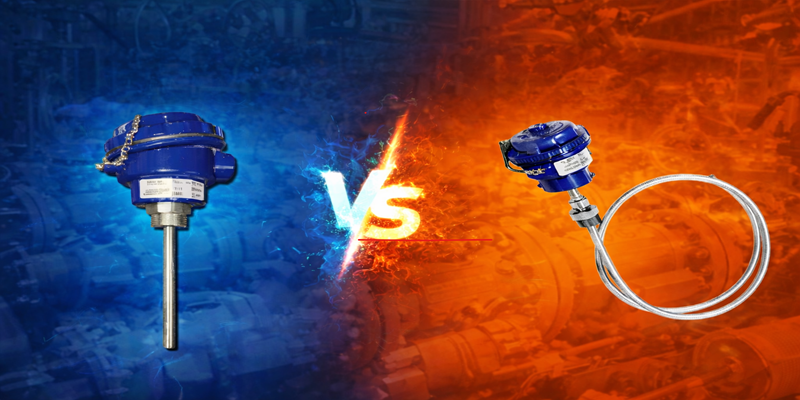
🌡️ RTD vs Thermocouple: Which Temperature Sensor Is Right for Your Industry?
⚙️ Introduction
Temperature measurement is critical in almost every industry. Whether it is manufacturing, power plants, food processing, or chemical production, accurate temperature control ensures quality, safety, and efficiency.
However, choosing the right sensor can be confusing. The two most common options are RTD (Resistance Temperature Detector) and Thermocouple. Although both measure temperature, they work differently and are used in different conditions.
Therefore, understanding their differences will help you select the best sensor for your application.
🔍 What is an RTD Sensor?
An RTD (Resistance Temperature Detector) measures temperature based on the change in electrical resistance of a metal, usually platinum (PT100 or PT1000).
⭐ Key Features of RTD:
- High accuracy (±0.1°C possible)
- Excellent stability over time
- Suitable for low to medium temperature ranges
- Linear and predictable output
🔹 Common Applications:
- Pharmaceutical industries
- Food & beverage processing
- HVAC systems
- Laboratory measurements
🔥 What is a Thermocouple?
A thermocouple works on the Seebeck effect, where two different metals generate voltage when exposed to temperature differences.
⭐ Key Features of Thermocouple:
- Wide temperature range (up to 1800°C)
- Fast response time
- Durable in harsh environments
- Suitable for high-temperature applications
🔹 Common Applications:
- Furnaces and kilns
- Metal and steel industries
- Boilers and heat treatment plants
- Gas turbines
⚖️ RTD vs Thermocouple: Key Differences
| Feature | RTD Sensor | Thermocouple |
|---|---|---|
| Accuracy | Very High | Moderate |
| Temperature Range | –200°C to 600°C | Up to 1800°C |
| Response Time | Slower | Faster |
| Stability | Excellent | Moderate |
| Durability | Sensitive | Very rugged |
| Cost | Higher | Lower |
🧠 When Should You Use RTD?
You should choose an RTD when:
✔ High accuracy is required
✔ Stable and repeatable readings are important
✔ Temperature range is moderate
✔ Clean and controlled environments are used
👉 Example:
In pharmaceutical production, even a small temperature variation can affect product quality. Therefore, RTD sensors are preferred.
🔥 When Should You Use Thermocouple?
You should choose a thermocouple when:
✔ Very high temperatures are involved
✔ Fast response is needed
✔ Environment is harsh (vibration, dust, heat)
✔ Budget is a concern
👉 Example:
In steel furnaces, temperatures can exceed 1000°C. In such cases, thermocouples are the best choice.
⚙️ RTD vs Thermocouple: Which is Better?
There is no single “best” sensor. The right choice depends on your application.
- If you need accuracy → choose RTD
- If you need high temperature & durability → choose Thermocouple
In many industries, both sensors are used together to balance accuracy and performance.
🏭 AAVAD INSTRUMENT PVT. LTD. Temperature Solutions
AAVAD INSTRUMENT PVT. LTD. offers a wide range of:
- RTD Sensors (PT100 / PT1000)
- Thermocouples (K, J, T, R, S types)
- Custom industrial temperature assemblies
👉 Explore products:
https://www.aavadinstrument.com/product-category/head-type-rtd-sensor/
https://www.aavadinstrument.com/product-category/thermocouple-sensor/
Our sensors are designed for:
✔ High accuracy
✔ Industrial durability
✔ Long-term stability
✔ SCADA / PLC compatibility
🌱 Conclusion
Both RTD and thermocouple sensors play a vital role in industrial temperature measurement. While RTDs provide high precision and stability, thermocouples offer wide range and durability.
Therefore, selecting the right sensor depends on your process requirements, environment, and budget.
With AAVAD INSTRUMENT PVT. LTD., you get reliable temperature solutions tailored for your industry.
AAVAD Instruments – Precision Temperature Measurement You Can Trust.