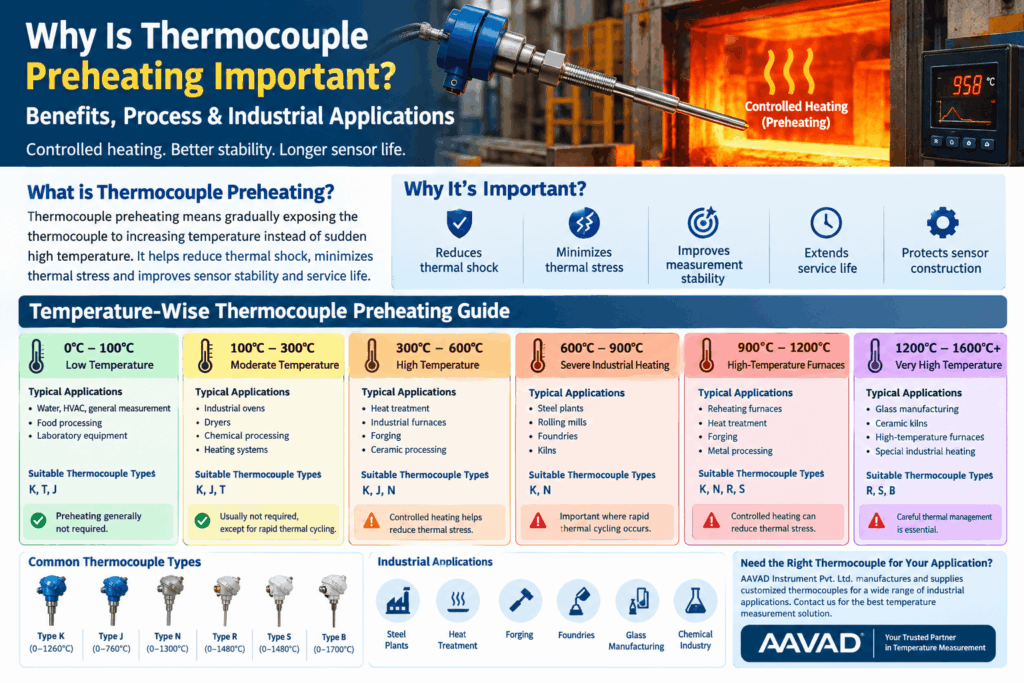
Why Is Thermocouple Preheating Important? Benefits, Process & Industrial Applications
Introduction
Thermocouples are among the most widely used temperature sensors in industrial applications. They are used to measure and control temperature in furnaces, ovens, heat-treatment plants, steel plants, foundries, forging units, boilers, kilns, glass manufacturing plants and many other industrial processes.
In high-temperature applications, simply installing a thermocouple and exposing it immediately to extreme temperature may not always be the best practice. Depending on the sensor construction, application and operating conditions, gradual heating or preheating can help reduce thermal stress, improve measurement stability and protect the thermocouple from sudden temperature changes.
This is particularly important for thermocouples used in demanding industrial environments where sensors are repeatedly exposed to high temperatures, thermal cycling, vibration and process contaminants.
In this article, we will understand why thermocouple preheating is important, how the heating process works, its benefits, precautions and applications in different industries.
What Is Thermocouple Preheating?
Thermocouple preheating refers to the controlled or gradual exposure of a thermocouple to increasing temperature before it reaches its normal high-temperature operating condition.
The objective is not to make the thermocouple generate a temperature signal—it naturally generates a thermoelectric voltage when there is a temperature difference between its measuring junction and reference junction.
Instead, controlled heating may be used to:
- Reduce thermal shock
- Minimize sudden thermal stress
- Allow the sensor to stabilize
- Protect sensitive sensor construction
- Improve reliability during thermal cycling
- Reduce the possibility of mechanical damage caused by rapid temperature changes
The requirement for preheating depends on the thermocouple type, sheath material, insulation, construction, installation method and application temperature.
Why Is Thermocouple Preheating Important?
1. Reduces Thermal Shock
One of the primary reasons for gradual heating is to reduce thermal shock.
When a thermocouple is suddenly exposed to a very high temperature, different parts of the sensor may heat at different rates. The sheath, insulation, sensing junction and internal components can experience rapid thermal expansion.
Repeated thermal shock can contribute to:
- Mechanical stress
- Sheath deformation
- Junction damage
- Insulation deterioration
- Reduced sensor life
Gradual heating allows the different components to respond to temperature changes more progressively.
2. Helps Improve Measurement Stability
A thermocouple does not instantly reach the same temperature as the process being measured. There is always a response time depending on the sensor’s construction and installation.
During a rapid temperature change, the thermocouple output can fluctuate while the sensor approaches thermal equilibrium.
Controlled heating allows the thermocouple to gradually stabilize, which can be useful when accurate and repeatable temperature monitoring is required.
This is particularly important in:
- Heat treatment
- Furnace temperature control
- Laboratory furnaces
- Industrial ovens
- Kilns
- Process heating systems
3. Helps Extend Thermocouple Service Life
Industrial thermocouples can operate under severe conditions.
Repeated exposure to:
- High temperature
- Rapid heating
- Rapid cooling
- Vibration
- Oxidation
- Corrosive gases
- Mechanical stress
can reduce the service life of a sensor.
A controlled heating approach can help reduce unnecessary thermal stress and therefore contribute to improved thermocouple reliability and service life.
However, sensor life also depends strongly on thermocouple material, sheath material, temperature, atmosphere, installation and process conditions.
4. Protects the Sensor Construction
Industrial thermocouples are available in different constructions.
For example:
- Mineral Insulated Thermocouples
- Sheathed Thermocouples
- Ceramic Thermocouples
- Exposed Junction Thermocouples
- Grounded Junction Thermocouples
- Ungrounded Junction Thermocouples
- High-temperature thermocouple assemblies
Each construction responds differently to temperature changes.
A suitable controlled-heating procedure can reduce the mechanical and thermal stress experienced by the sensor.
5. Important for Mineral Insulated Thermocouples
Mineral Insulated (MI) Thermocouples are commonly manufactured using thermocouple wires surrounded by compacted mineral insulation, such as magnesium oxide (MgO), inside a metallic sheath.
These sensors are widely used because of their:
- High-temperature capability
- Fast response
- Mechanical strength
- Flexibility
- Compact construction
- Good insulation properties
However, proper handling, storage, installation and thermal conditioning are important for achieving reliable performance.
If an MI thermocouple has been exposed to moisture or has been improperly stored, insulation resistance and sensor performance can be affected. Proper manufacturing and handling practices are therefore essential.
Thermocouple Preheating Process
The exact procedure depends on the application and thermocouple design. There is no single universal preheating temperature or heating time applicable to every thermocouple.
A general controlled-heating approach can include the following steps.
Step 1: Inspect the Thermocouple
Before installation, check:
- Sheath condition
- Sensor tip
- Thermocouple wires
- Terminal/connector
- Cable insulation
- Mounting threads
- Protection tube
- Insulation resistance where applicable
The thermocouple should be free from visible mechanical damage.
Step 2: Verify Thermocouple Type
Confirm the thermocouple type according to the application.
Common types include:
| Thermocouple Type | Typical Application |
|---|---|
| Type K | Furnaces, ovens, general industrial applications |
| Type J | Industrial equipment and moderate-temperature applications |
| Type T | Lower-temperature applications |
| Type E | Low-temperature and specialized applications |
| Type N | High-temperature industrial applications |
| Type R | High-temperature furnace applications |
| Type S | High-temperature industrial processes |
| Type B | Very high-temperature applications |
The appropriate type should always be selected according to the actual process temperature, atmosphere and required accuracy.
Step 3: Install the Thermocouple Correctly
Install the thermocouple at the correct measurement location.
Important factors include:
- Proper insertion depth
- Correct orientation
- Adequate protection
- Avoiding unnecessary mechanical stress
- Correct cable routing
- Proper electrical connection
Incorrect installation can result in inaccurate temperature readings even when the thermocouple itself is manufactured correctly.
Step 4: Start Controlled Heating
Where the process requires gradual heating, increase the temperature progressively rather than exposing the sensor immediately to the maximum process temperature.
The heating rate should be determined according to:
- Sensor construction
- Sheath material
- Process temperature
- Furnace design
- Manufacturer recommendations
- Thermal mass
- Process requirements
For critical applications, the thermocouple manufacturer’s installation instructions should be followed.
Step 5: Allow Temperature Stabilization
Once the thermocouple approaches the operating temperature, allow sufficient time for the sensor and surrounding process area to stabilize.
This helps ensure that the temperature measurement represents the actual process condition rather than a temporary transient.
Does Every Thermocouple Need Preheating?
No.
This is an important point.
Thermocouple preheating is not universally mandatory for every thermocouple installation.
A thermocouple is designed to measure temperature directly when exposed to the process. In many normal applications, the sensor can be installed and used without a separate preheating procedure.
However, gradual heating may be beneficial when:
- The temperature change is very rapid
- The operating temperature is very high
- The sensor is exposed to repeated thermal cycles
- The thermocouple has a sensitive construction
- The manufacturer recommends thermal conditioning
- Thermal shock could affect the sensor
- The process requires controlled furnace startup
Therefore, preheating should be considered an application-dependent practice, not a universal requirement.
What Happens If a Thermocouple Is Suddenly Exposed to High Temperature?
Sudden exposure to high temperature can cause rapid thermal expansion.
Depending on the construction and operating conditions, this may lead to:
Thermal Stress: Different materials expand at different rates, potentially creating stress inside the assembly.
Mechanical Stress: The sheath and internal components may experience mechanical loading during rapid heating.
Measurement Instability: The sensor output may change rapidly while the thermocouple approaches thermal equilibrium.
Reduced Service Life: Repeated severe thermal cycling can contribute to premature sensor degradation.
Insulation-Related Problems: In some constructions, especially where moisture or manufacturing issues are involved, rapid heating can aggravate insulation-related problems.
Thermocouple Preheating vs Thermocouple Response Time
These two concepts should not be confused.
Thermocouple response time is the time required for the sensor to respond to a change in temperature.
It depends on factors such as:
- Sensor diameter
- Sheath thickness
- Junction design
- Sensor construction
- Installation
- Fluid velocity
- Process conditions
Preheating, on the other hand, is a controlled heating practice intended primarily to reduce thermal stress or help with thermal conditioning/stabilization in appropriate applications.
A smaller thermocouple generally responds faster, while a larger protected thermocouple may respond more slowly.
Role of Thermocouple Sheath Material
The sheath material plays an important role in high-temperature thermocouple performance.
Common sheath materials may include:
- Stainless steel
- Inconel
- Nickel alloys
- Ceramic protection materials
- Other application-specific alloys
The correct material should be selected according to:
- Maximum temperature
- Chemical environment
- Oxidizing/reducing atmosphere
- Corrosion conditions
- Mechanical requirements
- Process contamination
For example, a thermocouple designed for a furnace application may require a different sheath material from one used in a chemical processing environment.
Thermocouple Preheating in Furnace Applications
Industrial furnaces frequently experience temperature changes during:
- Furnace startup
- Batch processing
- Heat treatment
- Annealing
- Normalization
- Hardening
- Tempering
- Stress relieving
During furnace startup, gradual heating can help reduce thermal stress on equipment and temperature sensors.
Thermocouples used for furnace temperature measurement should be selected according to the required temperature range and furnace atmosphere.
For high-temperature furnace applications, thermocouple types such as K, N, R, S and B may be considered depending on the actual temperature and environment.
Applications Where Thermocouple Heating Is Important
1. Steel Plants
Thermocouples are widely used for monitoring temperature in:
- Reheating furnaces
- Heat treatment furnaces
- Annealing lines
- Rolling mill heating systems
- Billet heating
- Continuous heat-treatment processes
Reliable temperature measurement is important for maintaining product quality and process consistency.
2. Foundries
Foundries use thermocouples for:
- Furnace temperature monitoring
- Molten metal temperature measurement
- Heat treatment
- Preheating systems
- Casting operations
The thermocouple construction must be selected according to the metal, temperature and operating environment.
3. Forging Industry
Forging processes require controlled heating of metal before forming.
Thermocouples can be used for:
- Furnace temperature monitoring
- Billet heating
- Die heating
- Heat-treatment operations
Stable temperature measurement helps maintain consistent material properties.
4. Heat Treatment Plants
Heat-treatment processes such as:
- Annealing
- Hardening
- Tempering
- Normalizing
- Stress relieving
require accurate temperature control.
Thermocouples are therefore an essential part of many heat-treatment systems.
5. Glass Manufacturing
Glass manufacturing involves extremely high temperatures.
Thermocouples may be used for:
- Furnace monitoring
- Melting process control
- Heating zones
- Temperature monitoring of equipment
High-temperature thermocouple selection becomes particularly important in such applications.
6. Chemical and Process Industries
Thermocouples can be used in:
- Reactors
- Process heaters
- Ovens
- Dryers
- Heating systems
- Industrial pipelines
The thermocouple sheath and protection materials should be compatible with the process chemicals.
Common Mistakes During Thermocouple Installation
1. Using the Wrong Thermocouple Type
-> Selecting Type K when the application requires another thermocouple type can result in unsuitable performance.
2. Exceeding the Recommended Temperature
-> Every thermocouple has a practical operating range based on its materials and construction.
3. Incorrect Insertion Depth
-> If the sensing junction is not positioned correctly, the measured temperature may not represent the actual process temperature.
4. Poor Electrical Connections
-> Loose or incorrect connections can cause unstable readings.
5. Ignoring Process Atmosphere
-> Oxidizing, reducing, carburizing or corrosive environments can affect thermocouple materials.
6. Rapid Thermal Cycling
-> Repeated extreme heating and cooling can increase thermal stress and shorten sensor life.
How to Improve Thermocouple Life?
For better thermocouple performance and service life:
- Select the correct thermocouple type.
- Select a suitable sheath material.
- Use the correct temperature range.
- Install the sensor properly.
- Avoid unnecessary mechanical stress.
- Protect the sensor from aggressive environments.
- Follow recommended heating and cooling procedures.
- Inspect the sensor periodically.
- Check insulation and electrical connections.
- Replace damaged or degraded thermocouples promptly.
Thermocouple Preheating: Key Benefits at a Glance
| Benefit | Importance |
|---|---|
| Reduces thermal shock | Protects sensor construction |
| Reduces thermal stress | Helps during rapid temperature changes |
| Supports stabilization | Helps achieve stable measurements |
| Improves reliability | Useful in demanding applications |
| Supports longer service life | Reduces unnecessary thermal cycling stress |
| Protects sensitive construction | Important for selected high-temperature sensors |
| Better startup practice | Useful in furnace and heating systems |
Frequently Asked Questions
Is thermocouple preheating mandatory?
-> No. Preheating is not mandatory for every thermocouple. Its requirement depends on the sensor design and application.
Why is gradual heating preferred for high-temperature thermocouples?
-> Gradual heating can reduce thermal shock and thermal stress when the sensor is exposed to significant temperature changes.
Can Type K thermocouples be used for furnace applications?
-> Yes. Type K thermocouples are widely used for industrial furnace and heating applications, provided the temperature, atmosphere and construction are suitable.
What is the best thermocouple for high-temperature applications?
-> There is no single best thermocouple for every application. Type K, N, R, S and B thermocouples may be suitable for different high-temperature conditions.
Does preheating improve thermocouple accuracy?
-> Preheating itself does not automatically make a thermocouple more accurate. Controlled heating can help the sensor reach thermal stability, while accuracy primarily depends on thermocouple type, calibration, construction, installation and operating conditions.
How can thermocouple life be increased?
-> Correct sensor selection, proper installation, suitable sheath material, controlled thermal cycling and operation within the recommended temperature range can help improve thermocouple life.
Thermocouples are critical temperature measurement devices used across a wide range of industrial processes. In high-temperature and thermally demanding applications, controlled heating or preheating can help reduce thermal shock, thermal stress and temperature-related mechanical strain on the sensor.
However, thermocouple preheating should not be treated as a compulsory procedure for every installation. The correct approach depends on the thermocouple type, sheath material, sensor construction, process temperature, heating rate and application environment.
For reliable temperature measurement, the most important factors are proper thermocouple selection, correct installation, suitable materials and operation within the recommended limits.
For applications involving industrial furnaces, steel plants, rolling mills, heat-treatment systems, forging, foundries, chemical plants and other high-temperature processes, selecting the right thermocouple construction is essential for reliable and long-term performance.
Looking for Industrial Thermocouples?
AAVAD Instrument Pvt. Ltd. manufactures and supplies industrial temperature sensors and instrumentation solutions for a wide range of industrial applications.
Our temperature measurement solutions can be customized according to:
- Temperature range
- Thermocouple type
- Probe length
- Probe diameter
- Sheath material
- Junction configuration
- Cable/lead length
- Connector requirements
- Industrial application
Contact AAVAD Instrument Pvt. Ltd. for thermocouple selection and industrial temperature measurement solutions.