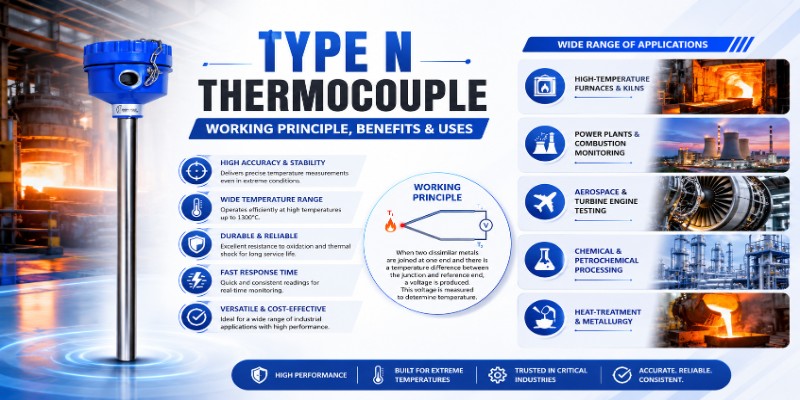
Type N Thermocouple: Working Principle, Benefits, and Applications
When a process runs hot, runs long, and can’t afford sensor drift, Type N thermocouples are often the instrument engineers reach for. Built from Nicrosil and Nisil alloys, Type N thermocouples were specifically developed to overcome a known weakness of more common types like K — oxidation-related drift at sustained high temperatures. This guide explains how Type N thermocouples work, why they outperform other types in demanding conditions, and where they’re used across industry.
What Is a Type N Thermocouple?
A Type N thermocouple is a base-metal thermocouple made from Nicrosil (the positive leg — a nickel-chromium-silicon alloy) and Nisil (the negative leg — a nickel-silicon alloy). This specific alloy combination was engineered to address a key limitation found in Type K thermocouples: a phenomenon called “green rot,” where oxidation at high sustained temperatures gradually shifts the sensor’s calibration and reduces accuracy over time.
Type N thermocouples are rated for use across an exceptionally wide span — from -270°C to +1300°C — owing to their inherent stability and oxidation resistance.
How a Type N Thermocouple Works
Like all thermocouples, a Type N sensor operates on the Seebeck effect: when two dissimilar metal wires are joined at one end (the “hot junction”) and exposed to heat, a voltage is generated that’s proportional to the temperature difference between that junction and a reference (“cold junction”). This millivolt signal is read by a connected instrument — a temperature controller, indicator, or PLC/SCADA input — and converted into a calibrated temperature reading using standardized Type N reference tables.
What sets Type N apart is the chemistry of its alloy pair. The added silicon content in both legs forms a stable, protective oxide layer at high temperatures, which is precisely what gives Type N its long-term stability advantage over Type K in sustained high-heat service.
Key Benefits of Type N Thermocouples
1. Superior Oxidation Resistance Compared to Type K
This is Type N’s defining advantage. In long-duration, high-temperature service, Type N resists the gradual calibration drift that affects Type K thermocouples exposed to similar conditions over time.
2. Exceptional Long-Term Stability and Repeatability
Because the alloy composition resists oxidation-driven changes, Type N thermocouples maintain more consistent readings over extended operating periods — valuable for continuous, unattended high-temperature monitoring.
3. Wide Operating Range
A -270°C to +1300°C span means a single Type N sensor type can serve a wide spectrum of high-temperature industrial applications, from process start-up through extreme combustion or metallurgical temperatures.
4. Versatile Atmosphere Compatibility
Type N thermocouples are suitable for oxidizing, inert, and air environments, making them adaptable across furnace, kiln, and combustion monitoring applications with varying atmospheric conditions.
5. Ideal for Harsh Industrial Conditions
Combined with a robust sheath (commonly SS 310 for high-temperature service) and ceramic inner sheath protection, Type N thermocouples are built to withstand the mechanical and thermal stress of demanding industrial environments.
Industrial Applications of Type N Thermocouples
| Industry/Application | Why Type N Fits |
|---|---|
| High-temperature furnaces and kilns | Wide range and oxidation resistance support long, continuous high-heat cycles |
| Power plants and combustion monitoring | Long-term stability reduces recalibration frequency in continuous-duty service |
| Aerospace and turbine engine testing | Reliable performance under extreme and rapidly changing temperature conditions |
| Chemical and petrochemical processing | Stable readings in high-temperature reactor and process environments |
| Heat-treatment and metallurgy | Consistent accuracy across repeated high-temperature thermal cycles |
Type N vs Type K: Which Should You Choose?
Type K remains the most widely used general-purpose thermocouple due to its lower cost and broad availability. However, for continuous, high-temperature applications where long-term calibration stability matters more than upfront cost — such as furnace zones running near or above 1,000°C for extended periods — Type N’s oxidation resistance often makes it the better long-term investment, reducing the frequency of replacement and recalibration.
Aavad Instrument’s Type N Thermocouple Specifications
Aavad Instrument Pvt. Ltd., based in Ahmedabad, Gujarat, manufactures the N Type Thermocouple (Model ANIS), engineered for high-temperature industrial service:
- Type: N (Nicrosil/Nisil)
- Configuration: Simplex, 2-wire
- Element diameter: 3.2 mm / 10 SWG
- Temperature range: Up to 1,200°C (model rating)
- Sheath material: SS 310
- Inner sheath: Ceramic tube (Ker-710), 18 mm OD
- Outer dimensions: 30 mm OD x 20 mm ID
- Length below head: 1,900 mm
- Protection head: Die-cast aluminum, flameproof, with threaded cap & safety chain
- Head protection class: IP-67
- Cable entry: 1/2″ NPT, single entry
- Terminal block: Nickel-plated ceramic
Manufactured under an ISO 9001:2015 quality system with calibration support from Aavad’s in-house NABL-accredited laboratory, this thermocouple is part of the broader Head Type Thermocouple Manufacturer range, with deployments across clients including BHEL, ONGC, NALCO, and Indian Oil.
Frequently Asked Questions
Q1. What does “Nicrosil-Nisil” mean in a Type N thermocouple? Nicrosil is the nickel-chromium-silicon alloy used for the positive leg, and Nisil is the nickel-silicon alloy used for the negative leg. The silicon content in both alloys forms a stable oxide layer that gives Type N its characteristic oxidation resistance.
Q2. Why does Type N resist oxidation drift better than Type K? The silicon content in Type N’s alloy composition forms a more stable, protective oxide layer at high temperatures, reducing the calibration drift (“green rot”) that can occur in Type K thermocouples under similar sustained high-heat conditions.
Q3. What is the maximum temperature a Type N thermocouple can measure? As a sensor type, Type N is rated up to +1,300°C. Specific industrial models, such as Aavad’s ANIS thermocouple, may carry a model-specific rating (in this case, up to 1,200°C) based on construction and sheath design — always confirm the exact rated range for your specific product.
Q4. Is Type N suitable for both oxidizing and inert atmospheres? Yes. Type N thermocouples are designed to perform reliably across oxidizing, inert, and air environments, giving them flexibility across different furnace and process atmosphere conditions.
Q5. How often should a Type N thermocouple be recalibrated? While Type N’s long-term stability reduces drift compared with some other types, periodic recalibration through a NABL-accredited lab — typically every 6 to 12 months for process-critical applications — is still recommended to maintain traceable accuracy.
Specify the Right Type N Thermocouple for Your Application
Aavad Instrument’s engineering team can help match the correct Type N thermocouple configuration — sheath, element size, and process connection — to your furnace, kiln, or high-temperature process. Request a quote or view the N Type Thermocouple product page for complete specifications.