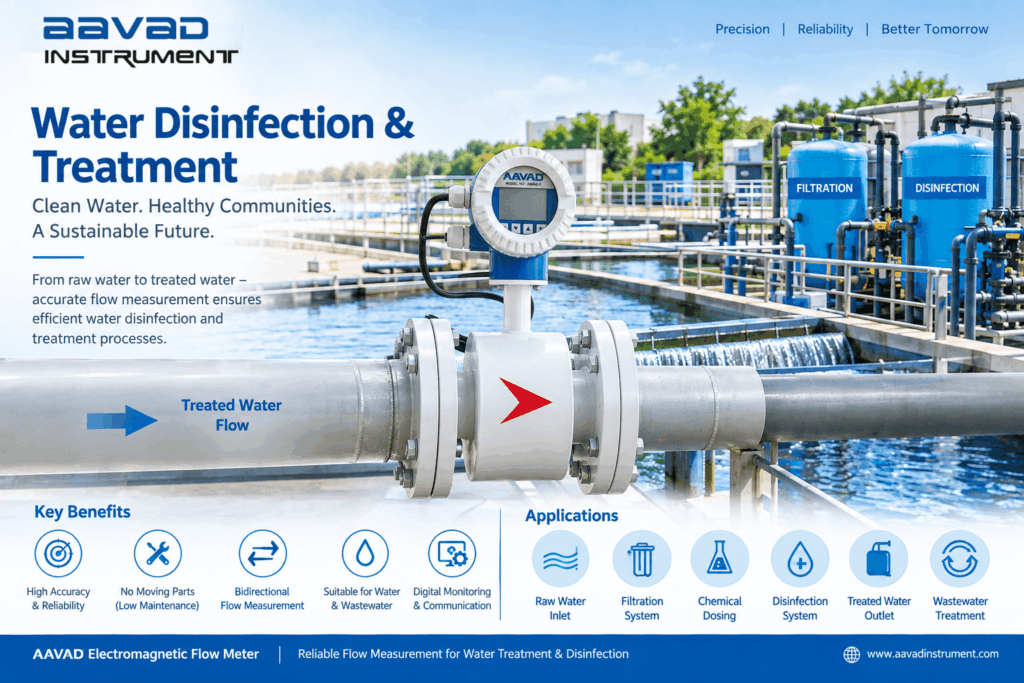
Water Disinfection & Treatment: Importance, Process & Flow Measurement Solutions
Introduction
Clean and safe water is essential for drinking, industrial processes, healthcare, agriculture, and municipal applications. Water disinfection and treatment is a critical process used to remove suspended impurities, reduce contaminants, control microorganisms, and improve overall water quality.
Water treatment plants use several processes, including filtration, coagulation, sedimentation, chemical dosing, disinfection, and monitoring. Accurate flow measurement is important throughout these processes because operators need to know how much water is entering, being treated, disinfected, and discharged.
An electromagnetic flow meter is widely suitable for conductive water and wastewater applications because it can provide accurate and reliable flow measurement without obstructing the flow path.
What Is Water Disinfection & Treatment?
Water treatment is the process of removing or reducing unwanted physical, chemical, and biological contaminants from water.
Water disinfection is a specific treatment step intended to control microorganisms such as bacteria, viruses, and other pathogens.
Depending on the water source and application, a treatment system may include:
- Raw water intake
- Screening
- Coagulation and flocculation
- Sedimentation
- Filtration
- Chemical dosing
- pH adjustment
- Disinfection
- Storage
- Treated water distribution
- Wastewater or sludge handling
The exact treatment process depends on the water quality, application, required treatment standard, and plant design.
Why Is Water Disinfection Important?
Disinfection helps reduce harmful microorganisms in treated water before it is supplied for its intended use.
It is particularly important in:
- Drinking water treatment
- Municipal water supply
- Hospitals and healthcare facilities
- Pharmaceutical industries
- Food and beverage plants
- Chemical industries
- Hotels and commercial facilities
- Industrial process water systems
- Wastewater treatment plants
A properly designed treatment system combines appropriate treatment processes with continuous monitoring and control.
Common Water Disinfection Methods
Different disinfection technologies are selected according to water quality, application requirements, and system design.
1. Chlorination
Chlorination is a commonly used water disinfection method. Chlorine or chlorine-based chemicals can be added to water to control microorganisms.
Flow measurement is important for monitoring the quantity of water entering the chlorination system and maintaining appropriate process control.
2. UV Disinfection
Ultraviolet (UV) treatment uses UV radiation to control microorganisms without adding a chemical disinfectant to the water.
UV systems are used in applications such as:
- Drinking water treatment
- Process water treatment
- Food and beverage applications
- Pharmaceutical water systems
- Commercial water treatment
Accurate flow measurement helps operators monitor the water flow through the UV treatment system.
3. Ozone Treatment
Ozone is another water treatment and disinfection technology. It can be used for oxidation and microorganism control.
Ozone-based systems require appropriate process monitoring, and water flow measurement is an important part of system control.
Role of Flow Measurement in Water Treatment Plants
Flow measurement is one of the important parameters in water treatment applications.
A flow meter can help operators monitor:
- Raw water flow
- Filter inlet and outlet flow
- Treated water flow
- Chemical dosing-related water flow
- Disinfection system flow
- Backwash water flow
- Recycled water flow
- Wastewater flow
- Final discharge flow
Accurate flow data can help improve process control, identify abnormal flow conditions, support consumption monitoring, and maintain consistent plant operation.
Why Use an Electromagnetic Flow Meter for Water Treatment?
An electromagnetic flow meter, also called an electromagnetic water flow meter, measures the flow of electrically conductive liquids using the principle of electromagnetic induction.
Water and many wastewater streams are sufficiently conductive for electromagnetic flow measurement.
Key advantages include:
1. No Moving Parts
-> Electromagnetic flow meters have no mechanical impeller or turbine inside the measuring tube. This can reduce mechanical wear and maintenance requirements.
2. Full-Bore Measurement
-> The measuring tube does not require a mechanical obstruction such as an impeller, making it suitable for continuous water-flow applications.
3. Suitable for Water and Wastewater
-> Electromagnetic flow meters can be used for many conductive liquid applications, including:
- Raw water
- Treated water
- Drinking water
- Industrial water
- Process water
- Wastewater
- Effluent
4. Bidirectional Flow Measurement
-> Depending on the transmitter configuration, electromagnetic flow meters can measure flow in both directions, which can be useful in certain water treatment and recycling systems.
5. Digital Monitoring
-> Modern electromagnetic flow meters can provide flow information through digital displays and electrical communication outputs, depending on the selected model.
Where Are Flow Meters Used in Water Treatment?
Raw Water Inlet: The incoming water flow can be measured before treatment begins. This helps operators understand the volume of water entering the plant.
Filtration System: Flow measurement can be installed at filter inlet and outlet lines to monitor water movement through filtration stages.
Chemical Dosing System: Water flow information can be used as an input for chemical dosing control systems where dosing is proportional to water flow.
Disinfection System: Flow measurement can help monitor the quantity of water passing through chlorination, UV, or other disinfection stages.
Treated Water Outlet: A flow meter installed on the treated water outlet can monitor the quantity of water leaving the treatment plant.
Backwash System: Filtration systems frequently require backwashing. Flow measurement can be used to monitor the water used during the backwash process.
Wastewater Treatment: Electromagnetic flow meters are also suitable for measuring conductive wastewater and effluent streams at different stages of wastewater treatment.
Important Parameters When Selecting a Flow Meter for Water Treatment
Selecting the correct flow meter requires consideration of several process parameters.
1. Pipe Size
-> The flow meter size should match the application and pipeline requirements. In some installations, a reduced-size meter may be considered depending on the required flow velocity and piping arrangement.
2. Flow Range
-> The minimum, normal, and maximum flow rates should be known before selecting the meter.
3. Fluid Conductivity
-> Electromagnetic flow meters require the liquid to have sufficient electrical conductivity for measurement.
4. Temperature
-> The operating temperature of the water should be considered when selecting the appropriate liner and electrode materials.
5. Pressure
-> Pipeline operating pressure should be checked against the pressure rating of the selected flow meter.
6. Liner and Electrode Material
-> The wetted materials should be selected according to the water chemistry and application.
7. Output & Communication
-> Depending on the automation system, required outputs may include:
- 4–20 mA
- Pulse output
- RS-485
- Modbus communication
- Digital display
Electromagnetic Flow Meter in Municipal Water Treatment
Municipal water treatment facilities handle large quantities of water and require reliable process monitoring.
Electromagnetic flow meters can be used for:
Raw Water → Treatment → Filtration → Disinfection → Treated Water Storage → Distribution
Flow measurement at different stages provides valuable operational data and helps plant operators monitor water movement through the treatment process.
Electromagnetic Flow Meter in Industrial Water Treatment
Industries often operate their own water treatment and wastewater treatment systems.
Applications can include:
- Pharmaceutical manufacturing
- Chemical industries
- Textile industries
- Food processing
- Dairy plants
- Paper industries
- Power plants
- Steel plants
- Cement plants
- Manufacturing facilities
Industrial water treatment systems may handle raw water, process water, cooling water, treated wastewater, and effluent. Selecting a suitable flow meter according to the liquid characteristics is therefore important.
Benefits of Accurate Flow Measurement
Accurate flow measurement can support:
- Better process monitoring
- Water consumption tracking
- Chemical dosing control
- Treatment process optimization
- Leak and abnormal-flow detection
- Production and utility monitoring
- Wastewater discharge monitoring
- Preventive maintenance
- Plant automation
For larger treatment plants, flow meters can also be integrated with PLC, SCADA, telemetry, or other plant monitoring systems.
AAVAD Electromagnetic Flow Meter for Water Treatment Applications
AAVAD Instrument Pvt. Ltd. provides electromagnetic flow measurement solutions for water, wastewater, effluent, and industrial applications.
Depending on the application, electromagnetic flow meters can be configured with suitable:
- Pipe sizes
- Liner materials
- Electrode materials
- Flow ranges
- Process connections
- Electrical outputs
- Communication interfaces
- Display and transmitter configurations
For water treatment applications, the correct flow meter should be selected according to the fluid conductivity, flow range, pipe size, pressure, temperature, installation conditions, and required output.
How to Improve Water Treatment Plant Efficiency?
A well-monitored water treatment system can help operators maintain consistent plant performance. Some important practices include:
- Monitor raw water flow continuously.
- Measure flow at important treatment stages.
- Monitor treated water production.
- Check chemical dosing against process requirements.
- Monitor filter performance and backwash flow.
- Track wastewater and effluent flow.
- Maintain flow meters and other instrumentation regularly.
- Integrate critical measurements with plant automation where required.
- Calibrate instruments periodically according to the applicable application and quality requirements.
Frequently Asked Questions
What is water disinfection?
-> Water disinfection is a treatment step used to control harmful microorganisms in water. Common technologies include chlorination, UV treatment, and ozone treatment.
Which flow meter is suitable for water treatment plants?
-> Electromagnetic flow meters are commonly suitable for conductive water and wastewater applications. The final selection should be based on conductivity, flow range, pipe size, pressure, temperature, and other process conditions.
Can an electromagnetic flow meter measure treated water?
-> Yes, an electromagnetic flow meter can measure treated water when the liquid has sufficient electrical conductivity for electromagnetic measurement.
Can an electromagnetic flow meter be used for wastewater?
-> Yes. Electromagnetic flow meters are widely applicable to conductive wastewater and effluent streams.
Why is flow measurement important in water treatment?
-> Flow measurement helps monitor the quantity of water moving through different treatment stages and can support process control, chemical dosing, water consumption monitoring, and plant automation.
What outputs are available in electromagnetic flow meters?
-> Depending on the model, electromagnetic flow meters may provide outputs such as 4–20 mA, pulse, RS-485, and other communication options.
Where should a flow meter be installed in a water treatment plant?
-> Installation locations depend on the plant design. Typical locations include raw water inlet, filter lines, treated water outlet, disinfection lines, backwash lines, and wastewater/effluent pipelines.
Conclusion
Water disinfection and treatment is an essential process for maintaining water quality across municipal, industrial, commercial, and other applications. While treatment technologies such as filtration, chlorination, UV, and ozone perform different functions, accurate flow measurement supports effective monitoring and process control.
For conductive water and wastewater applications, an electromagnetic flow meter can provide reliable flow measurement without moving parts and can be integrated with modern industrial automation systems.
Choosing the right flow meter requires careful evaluation of the process conditions and application requirements. A properly selected and maintained flow measurement system can contribute to efficient and consistent water treatment plant operation.
Looking for an electromagnetic flow meter for your water treatment, wastewater, or industrial water application? Contact AAVAD Instrument for application-based flow measurement solutions.