Resistance Temperature Detector (RTD) | Aavad
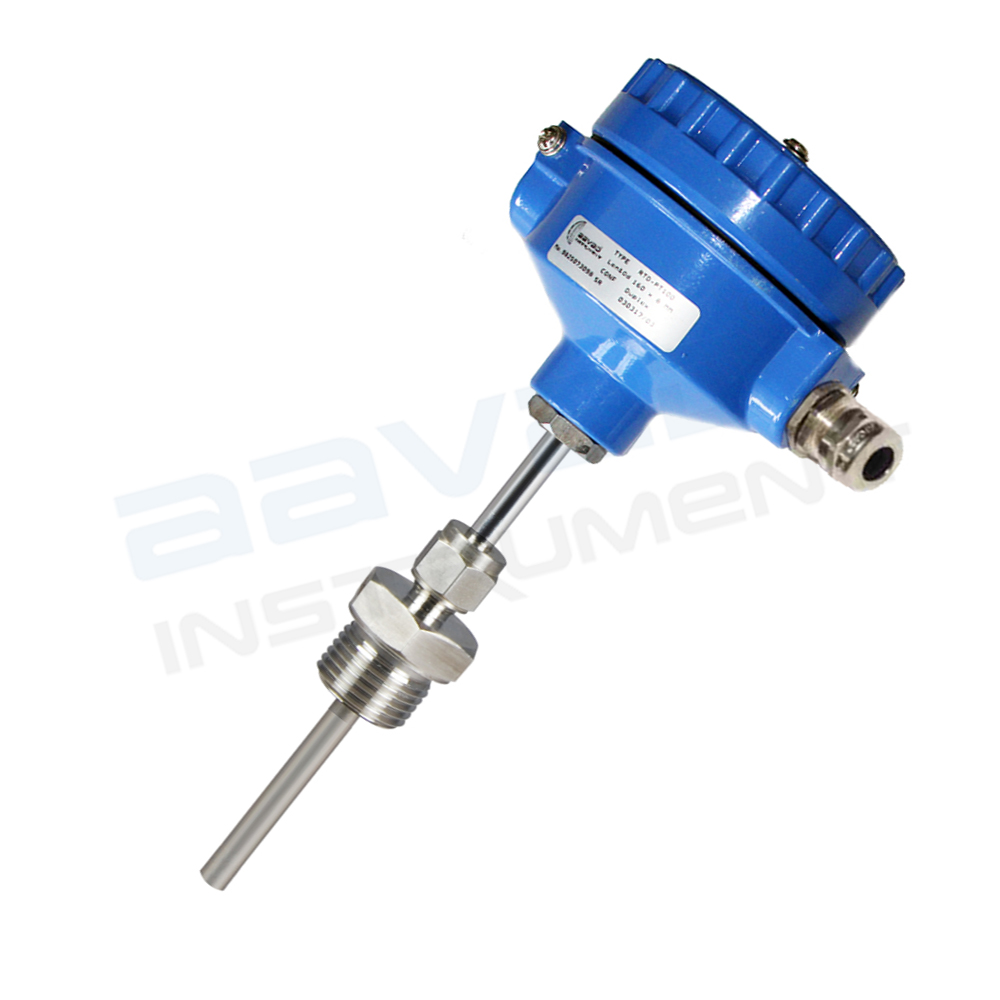
Resistance Temperature Detector (RTD) | Aavad
Resistance Temperature Detector (RTD)
| Parameter | Specification |
|---|---|
| Type | PT-100 |
| Make | Aavad |
| Model | APFS |
| Configuration | Simplex |
| Accuracy | Class A |
| Temperature range | -50 To 400℃ |
| Material of construction | SS 316 |
| Process connection | BSP |
| Process connection size | 1/2 ” (M) Adjustable |
| Insulation | Compacted MgO insulation |
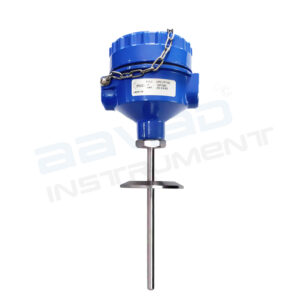
| Protection head | Die-cast aluminum flameproof head with threaded Cap & Chain |
| Head protection class | IP-67 |
| Head cable entry connection | 1/2 ” Npt |
| No. of cable entry | Single |
| Terminal block | Nickel-plated ceramic terminal block |
| Od | 6 mm |
| Length | 500 mm |
Description
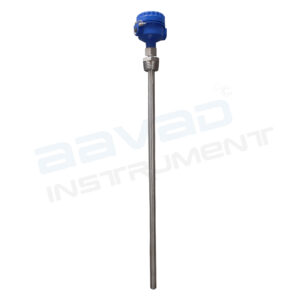
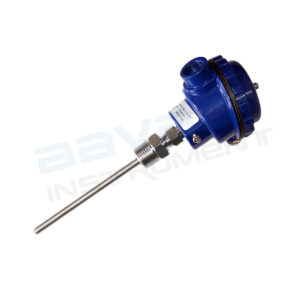
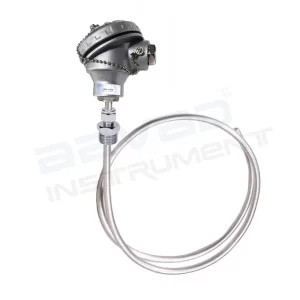
A Resistance Temperature Detector (RTD) is a temperature sensor that measures temperature by detecting the predictable change in the electrical resistance of a metal sensing element as temperature varies. Platinum RTDs, particularly PT100 sensors, are widely used in industrial process measurement because they provide excellent accuracy, repeatability, and long-term stability across a broad operating temperature range. Commonly installed in manufacturing plants, chemical processing facilities, power stations, food processing lines, pharmaceutical plants, HVAC systems, and industrial automation equipment, RTDs are available in different wiring configurations and construction styles to suit a wide variety of applications. The Aavad Resistance Temperature Detector (Model APFS-6) demonstrates this proven sensing technology with a Class A PT100 element, an adjustable 1/2-inch BSP process connection, a 500 mm SS316 probe, and a rugged IP67 flameproof aluminium terminal head designed for dependable industrial temperature measurement.
The APFS-6 combines the proven operating principle of resistance temperature detection with a durable industrial assembly suitable for demanding process environments. Its adjustable process connection allows immersion depth to be set during installation, while support for 2-wire, 3-wire, and 4-wire configurations enables integration with a wide range of industrial instrumentation systems. The sensor is compatible with temperature transmitters, PLCs, DCS, SCADA systems, controllers, and industrial automation platforms, making it suitable for process control, equipment monitoring, and continuous temperature measurement.