Description
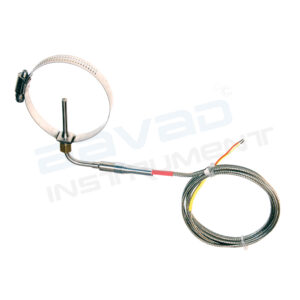
The Aavad Model APES-O serves as a core general-purpose industrial temperature sensor engineered for accurate thermal measurement across solid surfaces, liquids, and gaseous media. Designed around a high-precision Class A PT100 resistance temperature detector (RTD), this sensor converts physical thermal variance into a stable, highly repeatable electrical resistance output. Featuring a compact L-shaped (90° right-angle) stainless steel sheath with a slim $4\text{mm}$ outer diameter tip, it provides an optimal balance between fast thermal response, mechanical durability, and seamless integration into tight industrial equipment envelopes.
Key Features
-
General-Purpose Industrial Design Serves as an adaptable thermal sensing anchor suitable for monitoring gases, liquids, and solid metal bodies.
-
High-Precision Class A PT100 Element Delivers strict tolerance compliance ($pm 0.15^circtext{C}text{ at }0^circtext{C}$) for critical processing environments where tight thermal limits are required.
-
Compact L-Shaped Sheath Geometry Right-angle configuration reduces sensor depth clearance and protects cable lead exit points from tight mechanical pinching.
-
Fast-Response 4mm Outer Diameter Probe Reduced sheath mass enables rapid heat transfer to the internal platinum sensing element, reducing thermal lag.
-
Broad System Compatibility Integrates seamlessly with standard PID temperature controllers, multi-channel data loggers, transmitters, and PLC analog input modules.
-
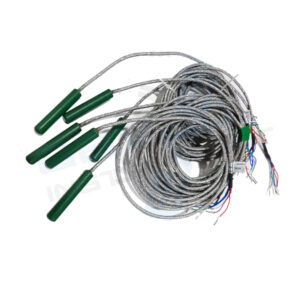
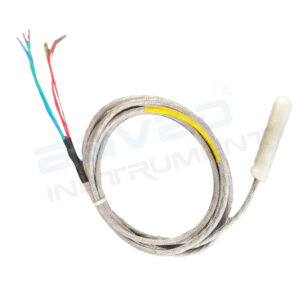
High-Temperature Fiberglass Cable (FG/FG) Dual-layer fiberglass insulation on conductor leads handles ambient temperatures up to 400°C without melting or hardening.
Applications
-
Industrial Process & Machinery Automation Multi-point temperature tracking in industrial ovens, processing tanks, and automated assembly machinery.
-
HVAC & Building Management Systems (BMS) Air duct thermal monitoring, chilled water loop tracking, and boiler room instrumentation.
-
Chemical, Petrochemical & Power Systems Thermal monitoring on auxiliary piping systems, fluid reservoirs, and heat exchanger loops.
-
Laboratory Testing & OEM Equipment Surface and media temperature tracking in scientific test rigs, environmental chambers, and OEM heating units.
-
General Liquid & Gas Measurement Direct-immersion or surface-contact temperature sensing across diverse manufacturing sectors.
Datasheet
FAQs
1. What is a Temperature Sensor, and how does a PT100 RTD work?
A Temperature Sensor is an electronic device that measures the temperature of a medium and converts thermal changes into a measurable electrical signal. A PT100 Resistance Temperature Detector (RTD) operates on the principle that the electrical resistance of platinum increases predictably as temperature rises. At 0°C, the PT100 sensing element has a resistance of 100 Ω. By measuring this resistance through the lead wires, a PLC, DCS, temperature controller, or monitoring system accurately calculates the corresponding temperature.
2. What is the difference between a PT100 RTD and a Thermocouple?
PT100 RTD Sensors provide higher measurement accuracy, excellent linearity, and superior long-term stability over a typical operating range of -200°C to +400°C. In contrast, Thermocouples generate a small millivolt (mV) signal using two dissimilar metals and are better suited for very high-temperature applications, often exceeding 1200°C and up to 1700°C with noble metal thermocouples, although they generally offer lower accuracy than Class A PT100 RTDs.
3. When should I choose an L-Shaped (90° Bend) Probe over a Straight Probe?
An L-shaped (90° bend) PT100 RTD probe is ideal when installation space is limited behind or above the mounting point. The 90° bend routes the cable parallel to the equipment surface, helping protect the wire connection from bending stress, mechanical damage, and crushing caused by adjacent machinery, guards, or access doors, while simplifying installation in confined spaces.