Description
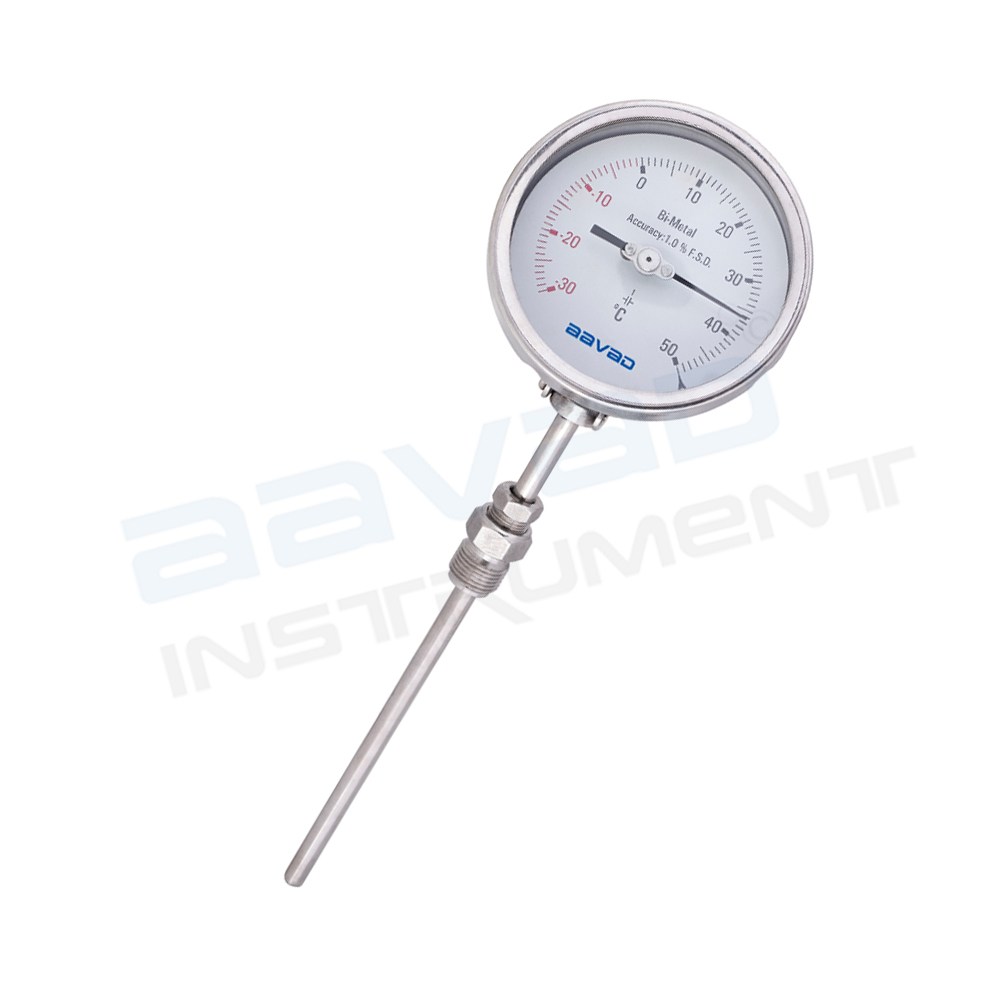
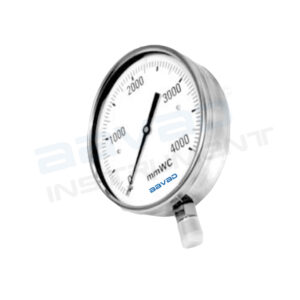
The Mercury Steel Temperature Gauge by Aavad Instrument Pvt. Ltd. — also known as a Mercury-in-Steel Thermometer or MIS Thermometer — is a liquid-in-metal temperature gauge in which mercury is hermetically enclosed within a stainless steel sensing system. As process temperature changes, the internal pressure generated by mercury expansion or contraction is transmitted via a capillary tube to a Bourdon tube in the dial head, converting thermal change into precise mechanical pointer movement — without requiring any electrical power.
This mercury-in-steel design delivers superior accuracy, fast thermal response, and long-term stability compared to standard bimetallic thermometers, making it ideal for precision process temperature monitoring across a working range of -30°C to +50°C in this model (with extended-range variants up to -38°C to 600°C available). The fully welded SS 304/SS 316 construction ensures the mercury remains completely sealed and isolated from the process media, eliminating the safety concerns of open mercury thermometers while retaining the same accuracy benefits.
Key Features
- Fully welded SS construction keeps the mercury hermetically sealed away from process media — none of the breakage or spill risk associated with open glass mercury thermometers, while keeping the same precision
- Faster thermal response than gas-actuated or bimetallic gauges means it catches genuine temperature changes sooner — valuable where a process reacts quickly and a slow gauge would mislead the operator
- Adjustable bottom connection lets installers fine-tune the mounting angle on site instead of ordering a fixed-angle gauge and hoping it matches the pipe orientation
- Long-term stability resists the gradual reading drift that affects gas-actuated gauges over years of service, reducing how often recalibration is needed
- Extended-range variants (-38°C to 600°C) are available from the same manufacturer, so a single trusted supplier can cover both this precision mid-range model and high-temperature furnace or steam applications
- NABL-accredited calibration on request gives plant engineers documented accuracy traceable to national standards — important for audits and ISO 9001 quality systems
Applications
- Precision temperature monitoring in chemical and petrochemical reactors
- Steam and condensate line temperature measurement in power plants
- Pharmaceutical process vessel and autoclave temperature indication
- Laboratory and quality-control temperature verification
- Heat exchanger inlet/outlet temperature monitoring
- Refinery distillation and fractionation column temperature gauging
- Calibration reference standard for plant temperature instruments
- Food and beverage pasteurization temperature verification
- District heating and HVAC hot/chilled water systems
- Textile dyeing and finishing process temperature control
Datasheet
FAQs
1. What is a Mercury Steel Temperature Gauge?
A Mercury Steel Temperature Gauge is a mechanical temperature measuring instrument that uses a hermetically sealed mercury-filled sensing system to provide accurate, stable, and reliable local or remote temperature indication without requiring an external power supply. It is widely used for industrial temperature monitoring within its specified operating range.
2. How does a Mercury Steel Temperature Gauge work?
As the process temperature changes, the sealed mercury inside the sensing bulb expands or contracts. This pressure change is transmitted through a capillary tube to a Bourdon tube mechanism, which converts the movement into pointer rotation, displaying the corresponding temperature on the calibrated dial.
3. What temperature range does this model measure?
This model measures temperatures from -30°C to +50°C, making it suitable for precision low-temperature monitoring in industrial processes, refrigeration systems, cold storage facilities, HVAC applications, and other controlled-temperature environments.
4. Why is Mercury used in this type of Temperature Gauge?
Mercury has historically been used because it offers excellent thermal linearity, fast response, and long-term measurement stability, making it well suited for precise mechanical temperature measurement within its intended operating range. Where applicable, users should also consider local environmental regulations governing the use, handling, and disposal of mercury-containing instruments.