Description
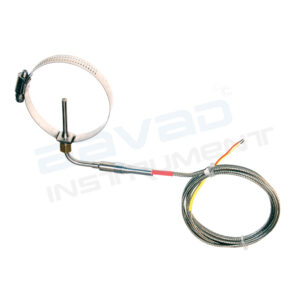
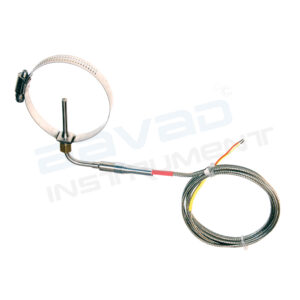
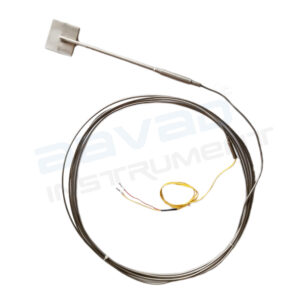
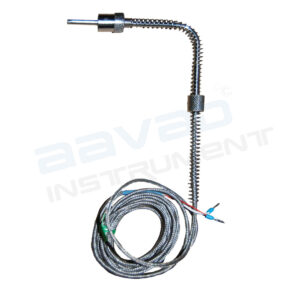
Sharp Tip Transition Joint PT100 RTD Sensor (Model APES-6×250) is designed for accurate temperature measurement in industrial applications requiring surface contact or shallow penetration sensing. Its sharp-edge reduced tip allows improved contact with the measurement point, making it suitable for applications where conventional immersion probes are not practical.
The sensor incorporates a Class A PT100, 3-wire sensing element with a measuring range of -50°C to +400°C. The 250 mm SS316 sheath provides mechanical strength and corrosion resistance, while the transition joint acts as a strain-relief between the rigid probe and flexible cable, helping reduce stress caused by repeated movement and improving long-term reliability.
A TF/TF/SS insulated cable offers excellent resistance to heat and abrasion, making the sensor suitable for demanding industrial environments. The sensor is compatible with PLCs, RTDs, transmitters, DCS, and industrial temperature monitoring systems. Aavad also manufactures customized versions with different probe lengths, cable lengths, sensing elements, and process connections.
Key Features
-
Sharp-Edge Reduced Tip Geometry Specially tapered tip profile allows effortless surface-piercing and fast thermal response in semi-solid or shallow measurement zones.
-
Heavy-Duty Transition Joint with Strain Relief Mechanically protects the delicate junction between the rigid sheath and flexible leads, preventing cable fatigue and wire breakage.
-
High-Accuracy Class A PT100 Element Delivers precision thermal tracking ($pm 0.15^circtext{C}$ at $0^circtext{C}$) across demanding operating environments up to 400°C.
-
Corrosion-Resistant SS316 Construction High-grade 316 stainless steel probe offers superior protection against chemical solvents, oils, and oxidative gases.
-
Armored High-Temperature TF/TF/SS Cable (1m) Premium Teflon inner conductor insulation with an outer stainless steel wire braid defends against heat, chemical spills, and abrasion.
-
Universal Instrument Compatibility 3-wire RTD output seamlessly integrates with standard PLCs, DCS networks, PID temperature controllers, and digital transmitters.
Applications
-
Surface-Piercing & Semi-Solid Temperature Checks Direct penetration temperature sensing in polymers, dense chemical media, and industrial pastes.
-
Chemical, Petrochemical & Refinery Process Monitoring Point-contact temperature tracking on process pipes, valve bodies, and vessel walls.
-
Power Plants & Industrial Boiler Systems Auxiliary thermal measurement points on steam lines and lubrication headers.
-
Handheld & Portable Field Testing Equipment Heavy-handling inspection probes requiring rugged strain relief against cable tugs and bending.
-
Critical Process Control Loops High-accuracy feedback loops demanding Class A stability and long-term durability.
Datasheet
FAQs
1. What is a Sharp Tip Transition Joint PT100 RTD Sensor?
A Sharp Tip Transition Joint PT100 RTD Sensor is a PT100 Resistance Temperature Detector (RTD) designed for surface contact and shallow penetration temperature measurement. It features a sharp-tip stainless steel probe for improved thermal contact and a reinforced transition joint between the probe and cable, providing enhanced mechanical strength and long-term reliability in industrial applications.
2. What is the purpose of the Sharp Tip?
The sharp tip improves contact with the measurement point, making it suitable for applications requiring precise surface temperature monitoring or shallow penetration sensing. It helps achieve faster thermal response and more accurate temperature measurement on products, components, and industrial equipment.
3. What is a Transition Joint?
A transition joint is the reinforced section between the rigid stainless steel sensing probe and the flexible extension cable. It helps reduce mechanical stress caused by pulling, vibration, and repeated handling, improving sensor durability, protecting the cable entry point, and extending the service life of the RTD sensor.