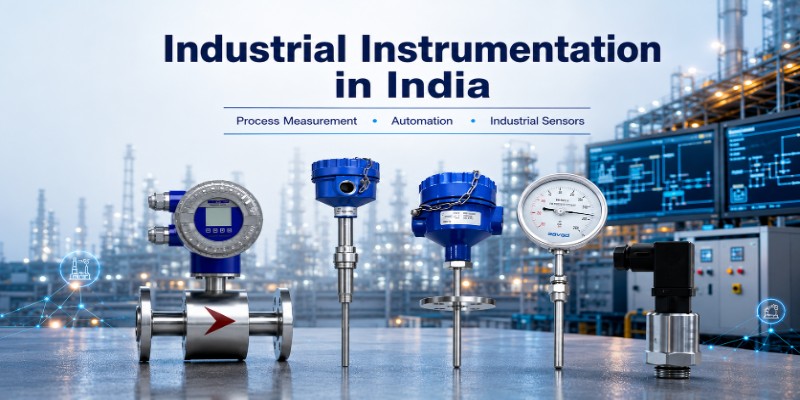
Industrial Instrumentation in India: The Complete Guide to Process Measurement, Automation & Industrial Sensors
Aavad Instrument Pvt. Ltd. | Industrial Instrumentation Manufacturer in Ahmedabad, Gujarat, India
Industrial Instrumentation | Process Control | Industrial Automation
Introduction
Every litre of petrochemical processed in Gujarat’s refinery corridor, every pharmaceutical tablet manufactured in Hyderabad, every megawatt generated in a thermal power station, and every tonne of steel produced in India’s industrial hubs depends on one critical factor—accurate industrial measurement.
Temperature, pressure, flow, and level are the four fundamental process variables that govern safety, efficiency, quality, and profitability in modern manufacturing. Without reliable industrial instrumentation, even the most advanced manufacturing facility can suffer from production losses, equipment failures, compliance issues, and costly downtime.
As India accelerates investments through Make in India, PLI schemes, Industry 4.0 initiatives, smart manufacturing, renewable energy projects, defence production, and semiconductor manufacturing, the demand for high-performance industrial instrumentation is growing rapidly.
This comprehensive guide explains how industrial instrumentation works, why it matters, and how industries can select the right sensors, transmitters, and measurement systems for long-term operational success.
What Is Industrial Instrumentation?
Industrial instrumentation refers to the devices and systems used to measure, monitor, control, and automate industrial processes.
These instruments collect real-time process data and help industries make informed operational decisions.
Key Functions of Industrial Instrumentation
✔ Process Monitoring
✔ Process Control
✔ Safety Management
✔ Quality Assurance
✔ Energy Optimization
✔ Regulatory Compliance
✔ Industrial Automation
Without accurate instrumentation, industries cannot maintain stable operations or achieve consistent product quality.
The Four Pillars of Industrial Measurement
Every industrial process depends on four critical measurements.
1. Temperature Measurement
Temperature affects chemical reactions, product quality, equipment performance, and energy consumption.
Common Temperature Measurement Instruments
- RTD Sensors (PT100/PT1000)
- Thermocouples
- Temperature Transmitters
- Thermowells
- Temperature Indicators
Industries Using Temperature Sensors
- Pharmaceutical Manufacturing
- Food Processing
- Power Generation
- Steel Manufacturing
- Chemical Processing
Why It Matters
Even a small temperature deviation can result in:
❌ Product rejection
❌ Equipment damage
❌ Safety risks
❌ Regulatory non-compliance
2. Flow Measurement
Flow measurement helps industries monitor liquids, gases, steam, chemicals, and wastewater.
Common Flow Measurement Instruments
- Electromagnetic Flow Meters
- Ultrasonic Flow Meters
- Turbine Flow Meters
- Differential Pressure Flow Meters
- Telemetry Flow Meters
Applications
- Water Treatment Plants
- Chemical Industries
- Pharmaceutical Plants
- Food & Beverage Manufacturing
- Power Plants
Benefits
✔ Water Conservation
✔ Energy Efficiency
✔ Process Optimization
✔ Regulatory Compliance
3. Pressure Measurement
Pressure monitoring is essential for operational safety and process control.
Common Pressure Instruments
- Pressure Gauges
- Pressure Transmitters
- Differential Pressure Transmitters
- Digital Pressure Indicators
Applications
- Boilers
- Compressors
- Hydraulic Systems
- Process Reactors
- Pipeline Networks
Benefits
✔ Prevent Equipment Failure
✔ Improve Process Safety
✔ Enable Predictive Maintenance
4. Level Measurement
Level monitoring helps industries manage inventory, process control, and storage systems.
Common Level Instruments
- Level Transmitters
- Piezometers
- Ultrasonic Level Sensors
- Radar Level Sensors
Applications
- Water Tanks
- Chemical Storage
- Borewell Monitoring
- Fuel Storage
- Wastewater Treatment
Why Industrial Instrumentation Is Critical for Modern Manufacturing
Modern industries operate in highly competitive environments where efficiency and reliability directly impact profitability.
Key Challenges Faced by Industries
- Rising energy costs
- Increasing regulatory requirements
- Water scarcity
- Product quality demands
- Equipment downtime
- Workforce shortages
Industrial instrumentation provides the real-time data required to address these challenges.
Benefits of Accurate Instrumentation
✔ Reduced Downtime
✔ Improved Product Quality
✔ Enhanced Worker Safety
✔ Better Resource Utilization
✔ Lower Maintenance Costs
✔ Increased Production Efficiency
Industry 4.0 and Smart Instrumentation
Industrial instrumentation is evolving beyond simple measurement devices.
Today’s smart instruments support:
- IoT Connectivity
- Remote Monitoring
- Cloud Analytics
- Predictive Maintenance
- Digital Twin Integration
- AI-Based Process Optimization
Smart Instrument Features
✔ 4-20mA Output
✔ RS485 Communication
✔ Modbus RTU
✔ HART Protocol
✔ Telemetry Integration
✔ SCADA Compatibility
Industries That Depend on Industrial Instrumentation
Oil & Gas Industry
Applications:
- Pipeline Monitoring
- Refineries
- LNG Facilities
- Storage Terminals
Pharmaceutical Industry
Applications:
- GMP Manufacturing
- Sterilization Systems
- Clean Utilities
- Validation Processes
Chemical Industry
Applications:
- Reactors
- Storage Tanks
- Process Pipelines
Food & Beverage Industry
Applications:
- Dairy Processing
- Breweries
- Beverage Manufacturing
- Pasteurization Systems
Water & Wastewater Industry
Applications:
- Treatment Plants
- Groundwater Monitoring
- Borewell Monitoring
- Distribution Networks
Power Generation Industry
Applications:
- Boilers
- Turbines
- Cooling Systems
- Fuel Monitoring
Textile Industry
Applications:
- Dyeing Units
- Steam Systems
- Utility Monitoring
Common Causes of Instrument Failure
Many industries experience avoidable failures due to poor instrument selection or maintenance.
Most Common Issues
❌ Incorrect Sensor Selection
❌ Improper Installation
❌ Lack of Calibration
❌ Environmental Exposure
❌ Poor Quality Components
❌ Inadequate Maintenance
How to Prevent Failures
✔ Choose Application-Specific Instruments
✔ Follow Installation Guidelines
✔ Perform Regular Calibration
✔ Use Certified Manufacturers
✔ Implement Preventive Maintenance Programs
Why Choose Aavad Instrument Pvt. Ltd.?
Aavad Instrument Pvt. Ltd. is a trusted Industrial Instrumentation Manufacturer in India serving customers across multiple industries.
Product Portfolio
Industries Served
- Oil & Gas
- Petrochemical
- Chemical
- Pharmaceutical
- Water Treatment
- Power Plants
- Food & Beverage
- Textile
- Steel & Metals
- Railways
- Defence & Aerospace
Why Industries Trust Aavad
✔ ISO 9001:2015 Certified
✔ NABL Calibration Support
✔ Custom Engineering Solutions
✔ Fast Delivery Across India
✔ Technical Consultation
✔ Reliable After-Sales Support
Future of Industrial Instrumentation in India
India is rapidly moving toward smart manufacturing and digital process control.
Emerging trends include:
- Smart Sensors
- Industrial IoT
- Predictive Maintenance
- Wireless Instrumentation
- Cloud-Based Monitoring
- AI-Driven Process Optimization
Companies that invest in advanced instrumentation today will be better positioned to improve productivity, reduce operational costs, and remain competitive in tomorrow’s industrial landscape.
Frequently Asked Questions
What is industrial instrumentation?
Industrial instrumentation refers to devices used for measuring, monitoring, controlling, and automating industrial processes.
Which industries require industrial instrumentation?
Industries including pharmaceuticals, chemicals, power plants, food processing, oil & gas, textiles, water treatment, and manufacturing rely heavily on instrumentation.
What are the four main process variables?
Temperature, pressure, flow, and level are the four primary process variables monitored in industrial operations.
Why is calibration important?
Calibration ensures measurement accuracy, regulatory compliance, and process reliability.
How do smart instruments improve efficiency?
Smart instruments provide real-time data, remote monitoring, predictive maintenance, and advanced process analytics.
Conclusion
Industrial instrumentation forms the foundation of modern manufacturing. Accurate measurement of temperature, pressure, flow, and level enables industries to improve safety, productivity, quality, and profitability.
As India continues its industrial transformation through automation, digitalization, and smart manufacturing initiatives, investing in reliable instrumentation will become even more critical.
Whether you are designing a new facility, upgrading an existing plant, or looking to improve process efficiency, choosing the right instrumentation partner can make a significant difference.
Aavad Instrument Pvt. Ltd.
Precision Measurement. Reliable Performance. Industrial Excellence.
📞 +91 90996 22823
🌐 www.aavadinstrument.com
📧 hrg@aavadinstrument.com