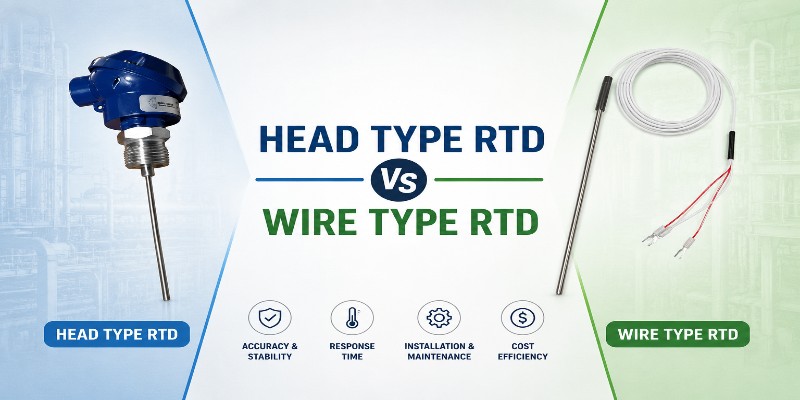
Head Type RTD vs. Wire Type RTD: Structural Differences and Application Limits
Specifying an RTD sounds straightforward until you hit the first real decision point: head type or wire type? The two formats use the same underlying PT100/PT1000 sensing element, but their construction, mounting, and ideal use cases are quite different — and picking the wrong one can mean a sensor that’s awkward to install, hard to maintain, or simply not durable enough for the job. This guide breaks down exactly how Head Type and Wire Type RTDs differ structurally, and where each one hits its application limits.
What Is an RTD, in Brief?
An RTD (Resistance Temperature Detector) measures temperature through a predictable change in electrical resistance as the sensing element heats or cools. It’s a passive device, and the resistance-vs-temperature relationship is well documented and repeatable over time — which is why RTDs are valued for accuracy and long-term stability. RTDs generally operate across a range of roughly -200°C to 600°C, depending on construction.
The difference between Head Type and Wire Type isn’t in this core sensing principle — it’s in how the sensor connects to the outside world and how it’s physically built for installation.
To understand more about RTD sensors, visit this blog.-
What is RTD Sensor? 6 Important Steps to Choose, Components, Application, etc.
Head Type RTD: Structure and Characteristics
A Head Type RTD terminates in a connection head — typically a die-cast aluminum or stainless steel housing mounted directly at the sensor’s process end, containing a terminal block where field wiring connects.
Structural Features
- Connection head (fixed, bayonet, mini-head, or flameproof variant) housing the terminal block
- Threaded or compression process connection (commonly BSP/NPT), often adjustable for correct insertion depth
- Rigid sheath construction (typically SS 316), suited to thermowell mounting
- Terminal block for direct field wiring — no integral cable, so wiring is done on-site at installation
Application Strengths
- Hazardous area installations — flameproof, IP-67-rated heads are readily available for Zone-classified environments
- Process vessels and pipelines with thermowells — rigid construction supports thermowell mounting and easy sensor replacement without breaching the process
- Field-wired installations — useful where cable runs and termination need to be customized on-site
- Long-term, fixed installations — robust head protects the termination from dust, moisture, and mechanical damage over years of service
Application Limits
- Less flexible for tight or irregular mounting spaces — the rigid head and body don’t bend or route around obstacles
- Higher footprint — the connection head takes up more physical space than a flexible cable termination
- Field wiring required — installation needs a qualified technician to terminate wiring correctly inside the head
Wire Type RTD: Structure and Characteristics
A Wire Type RTD (sometimes supplied with an integral cable or connector) replaces the rigid connection head with a flexible lead wire running directly from the sensing element, often terminating in a plug, connector, or bare leads for direct connection to an instrument.
Structural Features
- Flexible cable or wire leads extending directly from the sensor tip
- Compact sensor body — often smaller and lighter than head-type equivalents
- Connector or bare-wire termination — plug-and-socket types simplify connection to indicators, controllers, or data loggers
- Available in multiple configurations — including bayonet, spring-loaded, surface-mount, and probe styles
Application Strengths
- Tight or irregular installation spaces — flexible leads route around machine components, panels, and confined areas
- Frequent sensor swap-outs — connector-terminated types allow fast disconnection and replacement without rewiring
- OEM and machinery integration — common on plastics processing machinery, bearings, and equipment where a compact, lead-terminated sensor fits factory wiring harnesses better than a bulky head
- Lower-cost, simpler installations — no separate connection head or field wiring step needed
Application Limits
- Less mechanical protection for the termination — exposed cable or connector is more vulnerable to abrasion, chemical exposure, and physical damage than an enclosed head
- Generally not suited to flameproof/hazardous area certification in the same way as a properly rated head-type enclosure
- Cable length and routing constraints — long cable runs may need additional junction boxes or extension cables, introducing extra connection points
Head Type vs Wire Type: Side-by-Side Comparison
| Parameter | Head Type RTD | Wire Type RTD |
|---|---|---|
| Termination | Connection head with terminal block | Flexible cable/wire lead or connector |
| Best for hazardous areas | Yes (flameproof/IP-67 variants available) | Generally limited |
| Installation flexibility | Lower (rigid body) | Higher (flexible routing) |
| Mounting | Thermowell, threaded/compression fitting | Bayonet, spring-loaded, surface, probe styles |
| Typical use case | Process vessels, pipelines, fixed plant installations | Machinery, OEM equipment, tight spaces, frequent swaps |
| Field wiring required | Yes, inside the head | Often no — connector or pre-wired lead |
| Mechanical protection of termination | High (enclosed head) | Lower (exposed cable/connector) |
How to Choose Between Them
- Is the installation in a hazardous (Ex) area? Choose a flameproof Head Type RTD.
- Does the sensor need to mount in a thermowell on a vessel or pipeline? Head Type is generally the better structural fit.
- Is the installation space tight, irregular, or part of OEM machinery? Wire Type’s flexible leads are usually easier to route and integrate.
- Will the sensor need frequent replacement? Connector-terminated Wire Type RTDs allow faster swaps without re-wiring a terminal block.
- Is long-term mechanical protection of the termination critical? Head Type’s enclosed connection head offers better protection in harsh, exposed, or outdoor conditions.
Aavad Instrument’s Head Type & Wire Type RTD Range
Aavad Instrument Pvt. Ltd., based in Ahmedabad, Gujarat, manufactures both formats under one ISO 9001:2015 quality system, with NABL-accredited calibration available across the range:
- Head Type RTD Sensor Manufacturer category — PT100/PT1000 sensors in fixed, bayonet, mini-head, and flameproof variants, suited to process vessels, pipelines, and hazardous-area installations.
- Wire Type RTD & Thermocouple Sensor Manufacturer category — flexible, connector-terminated sensors including plastics machinery thermocouples, bearing temperature detectors, and connector-type RTDs for OEM and machinery integration.
With 15+ years of experience, 38+ million successful installations, and clients including BHEL, ONGC, Indian Oil, and Aditya Birla Group, Aavad supplies both RTD formats for virtually any industrial application across India.
Frequently Asked Questions
Q1. Can a Wire Type RTD be used in a hazardous area? Generally, flameproof or intrinsically safe certification is more readily available and standardized for Head Type RTDs with enclosed connection heads. If your installation is in a classified hazardous area, confirm certification specifics with your supplier before specifying a Wire Type sensor.
Q2. Which RTD type is easier to replace in the field? Wire Type RTDs with connector terminations are typically faster to swap, since they don’t require re-wiring a terminal block inside a connection head — useful for equipment with frequent sensor replacement needs.
Q3. Is one type more accurate than the other? No — accuracy is determined by the sensing element (e.g., PT100 Class A or Class B) and construction quality, not by whether the sensor is head-type or wire-type. Both formats can be supplied with the same accuracy class.
Q4. Can Head Type RTDs be used on plastics or OEM machinery? They can, but Wire Type RTDs are more commonly used in this context due to their compact size and flexible leads, which integrate more easily into machinery wiring harnesses and tight mounting spaces.
Q5. What temperature range do these RTDs typically cover? RTDs generally operate across -200°C to 600°C, though the exact range depends on the specific sensor model, sheath material, and insulation — always confirm the rated range of your chosen product.
Get the Right RTD Format for Your Application
Aavad Instrument’s engineering team can help you decide between Head Type and Wire Type RTD construction based on your installation environment, mounting requirements, and hazardous area classification. Request a quote or browse the Head Type RTD and Wire Type RTD categories for complete specifications.